Ideas Explained - Böcker
Visar alla böcker i serien Ideas Explained. Handla med fri frakt och snabb leverans.
12 produkter
12 produkter
352 kr
Skickas inom 5-8 vardagar
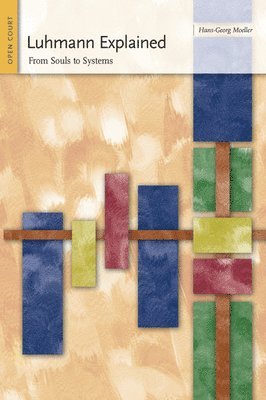
What are systems? What is society? What happens to human beings in a hypermodern world? This book is an introduction to Niklas Luhmann's social system theory which explains specific functions like economy and mass media from a cybernetic perspective. Integrating various schools of thought including sociology, philosophy and biology Luhmann Explained results in an overall analysis of "world society". Special attention is given to the present-day relevance of Luhmann's theory with respect to globalization, electronic mass media, ethics, and new forms of protest.
235 kr
Skickas inom 5-8 vardagar
What is the number one? How can we be sure that 2+2=4? These apparently ssimple questions have perplexed philosophers for thousands of years, but discussion of them was transformed by the German philosopher Gottlob Frege (1848-1925).Frege (pronounced Fray-guh)believed that arithmetic and all mathematics are derived from logic, and to prove this he developed a completely new approach to logic and numbers. Joan Weiner presents a very clear outline of Frege's life and ideas, showing how his thinking evolved through successive books and articles.
213 kr
Skickas inom 5-8 vardagar
Daoism Explained offers an interpretation of the tenets of Daoist philosophy on the basis of the imagery employed in various Daoist texts. The author explains the significance of such images as water and the female and allegories such as the "Dream of the Butterfly," and shows how they connect to each other and how ancient Chinese philosophers understood them. The book also sheds new light on many important allegories by showing how modern translations often conceal the wit and humor of the Chinese original. Written for those who are interested in Asian beliefs and religions as well as for specialists in the field of comparative and Chinese philosophy, Daoism Explained is a comprehensive and fascinating - yet easy-to-follow - introduction to Daoist thought.
235 kr
Skickas inom 5-8 vardagar
Martin Heidegger’s (1889-1976) influence has long been felt not just in philosophy, but also in such fields as art, architecture, and literary studies. Yet his difficult terminology has often scared away interested readers lacking an academic background in philosophy. In this new entry in the Ideas Explained series, author Graham Harman shows that Heidegger is actually one of the simplest and clearest of thinkers. His writings and analyses boil down to a single powerful idea: being is not presence. In any human relation with the world, our thinking and even our acting do not fully exhaust the world. Something more always withdraws from our grasp. As Harman shows, Heidegger understood that human beings are not lucid scientific observers staring at the world and describing it, but instead are thrown into a world where light is always mixed with shadow. The book concludes with a comprehensible discussion of the philosopher’s notoriously opaque concept of the fourfold.
309 kr
Skickas inom 3-6 vardagar
Jean-Paul Sartre is perhaps the most famous of the existentialists, and by far the most famous philosopher of the post-war era. Sartre was a highly prolific writer and thinker, and delving into his novels, plays, stories, essays, and memoirs can be challenging. Most books on Sartre focus on only one sphere of his astounding intellect -- either his philosophical treatises or his forays into fiction. Enter Sartre Explained, a comprehensive guide to Sartre's versatile work, as well as a valuable overview of his life and scholarly context. Detailing the philosophical notions central to all of Sartre's work, including his fictional pieces, this guide is an essential resource for anyone interested in Sartre's full range of talents.
291 kr
Skickas inom 5-8 vardagar
Atheism Explained explores the claims made both for and against the existence of God. On the pro side: that the wonders of the world can only be explained by an intelligent creator; that the universe had to start somewhere; telepathy, out-of-body experiences, and other paranormal phenomena demonstrate the existence of a spirit world; and that those who experience God directly provide evidence as real as any physical finding. After disputing these arguments through calm, careful criticism, author David Ramsay Steele presents the reasons why God cannot exist: monstrous, appalling evils; the impossibility of omniscience; and the senseless concept that God is a thinking mind without a brain. He also explores controversial topics such as Intelligent Design, the power of prayer, religion without God, and whether a belief in God makes people happier and healthier. Steele’s rational, easy-to-understand prose helps readers form their own conclusions about this eternally thorny topic.
213 kr
Skickas inom 5-8 vardagar
Ockham Explained is an important and much-needed resource on William of Ockham, one of the most important philosophers of the Middle Ages. His eventful and controversial life was marked by sharp career moves and academic and ecclesiastical battles. At 28, Ockham was a conservative English theologian focused obsessively on the nature of language, but by 40, he had transformed into a fugitive friar, accused of heresy, and finally protected by the German emperor as he composed incendiary treatises calling for strong limits on papal authority. This book provides a thorough grounding in Ockham's life and his many contributions to philosophy. It begins with an overview of the philosopher's youth and the Aristotelian philosophy he studied as a boy. Subsequent chapters cover his ideas on language and logic; his metaphysics and vaunted "razor," as well as his opponents' "anti-razor" theories; his invention of the church-state separation; and much more. The concluding chapter sums up Ockham's compelling philosophical personality and explains his modern appeal.
213 kr
Skickas inom 5-8 vardagar
John Rawls was arguably the most important political philosopher of the 20th century. Barely a word of political philosophy is written today that is not indebted in some way to the philosophical paradigm that Rawls bequeathed. Rawls Explained sets out the thinker's complex arguments in a way that makes them accessible to first-time readers of his hugely influential work. Both clear in its exposition of Rawls' ideas and true to the complex purposes of his arguments, this book also attends to the variety of objections that have been made to them. The book is divided into three parts corresponding to the three books that form the core of Rawls's theory: A Theory of Justice, Political Liberalism, and The Law of Peoples. Each section of the book ends with a survey of some of the main criticisms of the arguments coupled with Rawls's strongest counterarguments.
213 kr
Skickas inom 5-8 vardagar
Phenomenology is one of the most important and influential philosophical movements of the last one hundred years. It began in 1900, with the publication of a massive two-volume work, Logical Investigations, by a Czech-German mathematician, Edmund Husserl. It proceeded immediately to exert a strong influence on both philosophy and the social sciences. For example, phenomenology provided the central inspiration for the existentialist movement, as represented by such figures as Martin Heidegger in Germany and Jean-Paul Sartre in France. Subsequent intellectual currents in Europe, when they have not claimed phenomenology as part of their ancestry, have defined themselves in opposition to phenomenology. Thus, to give just one example, the first two works of Jacques Derrida, the father of deconstruction, were devoted to criticisms of Husserl's phenomenological works. In the English-speaking world, where "analytic philosophy" dominates, phenomenology has recently emerged as a hot topic after decades of neglect. This has resulted from a dramatic upswing in interest in consciousness, the condition that makes all experience possible.Since the special significance of phenomenology is that it investigates consciousness, analytic philosophers have begun to turn to it as an underutilized resource. For the same reason, Husserl's work is now widely studied by cognitive scientists. The current revival of interest in phenomenology also stems from the recognition that not every kind of question can be approached by means of experimental techniques. Not all questions are scientific in that sense. Thus, if there is to be knowledge in logic, mathematics, ethics, political philosophy, aesthetics, epistemology (theory of knowledge), psychology (from the inside), and the study of consciousness, among others, another method is clearly needed. Phenomenology is an attempt to rectify this. Its aim is to focus on the world as given in experience, and to describe it with unprecedented care, rigor, subtlety, and completeness. This applies not only to the objects of sense experience, but to all phenomena: moral, aesthetic, political, mathematical, and so forth.One can avoid the obscure problem of the real, independent existence of the objects of experience in these domains by focusing instead on the objects, as experienced, themselves, along with the acts of consciousness which disclose them. Phenomenology thus opens up an entirely new field of investigation, never previously explored. Rather than assuming, or trying to discern, what exists outside the realm of the mental, and what causal relations pertain to these extra-mental entities, we can study objects strictly as they are given, that is, as they appear to us in experience. This book explains what phenomenology is and why it is important. It focuses primarily on the works and ideas of Husserl, but also discusses important later thinkers, giving special emphasis to those whose contributions are most relevant to contemporary concerns. Finally, while Husserl's greatest contributions were to the philosophical foundations of logic, mathematics, knowledge, and science, this book also addresses extensively the relatively neglected contribution of phenomenology to value theory, especially ethics, political philosophy, and aesthetics.
309 kr
Skickas inom 3-6 vardagar
Fifty-five years after Atlas Shrugged, Ayn Rand is more in the news than ever. Ayn Rand Explained is an accurate and riveting account of Rand's life, work, and influence, with the emphasis on her ideas. The book covers Rand's career, from youth in Soviet Russia to Hollywood screenwriter and then to ideological guru; her novels and other fiction writings; her work in ethics, epistemology, and metaphysics; her influence on--and personal animosity toward--both conservatism and libertarianism. Rand's Objectivism encompasses the ethics of rational egoism ('The Virtue of Selfishness'); dedication to rational thinking and acting; rejection of faith in the supernatural, personal freedom from political interference, and a moral defense of limited government and laissez-faire. Objectivism was first promoted through the Nathaniel Branden Institute, headed by Rand's young protege and designated heir. The Institute's phenomenally rapid growth was abruptly cut short when Rand expelled Branden and his followers in 1968. Today Objectivism is represented by different factions, notably the Ayn Rand Institute and the Atlas Society.This is a revised, updated edition of The Ideas of Ayn Rand (1991), including new information on Rand's rocketing influence, new stories about her personal relationships, and new analysis of her life and ideas.
292 kr
Skickas inom 3-6 vardagar
The Tea Party first attracted the media spotlight with Rick Santelli's televised rant against the government's bailout of mortgage borrowers on February 19, 2009, which instantly went viral as a video. As the authors document, however, "tea parties" associated with the Ron Paul movement had already been gathering momentum for more than a year. Beginning as a protest against government spending sprees, the Tea Party's sudden fame forced it to define itself on many issues where the membership was seriously divided. Fiscal conservatives, who were usually liberal on social issues, battled social conservatives in an uneasy series of maneuvers that continues unresolved and is described in the book. The Tea Party Explained, written by two Tea Party activists, gives a well-documented account of the Tea Party, its origins, its evolution, the bitter squabbles over its direction, its amazing successes in 2010, and its electoral rebuff in 2012. Maltsev and Skaskiw analyze its demographics, the many organizations which have tried to represent, appropriate, or infiltrate the movement, and the ideological divisions within.
267 kr
Skickas inom 3-6 vardagar
A readable, compact account and analysis of the Occupy protests, The Occupy Movement Explained is thoroughly researched, painstakingly accurate, and fully documented. Debunking a number of prominent myths and misunderstandings, Nicholas Smaligo shows how the movement arose out of radical currents that have been active below the media's radar since the 1970s. Occupiers are not all the same, and the author reviews some of the debates and changes within the movement. The occupations began under a slogan that conjured up a naive sense of unity -- "We Are the 99%!" It did not take very long for that sense of unity to give way to an appreciation of just how socially, economically, and ideologically fragmented American society is. For some, this was an excuse to return to their cynicism; for others, it was an invitation to lose their illusions and begin to see the world from the viewpoint of political activists. The Occupy Movement Explained describes this process of education and the lessons learned about "the 99%," the police, direct democracy, political demands, and the intimately related questions of social change, violence, and property.