IFIP State-of-the-Art Reports - Böcker
Visar alla böcker i serien IFIP State-of-the-Art Reports. Handla med fri frakt och snabb leverans.
5 produkter
5 produkter
550 kr
Skickas inom 10-15 vardagar
This reader contains contributions referring to one of the most urgent problems in systems design: the effects of computerization on human work and approaches to ameliorate systems design in order to create better conditions for living human work in a computerized world. Of course the choice of papers has been operated somewhat arbitrarily. It primarily reflects the work of IFIP's Working Group 9.1. "Compu ters and Work" and of some of its members. The papers were compiled aiming at focussing on very material pro blems in the field of "Computers and Work". They substantively re flect in several points the discussions and the concern of the Wor king Group. Some conclusions from a series of workshops held from 1980 onward by the Working Group are likewise contained and directed to the IFIP community and to other parties concerned. The reader inserts itself into a rather extended line of activities of the Working Group: in addition to contributions to the two IFIP Working Conferences on Human Choice and Computers held in 1974 and in 1979 (proceedings published by North Holland) a recent IFIP Wor king Conference on Systems Design For, With and By the Users (held in September 82, proceedings published in March 83 by North Holland) and a joint TC3/TC9 Working Conference on Education for Systems De signer/User Co-operation (proceedings to be published by end 84).
1 094 kr
Skickas inom 10-15 vardagar
In software engineering there is a growing need for formalization as a basis for developing powerful computer assisted methods. This volume contains seven extensive lectures prepared for a series of IFIP seminars on the Formal Description of Programming Concepts. The authors are experts in their fields and have contributed substantially to the state of the art in numerous publications. The lectures cover a wide range in the theoretical foundations of programming and give an up-to-date account of the semantic models and the related tools which have been developed in order to allow a rigorous discussion of the problems met in the construction of correct programs. In particular, methods for the specification and transformation of programs are considered in detail. One lecture is devoted to the formalization of concurrency and distributed systems and reflects their great importance in programming. Further topics are the verification of programs and the use of sophisticated type systems in programming. This compendium on the theoretical foundations of programming is also suitable as a textbook for special seminars on different aspects of this broad subject.
550 kr
Skickas inom 10-15 vardagar
The aim of software engineering is the provision and investigation of methods for the development of software systems of high quality with correctness as a key issue. A system is called correct if it does what one wants, if it meets the requirements. To achieve and to guarantee correct systems, the need of formal methods with rigorous semantics and the possibility of verification is widely accepted. Algebraic specification is a software engineering approach of this perspective. When Liskov and Zilles, Guttag and the ADJ-group with Goguen, Thatch er, Wagner and Wright introduced the basic ideas of algebraic specification in the mid seventies in the U. S. A. and Canada, they initiated a very successful and still flourishing new area. In the late seventies, algebraic specification became a major research topic also in many European countries. Originally, the algebraic framework was intended for the mathematical foundation of ab stract data types and the formal development of first-order applicative pro grams. Meanwhile, the range of applications has been extended to the precise specification of complete software systems, the uniform definition of syntax and semantics of programming languages, and to the stepwise development of correct systems from the requirement definitions to the running programs. The activities in the last 25 years have led to an abundance of concepts, methods, approaches, theories, languages and tools, which are mathemati cally founded in universal algebra, category theory and logic.
1 062 kr
Skickas inom 10-15 vardagar
"Developments in Computer-Integrated Manufacturing" arose from the joint work of members of the IFIP-Working Group 5.3 - Discrete Manufacturing, and other IFIP members. Within the Technical Committee 5 of the International Federation of Information Processing (lFIP) the aim of this Working Group is the advancement of computers and their application to the field of discrete part manufacturing. Capabilities will be expanded in the general areas of planning, selection, and con trol of manufacturing equipment and systems. Tools for problem solution include: mathematics, geometry, algorithms, computer techniques, and manufacturing technology. This technology will influence many industries - machine tool, auto mation, aircraft, appliance, and electronics, to name but a few. The Working Group undertook the following specific tasks: 1. To maintain liaison with other national and international organizations work ing in the same field, cooperating with them whenever desirable to further the common goal 2. To be responsible for the IFIP's work in organizing and presenting the PRO LAMA T Conferences 3. To conduct other working conferences and symposia as deemed appropriate in furthering its mission 4. To develop and sponsor research and industrial and social studies into the various aspects of its mission. The book can be regarded as an attempt to underline the main aspects of techno logy from the point of view of its software and hardware realization. Because of limitations in size and the availability of literature, the problems of robotics and quality control are not described in detail.
550 kr
Skickas inom 10-15 vardagar
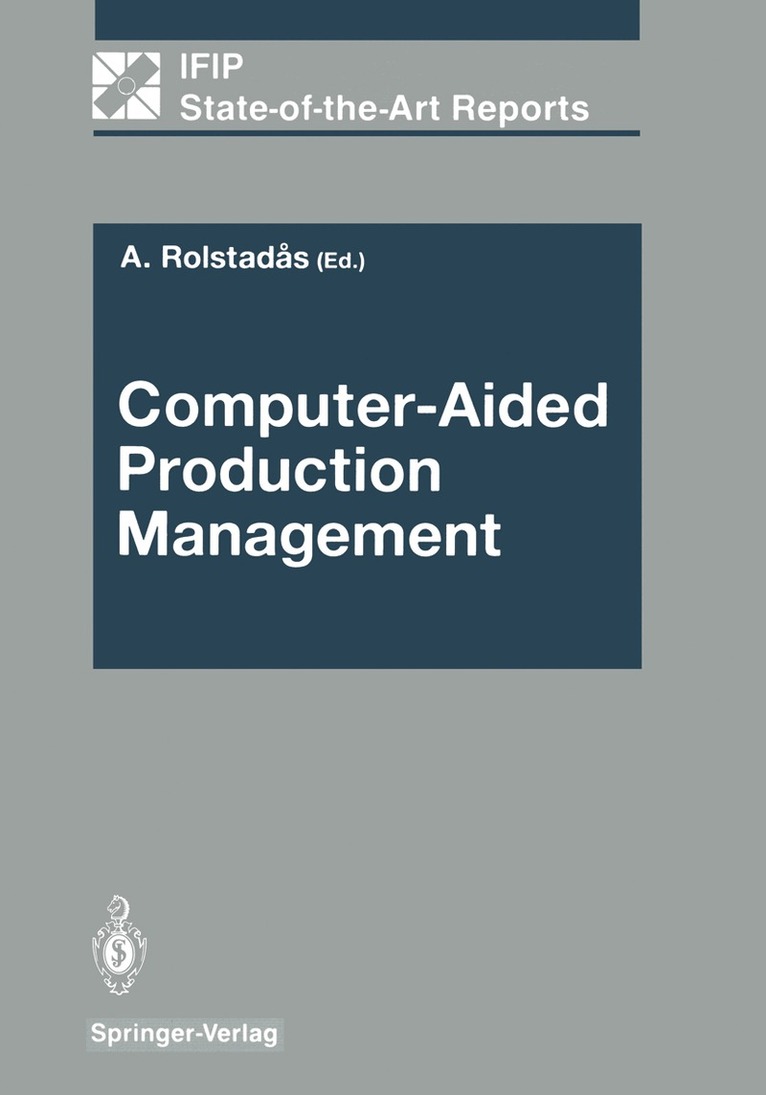
The purpose of this book is to discuss the state of the art and future trends in the field of computerized production management systems. It is composed of a number of independent papers, each presented in a chapter. Some of the widely recognized experts in the field around the world have been asked to contribute. lowe each of them my sincere gratitude for their kind cooperation. I am also grateful to Peter Falster and Jim Browne for their kind support in helping me to review topics to be covered and to select the authors. This book is a result of the professional work done in the International Federation of Information Processing Technical Committee IFIP TC5 "Com puter Applications in Technology" and especially in the Working Group WG5. 7 "Computer-Aided Production Management". This group was established in 1978 with the aim of promoting and encouraging the advancement of the field of computer systems for the production management of manufacturing, off shore, construction, electronic and similar and related industries. The scope of the work includes, but is not limited to, the following topics: 1) design and implementation of new production planning and control systems taking into account new technology and management philosophy; 2) CAPM in a CIM environment including interfaces to CAD and CAM; 3) project management and cost engineering; 4) knowledge engineering in CAPM; 5) CAPM for Flexible Manufacturing Systems (FMS) and Flexible Assembly Systems (F AS); 6) methods and concepts in CAPM; 7) economic and social implications of CAPM.