Integrated Disaster Risk Management - Böcker
Visar alla böcker i serien Integrated Disaster Risk Management. Handla med fri frakt och snabb leverans.
9 produkter
9 produkter
Defining and Measuring Economic Resilience from a Societal, Environmental and Security Perspective
Inbunden, Engelska, 2017
956 kr
Skickas inom 10-15 vardagar
This volume presents an economic framework for the analysis of resilience in relation to societal, environmental, and personal security perspectives. It offers a rigorous definition of economic resilience and an operational metric, and it shows how they can be applied to measuring and applying the concept to private and public decision making. Major dimensions of resilience and their implications for human development are explored. Resilience is emphasized as a coping mechanism for dealing with short-term crises, such as natural disasters and acts of terrorism. As well, the author shows how lessons learned in the short-run out of necessity and through the application of human ingenuity can be incorporated into long-run sustainability practices. In part, this opportunity stems from viewing resilience as a process, one that enhances individual and societal competencies. The book links economic resilience to several other disciplines and examines the relationshipbetween resilience and various other key concepts such as vulnerability, adaptation, and sustainability. It scrutinizes the measurement of economic resilience in terms of temporal, spatial, and scale dimensions. It examines the time-path of resilience and relates it to the recovery process.This work also looks closely at progress on the formulation of resilience indices and stresses the importance of actionable variables. It presents a risk-management framework, including aspects of cost-effectiveness and cost-benefit analysis. Additionally, it explores the role of resilience in relation to the co-benefits of disaster risk management.
640 kr
Skickas inom 10-15 vardagar
This study develops a methodology for rapidly obtaining approximate estimates of the economic consequences from numerous natural, man-made and technological threats. This software tool is intended for use by various decision makers and analysts to obtain estimates rapidly. It is programmed in Excel and Visual Basic for Applications (VBA) to facilitate its use. This tool is called E-CAT (Economic Consequence Analysis Tool) and accounts for the cumulative direct and indirect impacts (including resilience and behavioral factors that significantly affect base estimates) on the U.S. economy. E-CAT is intended to be a major step toward advancing the current state of economic consequence analysis (ECA) and also contributing to and developing interest in further research into complex but rapid turnaround approaches.The essence of the methodology involves running numerous simulations in a computable general equilibrium (CGE) model for each threat, yielding synthetic data for the estimation of a single regression equation based on the identification of key explanatory variables (threat characteristics and background conditions). This transforms the results of a complex model, which is beyond the reach of most users, into a "reduced form" model that is readily comprehensible. Functionality has been built into E-CAT so that its users can switch various consequence categories on and off in order to create customized profiles of economic consequences of numerous risk events. E-CAT incorporates uncertainty on both the input and output side in the course of the analysis.
Defining and Measuring Economic Resilience from a Societal, Environmental and Security Perspective
Häftad, Engelska, 2018
956 kr
Skickas inom 10-15 vardagar
This volume presents an economic framework for the analysis of resilience in relation to societal, environmental, and personal security perspectives. It offers a rigorous definition of economic resilience and an operational metric, and it shows how they can be applied to measuring and applying the concept to private and public decision making. Major dimensions of resilience and their implications for human development are explored. Resilience is emphasized as a coping mechanism for dealing with short-term crises, such as natural disasters and acts of terrorism. As well, the author shows how lessons learned in the short-run out of necessity and through the application of human ingenuity can be incorporated into long-run sustainability practices. In part, this opportunity stems from viewing resilience as a process, one that enhances individual and societal competencies. The book links economic resilience to several other disciplines and examines the relationshipbetween resilience and various other key concepts such as vulnerability, adaptation, and sustainability. It scrutinizes the measurement of economic resilience in terms of temporal, spatial, and scale dimensions. It examines the time-path of resilience and relates it to the recovery process.This work also looks closely at progress on the formulation of resilience indices and stresses the importance of actionable variables. It presents a risk-management framework, including aspects of cost-effectiveness and cost-benefit analysis. Additionally, it explores the role of resilience in relation to the co-benefits of disaster risk management.
640 kr
Skickas inom 10-15 vardagar
This study develops a methodology for rapidly obtaining approximate estimates of the economic consequences from numerous natural, man-made and technological threats. This software tool is intended for use by various decision makers and analysts to obtain estimates rapidly. It is programmed in Excel and Visual Basic for Applications (VBA) to facilitate its use. This tool is called E-CAT (Economic Consequence Analysis Tool) and accounts for the cumulative direct and indirect impacts (including resilience and behavioral factors that significantly affect base estimates) on the U.S. economy. E-CAT is intended to be a major step toward advancing the current state of economic consequence analysis (ECA) and also contributing to and developing interest in further research into complex but rapid turnaround approaches.The essence of the methodology involves running numerous simulations in a computable general equilibrium (CGE) model for each threat, yielding synthetic data for the estimation of a single regression equation based on the identification of key explanatory variables (threat characteristics and background conditions). This transforms the results of a complex model, which is beyond the reach of most users, into a "reduced form" model that is readily comprehensible. Functionality has been built into E-CAT so that its users can switch various consequence categories on and off in order to create customized profiles of economic consequences of numerous risk events. E-CAT incorporates uncertainty on both the input and output side in the course of the analysis.
Disaster Risk Communication
A Challenge from a Social Psychological Perspective
Inbunden, Engelska, 2020
1 378 kr
Skickas inom 10-15 vardagar
This book provides a unique blend of integrated disaster risk communication research conducted by authors with diverse backgrounds, including social psychology, sociology, civil engineering, informatics, and meteorology. It reports on the latest advances in collaborative and participatory action research on community-based disaster management from the frontline in Japan, Nepal, China and the USA. In addition, it employs and integrate a broad range of methodologies, including mathematical analyses, computer simulations, questionnaire surveys, gaming approaches, and participatory observation. Each chapter deals with disaster risk communication initiatives to address various hazards, such as earthquakes, tsunamis, floods and landslides, which are uniquely integrated from a social psychological perspective.
1 273 kr
Skickas inom 10-15 vardagar
This book is about how extreme and systemic risk can be analyzed in an integrated way. Risk analysis is understood to include measurement, assessment as well as management aspects. Integration is understood as being able to perform risk analysis for extreme and systemic events simultaneously. The presented approach is based on Sklar's theorem, which states that a multivariate distribution can be separated into two parts – one describing the marginal distributions and the other describing the dependency between the distributions using a so-called copula. It is suggested to reinterpret Sklar's theorem from a system or network perspective, treating copulas as a network property and individual, including extreme, risk as elements within the network. In that way, extreme and systemic risk can be analyzed independently as well as jointly across several scales. The book is intended for a large audience, and all techniques presented are guided with examples and applications with a special focus on natural disaster events. Furthermore, an extensive literature and discussion of it are given in each chapter for the interested reader.
904 kr
Skickas inom 10-15 vardagar
This book is about how extreme and systemic risk can be analyzed in an integrated way. It is suggested to reinterpret Sklar's theorem from a system or network perspective, treating copulas as a network property and individual, including extreme, risk as elements within the network.
1 484 kr
Skickas inom 10-15 vardagar
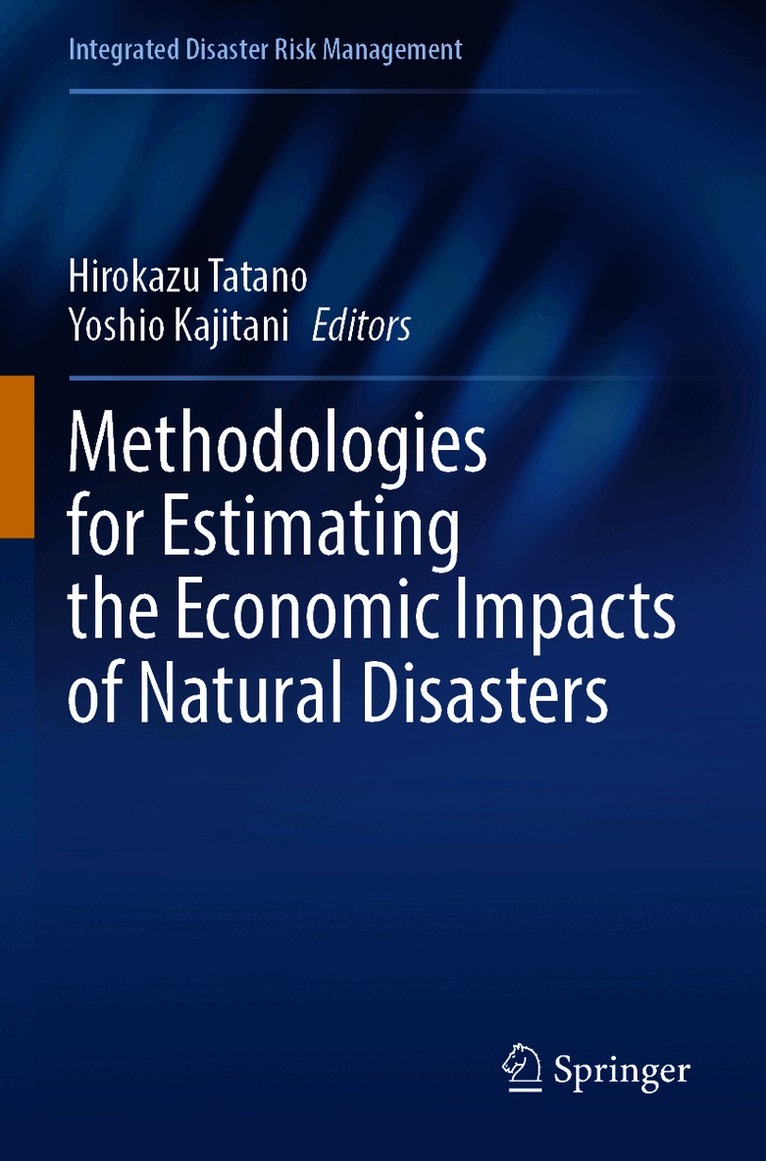
This book outlines methodologies to estimate the economic impacts of natural disasters based on business surveys conducted after large disasters in Japan.
1 484 kr
Skickas inom 10-15 vardagar
This book outlines methodologies to estimate the economic impacts of natural disasters based on business surveys conducted after large disasters in Japan.