International Series in Economic Modelling - Böcker
Visar alla böcker i serien International Series in Economic Modelling. Handla med fri frakt och snabb leverans.
5 produkter
5 produkter
Del 3 - International Series in Economic Modelling
Measuring Water Quality Benefits
Inbunden, Engelska, 1986
1 589 kr
Skickas inom 10-15 vardagar
Almost 5 years ago we began working together on research for the U.S. Environmental Protec tion Agency (EPA) to measure the benefits of water quality regulations. EPA had awarded a contract to Research Triangle Inst~ute (RTIl in response to a proposal that Bill wrote on measuring these benefits. After meeting with the EPA project officer, Dr Ann Fisher, the basic outlines of what would become this research were framed. Upon the suggestion of Bob Anderson, then chief of the Benefits Branch at EPA, we selected the Monongahela River as the focal point of a case study that would compare alternative benefit measurement approaches. Exactly how this case study would be done remained vague, but Ann urged that there be a survey and that nonuse benefits be included in the question naire design. Of course, Bill agreed. At the same time, Kerry was independently working on a review article that tied together some of the loose threads in the option value literature. He had also been thinking about how to measure option value, as well as working on ways to generalize the travel cost approach for estimating benefits of site attributes. Glenn Morris at RTI suggested that Bill have lunch with him and Kerry and that they could talk about Bill's research to see if there were any mutual interest. Over the lunch and Bill's ever present dessert in a Chapel Hill restaurant, we found out just how much we have in common.
Del 2 - International Series in Economic Modelling
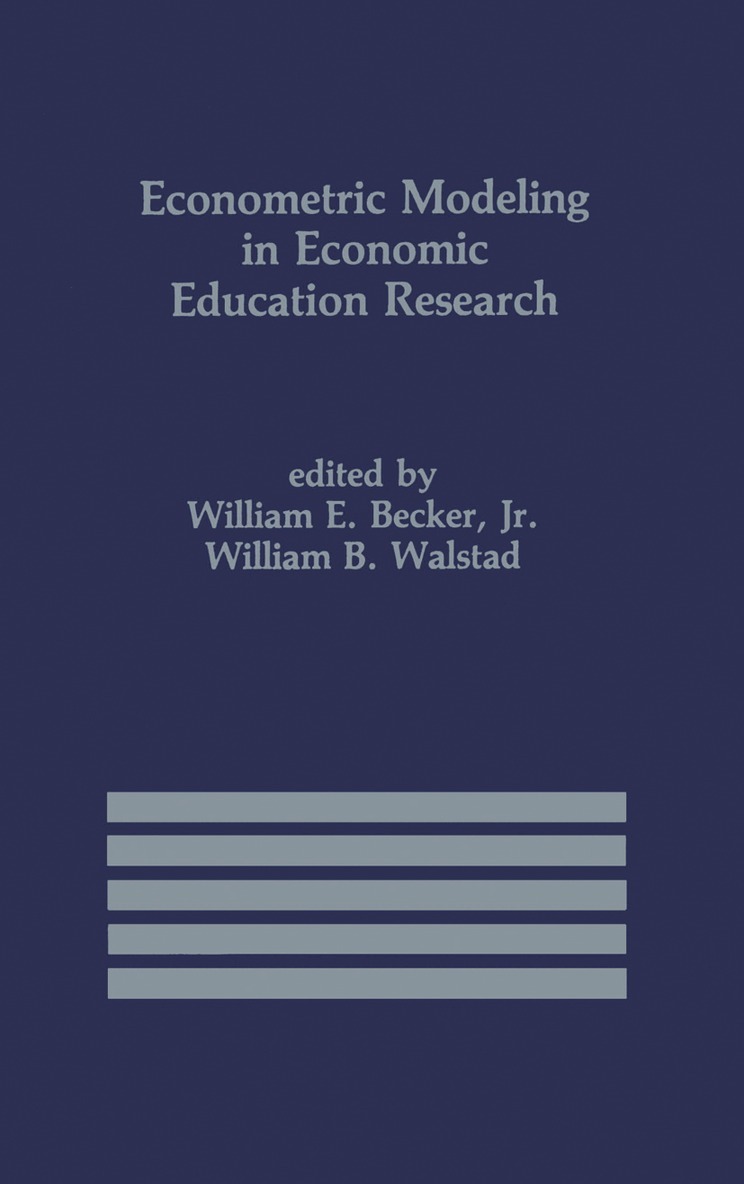
Econometric Modeling in Economic Education Research
Inbunden, Engelska, 1987
1 637 kr
Skickas inom 10-15 vardagar
Since its establishment in the 1950s the American Economic Association's Committee on Economic Education has sought to promote improved instruction in economics and to facilitate this objective by stimulating research on the teaching of economics. These efforts are most apparent in the sessions on economic education that the Committee organizes at the Association's annual meetings. At these sessions economists interested in economic education have opportunities to present new ideas on teaching and research and also to report the findings of their research. The record of this activity can be found in the Proceedings of the American Eco nomic Review. The Committee on Economic Education and its members have been actively involved in a variety of other projects. In the early 1960s it organized the National Task Force on Economic Education that spurred the development of economics teaching at the precollege level. This in turn led to the development of a standardized research instrument, a high school test of economic understanding. This was followed later in the 1960s by the preparation of a similar test of understanding college economics. The development of these two instruments greatly facilitated research on the impact of economics instruction, opened the way for application of increasingly sophisticated statistical methods in measuring the impact of economic education, and initiated a steady stream of research papers on a subject that previously had not been explored.
Del 1 - International Series in Economic Modelling
Regional Econometric Modeling
Häftad, Engelska, 2011
550 kr
Skickas inom 10-15 vardagar
This book is the first volume of the International Series in Economic Model ing, a series designed to summarize current issues and procedures in applied modeling within various fields of economics and to offer new or alternative approaches to prevailing problems. In selecting the subject area for the first volume, we were attracted by the area to which applied modeling efforts are increasingly being drawn, regional economics and its associated subfields. Applied modeling is a broad rubric even when the focus is restricted to econometric modeling issues. Regional econometric modeling has posted a record of rapid growth during the last two decades and has become an established field of research and application. Econometric models of states and large urban areas have become commonplace, but the existence of such models does not signal an end to further development of regional econ ometric methods and models. Many issues such as structural specification, level of geographic detail, data constraints, forecasting integrity, and syn thesis with other regional modeling techniques will continue to be sources of concern and will prompt further research efforts. The chapters of this volume reflect many of these issues. A brief synopsis of each contribution is provided below: Richard Weber offers an overview of regional econometric models by discussing theoretical specification, nature of variables, and ultimate useful ness of such models. For an illustration, Weber describes the specification of the econometric model of New Jersey.
1 637 kr
Skickas inom 10-15 vardagar
Since its establishment in the 1950s the American Economic Association's Committee on Economic Education has sought to promote improved instruction in economics and to facilitate this objective by stimulating research on the teaching of economics. These efforts are most apparent in the sessions on economic education that the Committee organizes at the Association's annual meetings. At these sessions economists interested in economic education have opportunities to present new ideas on teaching and research and also to report the findings of their research. The record of this activity can be found in the Proceedings of the American Eco nomic Review. The Committee on Economic Education and its members have been actively involved in a variety of other projects. In the early 1960s it organized the National Task Force on Economic Education that spurred the development of economics teaching at the precollege level. This in turn led to the development of a standardized research instrument, a high school test of economic understanding. This was followed later in the 1960s by the preparation of a similar test of understanding college economics. The development of these two instruments greatly facilitated research on the impact of economics instruction, opened the way for application of increasingly sophisticated statistical methods in measuring the impact of economic education, and initiated a steady stream of research papers on a subject that previously had not been explored.
1 589 kr
Skickas inom 10-15 vardagar
Almost 5 years ago we began working together on research for the U.S. Environmental Protec tion Agency (EPA) to measure the benefits of water quality regulations. EPA had awarded a contract to Research Triangle Inst~ute (RTIl in response to a proposal that Bill wrote on measuring these benefits. After meeting with the EPA project officer, Dr Ann Fisher, the basic outlines of what would become this research were framed. Upon the suggestion of Bob Anderson, then chief of the Benefits Branch at EPA, we selected the Monongahela River as the focal point of a case study that would compare alternative benefit measurement approaches. Exactly how this case study would be done remained vague, but Ann urged that there be a survey and that nonuse benefits be included in the question naire design. Of course, Bill agreed. At the same time, Kerry was independently working on a review article that tied together some of the loose threads in the option value literature. He had also been thinking about how to measure option value, as well as working on ways to generalize the travel cost approach for estimating benefits of site attributes. Glenn Morris at RTI suggested that Bill have lunch with him and Kerry and that they could talk about Bill's research to see if there were any mutual interest. Over the lunch and Bill's ever present dessert in a Chapel Hill restaurant, we found out just how much we have in common.