Jacana pocket biography - Böcker
Visar alla böcker i serien Jacana pocket biography. Handla med fri frakt och snabb leverans.
4 produkter
4 produkter
131 kr
Tillfälligt slut
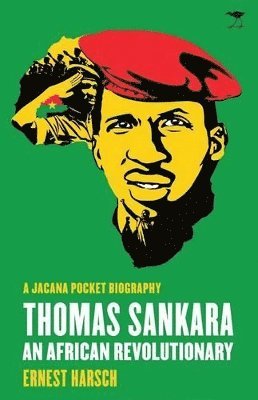
Thomas Sankara, often called the African Che Guevara, was president of Burkina Faso, one of the poorest countries in Africa, until his assassination during the military coup that brought down his government. Although his tenure in office was relatively short, Sankara left an indelible mark on his country's history and development. An avowed Marxist, he outspokenly asserted his country's independence from France and other Western powers while at the same time seeking to build a genuine pan-African unity. He is held in high esteem by Julius Malema and the Economic Freedom Fighters. Ernest Harsch traces Sankara's life from his student days to his recruitment into the military, early political awakening, and increasing dismay with his country's extreme poverty and political corruption. As he rose to higher leadership positions, he used those offices to mobilise people for change and to counter the influence of the old, corrupt elites. Sankara and his colleagues initiated economic and social policies that shifted away from dependence on foreign aid and toward a greater use of the country's own resources to build schools, health clinics, and public works.Although Sankara's sweeping vision and practical reforms won him admirers both in Burkina Faso and across Africa, a combination of domestic opposition groups and factions within his own government and the army finally led to his assassination in 1987. This is the first English-language book to tell the story of Sankara's life and struggles, drawing on the author's extensive first-hand research and reporting on Burkina Faso, including interviews with the late leader. Decades after his death, Sankara remains an inspiration to young people throughout Africa for his integrity, idealism, and dedication to independence and self-determination.
143 kr
Skickas inom 11-20 vardagar
Emperor Haile Selassie was an iconic figure of the twentieth century, a progressive monarch who ruled Ethiopia from 1916 to 1974. This book, written by a former state official who served in a number of important positions in Selassie's government, tells both the story of the emperor's life and the story of modern Ethiopia. After a struggle for the throne in 1916, the young Selassie emerged first as regent and then as supreme leader of Ethiopia. Over the course of his nearly six-decade rule, the emperor abolished slavery, introduced constitutional reform, and expanded educational opportunity. The Italian invasion of Ethiopia in the 1930s led to a five-year exile in England, from which he returned in time to lead his country through World War II. Selassie was also instrumental in the founding of the Organization of African Unity in 1963, but he fell short of the ultimate goal of a promised democracy in Ethiopia. The corruption that grew under his absolute rule, as well as his seeming indifference to the famine that gripped Ethiopia in the 1970s, led finally to his overthrow by the armed forces that he had created.Haile Selassie was an enlightened monarch in many ways, but also a man with flaws like any other. This short biography is a sensitive portrayal of Selassie as both emperor and man, by one who knew him well.
143 kr
Skickas inom 11-20 vardagar
While African National Congress narratives dominate much of the scholarship on South Africa’s freedom struggle, Josie Mpama/Palmer’s political life offers a different perspective. Highly critical of the patriarchal attitudes that hindered black women from actively participating in politics, Mpama/Palmer was an outspoken advocate for women’s social equality. and encouraged black women to become more involved in national conversations. Mpama/Palmer was the first black woman to join the Communist Party of South Africa, and spent a year in Moscow at the Lenin School. She was an integral figure in establishing the Federation of South African Women, an organization, and served as its Potchefstroom Branch Secretary. Mpama/Palmer’s activism and political legacy is an inspiring example for women in South Africa and around the world.
139 kr
Skickas inom 11-20 vardagar
We all picture Shaka as a lean, mean, assegai-wielding warrior-king, the military genius who founded the Zulu nation. In fact, we don't actually know when he was born, what he looked like, or exactly when he died. Almost every other story you've heard is probably either wrong or contested. This biography draws on the last two decades of historical research to reassess the eyewitness accounts and use newly available oral traditions. The picture that emerges is astonishingly different from the popular stereotype.