Languages of the Greater Himalayan Region – Serie
Visar alla böcker i serien Languages of the Greater Himalayan Region. Handla med fri frakt och snabb leverans.
11 produkter
11 produkter
2 448 kr
Skickas inom 3-6 vardagar
This book is the first description of Kulung, a complex-pronominalising Kiranti (Tibeto-Burman) language spoken in eastern Nepal. It contains the phonology, morphology, and syntax as well as sample texts, verbal paradigms, and a Kulung-English lexicon. The data presented here were collected during four field trips which the author undertook to Nepal between 1992 and 1995. This grammar of Kulung is an exhaustive reference work for Tibeto-Burman linguistics, language typology, and linguistic theory. With financial support of the International Institute for Asian Studies (www.iias.nl).
Del 14 - Languages of the Greater Himalayan Region
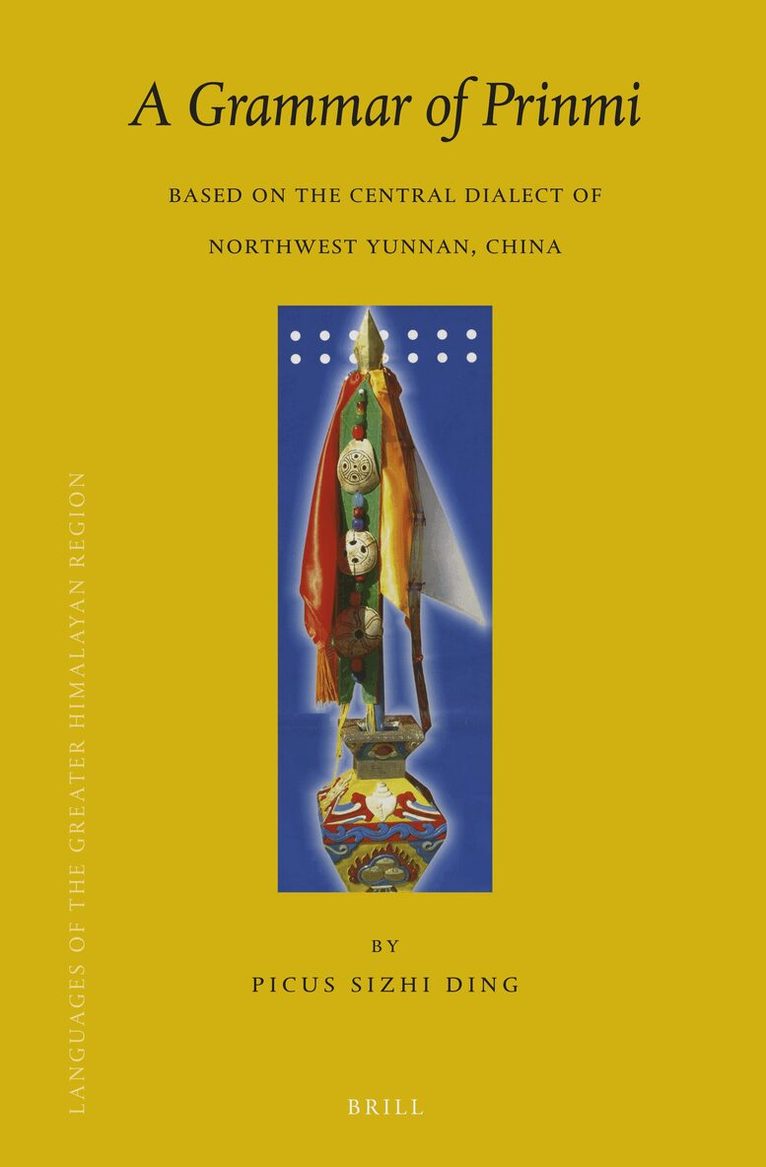
Grammar of Prinmi
Based on the Central Dialect of Northwest Yunnan, China
Inbunden, Engelska, 2014
2 988 kr
Skickas inom 5-8 vardagar
A Grammar of Prinmi represents the first in-depth description of a Tibeto-Burman language spoken by the Pǔmǐ Nationality and the Zàng Nationality (in Mùlǐ, Sichuan) in southwest China. Prinmi belongs to the Qiangic branch and is closely related to the extinct language of Tangut.Picus Ding examines in the grammar the phonology (both segmental and suprasegmental), morphology, syntax and information structure of Prinmi, with two sample texts and an English-Prinmi glossary provided in appendices. Some noteworthy features of Prinmi include a wealth of clitics (appearing as proclitic, enclitic, mesoclitic or endoclitic), a lexical tone system akin to Japanese, and a collection of existential verbs that discriminates concreteness, animacy, and location.
2 504 kr
Skickas inom 5-8 vardagar
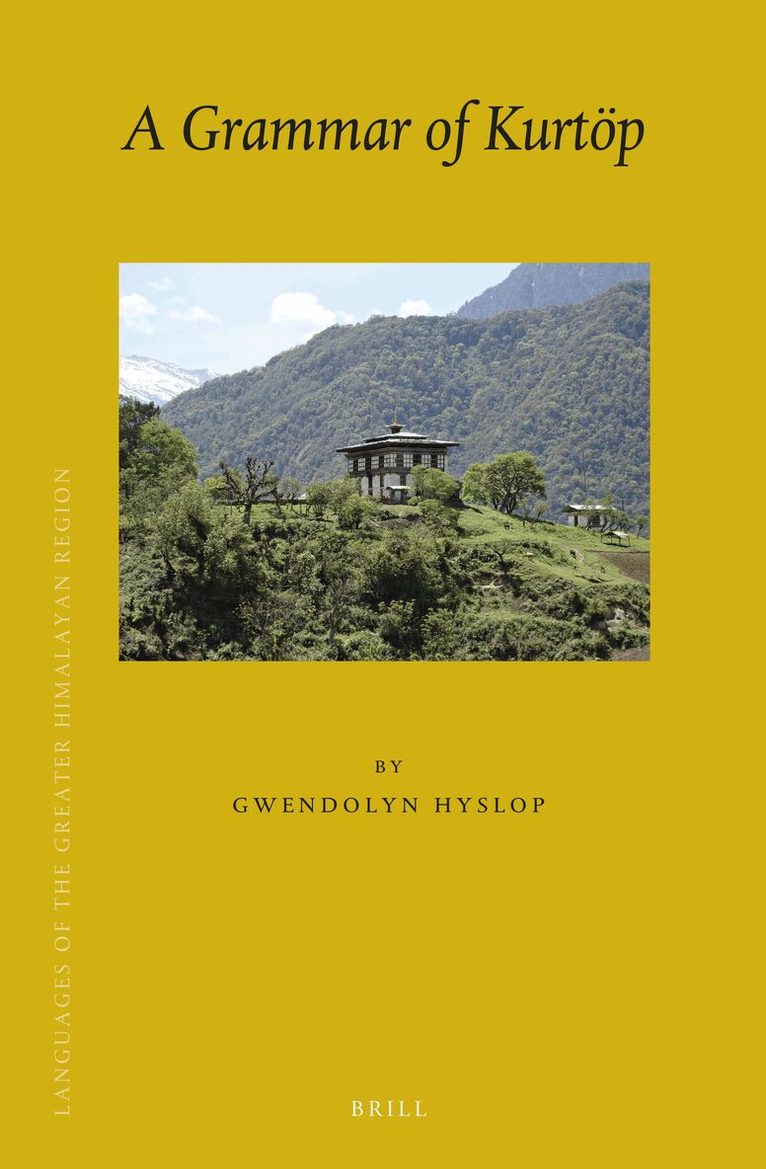
A grammar of Kurtöp is the first descriptive grammar of Kurtöp, a threatened language of Bhutan, and the only reference grammar of any East Bodish language. The East Bodish languages are a relatively unstudied branch of the larger Tibeto-Burman family, situated in Bhutan and neighbouring regions in Tibet and Arunachal Pradesh. The chapters introduce the language and the people who speak in a historical context and then go on to detail the synchronic and diachronic phonology, discuss word classes and cause structure, morphosyntax and syntax, and illustrate rich system of evidentiality and related categories. The book will be of interest to Tibeto-Burmanists, historical linguists and those interested in the prehistory of the eastern Himalayas, and to typologists.
Del 17 - Languages of the Greater Himalayan Region
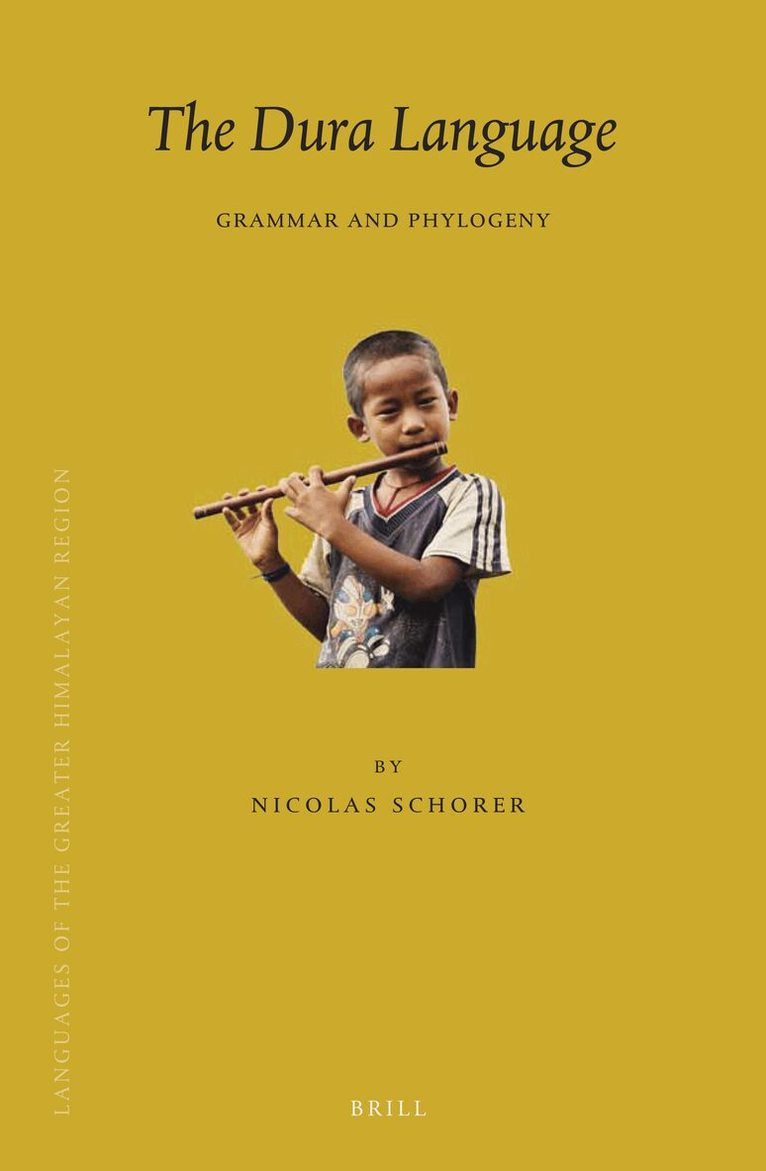
Dura Language
Grammar and Phylogeny
Inbunden, Engelska, 2016
2 593 kr
Skickas inom 5-8 vardagar
In The Dura Language: Grammar & Phylogeny Nicolas Schorer provides the definite descriptive account of this hitherto poorly documented language of Lamjung, Nepal. The Dura language is effectively extinct, although attempts at revival may be undertaken by well-intentioned members of Dura ethnicity. On the basis of a comprehensive study and analysis of all of the extant Dura language material, the book outlines the phonology, nominal and verbal morphology, lexical and syntactic properties as well as the phylogenetic position of the language in unprecedented detail. The result of the phylogenetic inquiry will help explain some of the sociocultural realities associated with the Dura community in Nepal and is a significant contribution to our understanding of the linguistic landscape of the Himalayas.
Del 19 - Languages of the Greater Himalayan Region
Tangam Language
Grammar, Lexicon and Texts
Inbunden, Engelska, 2017
2 070 kr
Skickas inom 5-8 vardagar
Tangam is a critically endangered Trans-Himalayan (Tibeto-Burman) language spoken by around 150 hilltribespeople in the far Eastern Himalaya. A member of the Tani subgroup of Trans-Himalayan, Tangam is mutually-unintelligible with other languages of this otherwise relatively homogeneous subgroup. This is demonstrated to be a consequence of Tangam's early-branching status within the Western Tani subgroup, subsequent contact with Eastern Tani languages, and historical relationship with speakers of Bodic languages. Based on three field trips to the Tangam-speaking area over two years, this work presents a brief but comprehensive cultural, historical and grammatical introduction to the Tangam language, together with a trilingual lexicon in Tangam, English and Minyong, and a collection of fully-analysed texts. It will be of interest to linguists and anthropologists of the Himalayan region, as well as to historical linguists and language typologists.
Del 20 - Languages of the Greater Himalayan Region
Sociohistorical Linguistics in Southeast Asia
New Horizons for Tibeto-Burman Studies in honor of David Bradley
Inbunden, Engelska, 2017
1 790 kr
Skickas inom 5-8 vardagar
Sociohistorical Linguistics in Southeast Asia blends insights from sociolinguistics, descriptive linguistics and historical-comparative linguistics to shed new light on regional Tibeto-Burman language varieties and their relationships across spatial, temporal and cultural differences. The approach is inspired by leading Tibeto-Burmanist, David Bradley, to whom the book is dedicated.The volume includes twelve original research essays written by eleven Tibeto-Burmanists drawing on first-hand field research in five countries to explore Tibeto-Burman languages descended from seven internal sub-branches. Following two introductory chapters, each contribution is focused on a specific Tibeto-Burman language or sub-branch, collectively contributing to the literature on language identification, language documentation, typological analysis, historical-comparative classification, linguistic theory, and language endangerment research with new analyses, state-of-the-art summaries and contemporary applications.
4 175 kr
Skickas inom 5-8 vardagar
In A Grammar of Purik Tibetan, Marius Zemp offers a comprehensive description of the phonologically archaic Tibetan variety spoken in Kargil, the capital of a region called Purik, situated in the state of Jammu & Kashmir, India. This book contains the most thorough and insightful description of the verbal system of a Tibetic language yet written and will be particularly relevant for scholars studying evidentiality. It also includes highly valuable discussions of a syntactically and pragmatically well-defined class of ideophones which Zemp calls “dramatizers” and of prosody – topics which are too often neglected in language descriptions. Finally, this book goes beyond what others have done in that Purik data are used to elucidate our understanding of Classical Tibetan and its origins.
Del 23 - Languages of the Greater Himalayan Region
Grammar of Duhumbi (Chugpa)
Inbunden, Engelska, 2020
3 678 kr
Skickas inom 5-8 vardagar
With Grammar of Duhumbi (Chugpa), Timotheus Adrianus (Tim) Bodt provides the first comprehensive description of any of the Western Kho-Bwa languages, a sub-group of eight linguistic varieties of the Kho-Bwa cluster (Tibeto-Burman).Duhumbi is spoken by 600 people in the Chug valley in West Kameng district, Arunachal Pradesh, India. The Duhumbi people, known to the outside world as Chugpa or Chug Monpa, belong to the Monpa Scheduled Tribe. Despite that affiliation, Duhumbi is not intelligible to speakers of any of the other Monpa languages except Khispi (Lishpa).The volume Grammar of Duhumbi (Chugpa) describes all aspects of the language, including phonology, morphology, lexicon, syntax and discourse. Moreover, it also contains links to additional resources freely accessible on-line.
Del 25 - Languages of the Greater Himalayan Region
Grammar of Poumai Naga (Poula)
A Trans-Himalayan Language of North-East India
Inbunden, Engelska, 2021
4 124 kr
Skickas inom 5-8 vardagar
This is the first complete description of Poumai Naga (Poula), an understudied language spoken in Manipur in northeast India. Poumai Naga belongs to the Angami-Pochuri clade of the Trans-Himalayan family. The book comprises all aspects of the language, including phonology, lexicon, morphosyntax, syntax and discourse. This work employs the tone periodic table, an innovative method used for documenting tone languages. A bilingual lexicon and a collection of fully-analysed texts are provided in the appendices. This research work represents a substantial contribution to the field of comparative Trans-Himalayan linguistics.
3 473 kr
Skickas inom 5-8 vardagar
A Grammar of Bjokapakha by Selin Grollmann constitutes the first description of Bjokapakha, an endangered language spoken in central Bhutan belonging to the Tshangla branch of Trans-Himalayan. This grammar comprises a description of the phonology, lexicon, nominal morphology, predicate structures and syntax. In addition to the descriptive parts, this book encompasses a historical-comparative account of Bjokapakha. The introductory chapter provides a comparison with the standard variety of Tshangla and corroborates the internal diversity of the Tshangla branch. The present-day structure of Bjokapakha verbal morphology is illuminated by means of an internal reconstruction. Moreover, this book contains a glossary and a text collection.
Del 26 - Languages of the Greater Himalayan Region
Ethnolinguistic Prehistory
The Peopling of the World from the Perspective of Language, Genes and Material Culture
Inbunden, Engelska, 2021
2 109 kr
Skickas inom 5-8 vardagar
This volume provides the most up-to-date and holistic but compact account of the peopling of the world from the perspective of language, genes and material culture, presenting a view from the Himalayas. The phylogeny of language families, the chronology of branching of linguistic family trees and the historical and modern geographical distribution of language communities inform us about the spread of languages and linguistic phyla. The global distribution and the chronology of spread of Y chromosomal haplogroups appears closely correlated with the spread of language families. New findings on ancient DNA have greatly enhanced our understanding of the prehistory and provenance of our biological ancestors. The archaeological study of past material cultures provides yet a third independent window onto the complex prehistory of our species.