Made in America - Böcker
Visar alla böcker i serien Made in America. Handla med fri frakt och snabb leverans.
5 produkter
5 produkter
239 kr
Skickas inom 7-10 vardagar
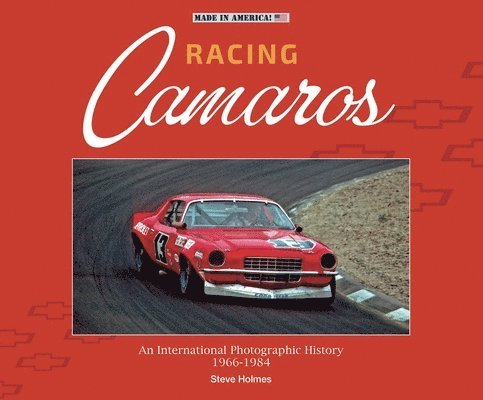
Chevrolet created the Camaro in response to the runaway sales success of the Ford Mustang, the first pony car. The Mustang went on sale in April 1964, and by August that same year, General Motors launched an intensive program to bring its own pony car to market. In September 1966, the Camaro went on sale.Chevrolet wanted the Camaro to be better than the Mustang in every area, including style, ride-quality, and performance. To that end, with the Mustang having already achieved so much racing success, Chevrolet wanted to beat it on the track also.Racing Camaros: An International Photographic History 1966 - 1984 is a photographic celebration of road racing Camaros throughout the world. It focuses on production-based cars, rather than the heavily modified tube-frame silhouette machines that began appearing in the late 1970s. Included are images of big-budget factory-supported cars competing in the Trans-Am series, right through to low-buck independents, and cars competing throughout the world.For the first time, the international road racing representation of the Camaro is featured in a book, which includes countless photos that have never been published. Technical detail is provided throughout, from concept and design, right through its racing career, and the challenges and developments that took place to make it a winner. Only period images have been used. This is a true photographic history depicting the global popularity of the Chevrolet Camaro as a road racing car.
232 kr
Skickas inom 7-10 vardagar
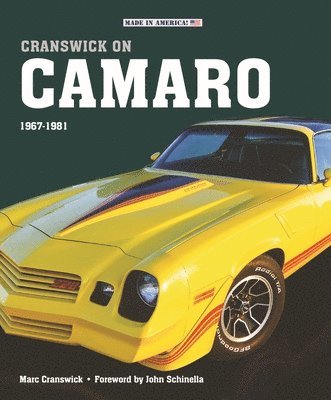
Chevrolet was Number One in the sales race. If you needed a car, chances are Chevrolet made it. However, in 1964 there arose a problem. Some guy at Ford came up with a car called the Mustang, maybe you’ve heard of it? But don’t worry, Chevrolet had a solution called the Camaro.In racing, where you are on lap one, isn’t nearly as important as your position when the checkered flag falls. By 1981, Camaro was so far in front of Mustang, Henry needed binoculars to see the Z28’s taillights! Camaro was part of the speed shop scene, modified by the most famous names of the muscle car era. In racing, Chevrolet’s pony left no stone unturned, inside and outside America.With the fuel crisis, insurance, and inflation, America sought a new kind of coupe. The Bowtie boys even outsold Mustang, with that Z28 having the upper hand in the Chevrolet versus Ford rivalry. Chevrolet’s dedicated coupe even outfoxed Ford’s sedan based Mustang. If the Corvette is the King of American Sportscars, then ‘The Hugger’ must be the Prince of Ponies!
221 kr
Skickas
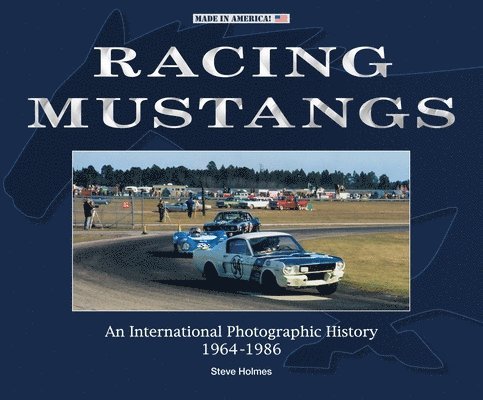
Virtually from the moment of its launch in April, 1964, the Ford Mustang has been a favorite among road racers. From the Tour de France, to production sports car racing, the SCCA Trans-Am series, regional and national A/Sedan competitions, and international and domestic sedan championships in Great Britain, Europe, Australia, and New Zealand, the Mustang has enjoyed a following like few other models.This book is a photographic celebration of road racing Mustangs throughout the world. It focuses on production-based cars, rather than the heavily modified tube-frame silhouette machines that began appearing in the late 1970s. Included are images of big-budget factory-supported cars competing in the Trans-Am series, right through to low-buck independents, and cars competing throughout the world.Using only period images, including countless photos that have never before been published, this is a true photographic history, depicting the global popularity of the Ford Mustang as a road racing car.
331 kr
Skickas inom 3-6 vardagar
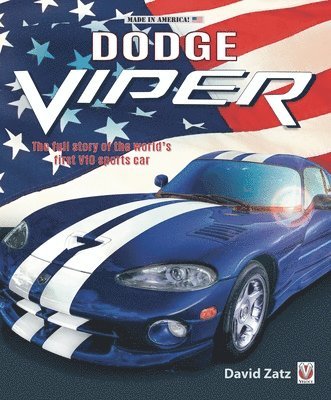
Now in Paperback! The Viper stunned Americans by showing that Dodge, whose cars were all front-wheel drive (and mostly powered by four-cylinder engines), could make a raw, brutal, V10-powered car that could run with the best. Team Viper went a step further at Le Mans, proving that an American car could handle turns, too; so well that it won its class, repeatedly, at a fraction of the cost of the cars it beat. This book covers the transition from a concept to a rough and brutal rocket to a world-class supercar, and includes every generation. The story also tells of the rough times when the entire Viper business could have been sold to the highest bidder, and considers alternative paths the 2013-17 Viper might have taken.This is not just a gushing tribute to the Dodge Viper, the author provides an objective view of the full story, using business, historical, and enthusiast perspectives. The book looks at the business case for each generation, the development stories and their outcomes, and describes some of the issues owners may have to watch out for, particularly in the early models.
331 kr
Skickas inom 7-10 vardagar
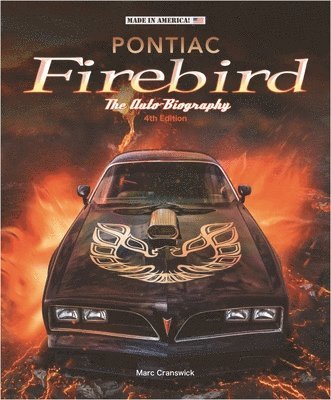
Over a 40-year period the Pontiac Firebird earned a unique place amongst speedy American domestic cars, and what began as just another contender in the pony car race, ended up a true American classic. The Firebird’s tale is a reflection of the development of the mainstream domestic car in the modern era: V8s, turbo V8s, turbo V6s, HO V6s, overhead cam I6s, and even a Super Duty four banger. If there’s a performance avenue to be explored, then the Firebird has been there. Popular in the sales charts, the Firebird has also been high profile both in television and movies, cementing its legendary status in pop culture and beyond. From the go-faster 1960s, gas mileage- and pollution-controlled 1970s, performance renaissance of the 1980s, through to the indifference of the 1990s, the Firebird was always there. This is its story.Close attention is paid to both regular models and high level variants such as Formula and Trans Am, and an appendix featuring model highlights from the Firebird’s 35 year span details the specifications and statistics covering sixteen notable models, from the 19671/2 Firebird 400 Coupé, to the 1999 30th Anniversary Firebird Trans Am Convertible. Revealing all aspects of the Firebird story, from social, to economic and beyond, Cranswick shows how Pontiac made the Firebird unique.