Mathematical Biosciences Institute Lecture Series – serie
Visar alla böcker i serien Mathematical Biosciences Institute Lecture Series. Handla med fri frakt och snabb leverans.
6 produkter
6 produkter
Del 1 - Mathematical Biosciences Institute Lecture Series
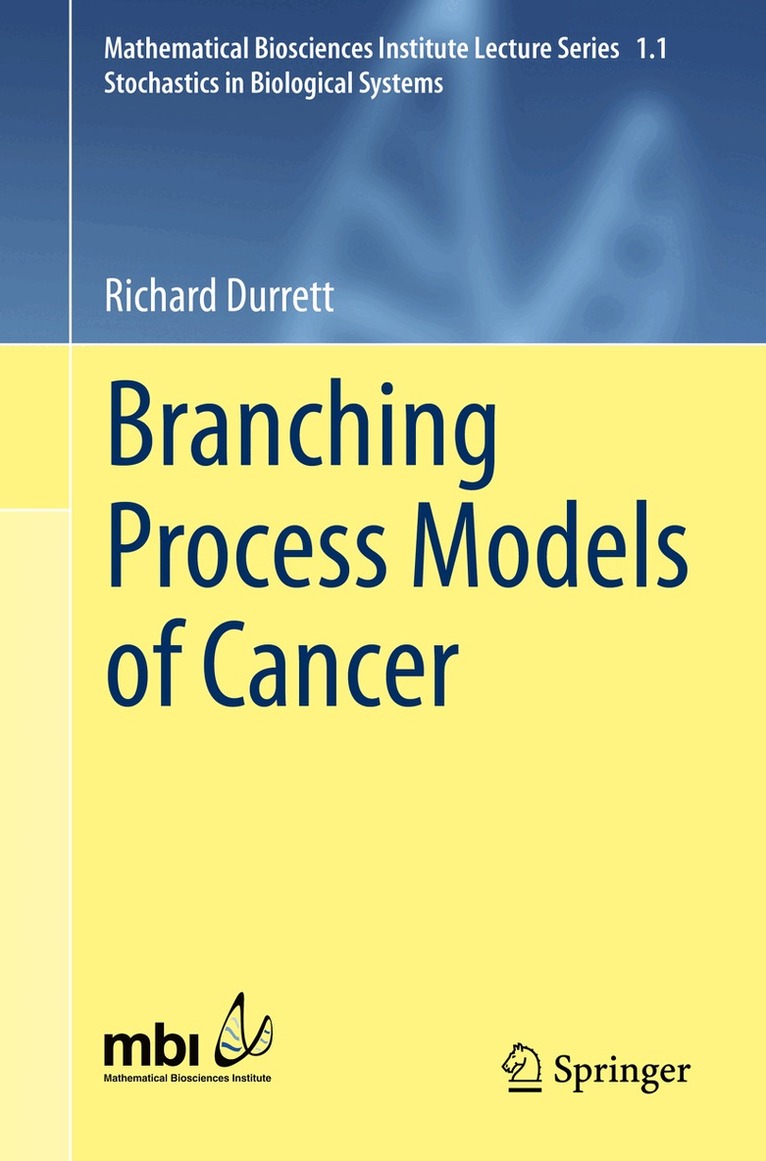
Branching Process Models of Cancer
Häftad, Engelska, 2015
342 kr
Skickas inom 10-15 vardagar
This volume develops results on continuous time branching processes and applies them to study rate of tumor growth, extending classic work on the Luria-Delbruck distribution. As a consequence, the author calculate the probability that mutations that confer resistance to treatment are present at detection and quantify the extent of tumor heterogeneity. As applications, the author evaluate ovarian cancer screening strategies and give rigorous proofs for results of Heano and Michor concerning tumor metastasis. These notes should be accessible to students who are familiar with Poisson processes and continuous time Markov chains. Richard Durrett is a mathematics professor at Duke University, USA. He is the author of 8 books, over 200 journal articles, and has supervised more than 40 Ph.D students. Most of his current research concerns the applications of probability to biology: ecology, genetics and most recently cancer.
Del 1 - Mathematical Biosciences Institute Lecture Series
Stochastic Analysis of Biochemical Systems
Häftad, Engelska, 2015
440 kr
Skickas inom 10-15 vardagar
This book focuses on counting processes and continuous-time Markov chains motivated by examples and applications drawn from chemical networks in systems biology. The book should serve well as a supplement for courses in probability and stochastic processes. While the material is presented in a manner most suitable for students who have studied stochastic processes up to and including martingales in continuous time, much of the necessary background material is summarized in the Appendix. Students and Researchers with a solid understanding of calculus, differential equations and elementary probability and who are well-motivated by the applications will find this book of interest.David F. Anderson is Associate Professor in the Department of Mathematics at the University of Wisconsin and Thomas G. Kurtz is Emeritus Professor in the Departments of Mathematics and Statistics at that university. Their research is focused on probability and stochastic processes with applications in biology and other areas of science and technology.These notes are based in part on lectures given by Professor Anderson at the University of Wisconsin – Madison and by Professor Kurtz at Goethe University Frankfurt.
Del 1 - Mathematical Biosciences Institute Lecture Series
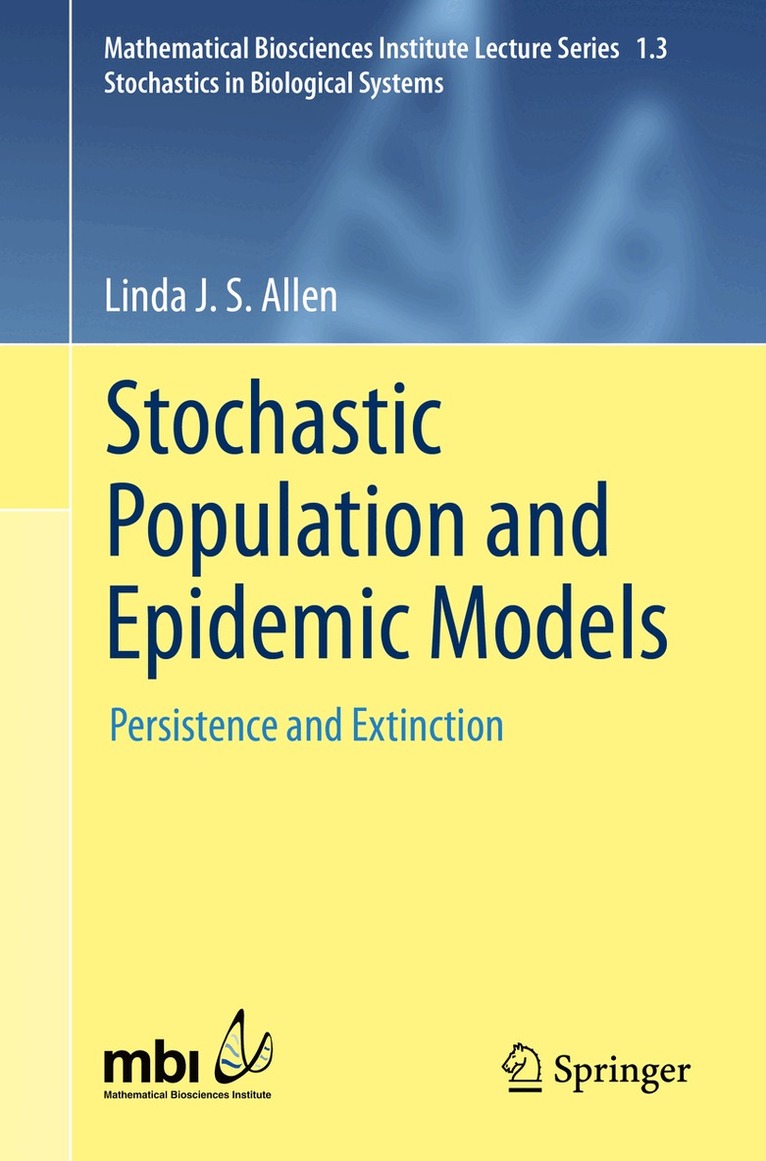
Stochastic Population and Epidemic Models
Persistence and Extinction
Häftad, Engelska, 2015
440 kr
Skickas inom 10-15 vardagar
This monograph provides a summary of the basic theory of branching processes for single-type and multi-type processes. Classic examples of population and epidemic models illustrate the probability of population or epidemic extinction obtained from the theory of branching processes. The first chapter develops the branching process theory, while in the second chapter two applications to population and epidemic processes of single-type branching process theory are explored. The last two chapters present multi-type branching process applications to epidemic models, and then continuous-time and continuous-state branching processes with applications. In addition, several MATLAB programs for simulating stochastic sample paths are provided in an Appendix.These notes originated as part of a lecture series on Stochastics in Biological Systems at the Mathematical Biosciences Institute in Ohio, USA.Professor Linda Allen is a Paul Whitfield Horn Professor of Mathematics in theDepartment of Mathematics and Statistics at Texas Tech University, USA.
Del 1 - Mathematical Biosciences Institute Lecture Series
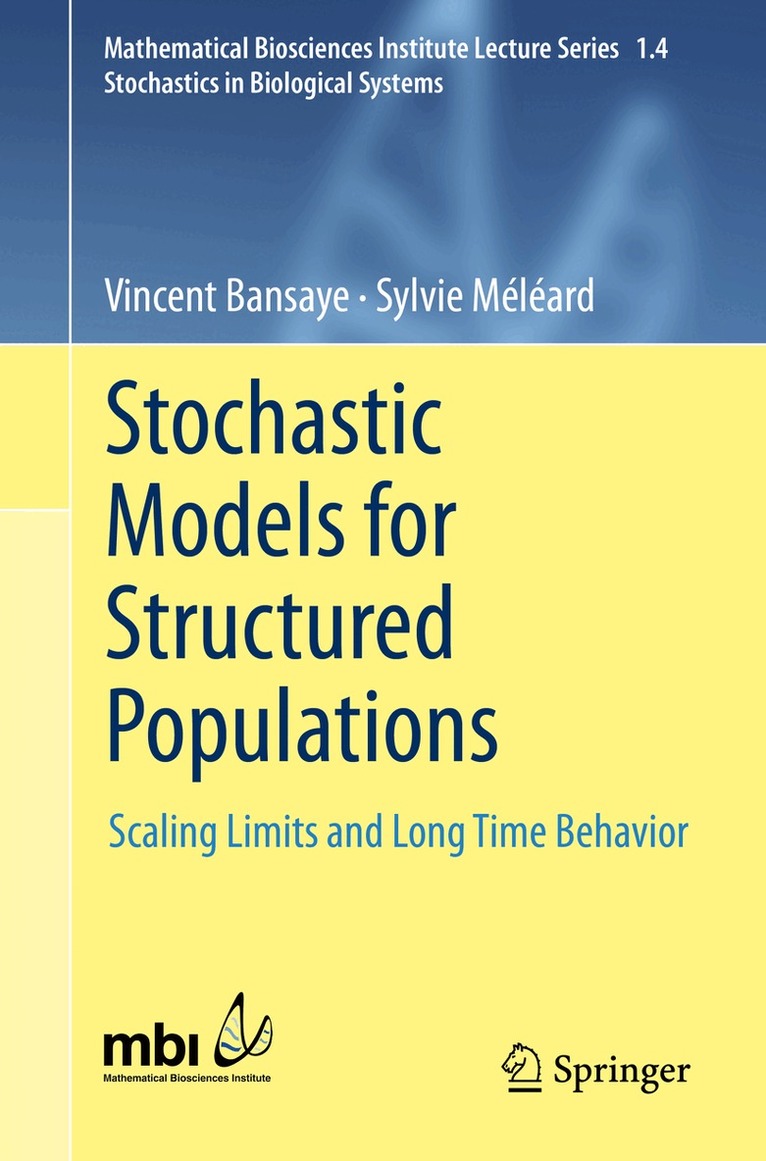
Stochastic Models for Structured Populations
Scaling Limits and Long Time Behavior
Häftad, Engelska, 2015
440 kr
Skickas inom 10-15 vardagar
In this contribution, several probabilistic tools to study population dynamics are developed. The focus is on scaling limits of qualitatively different stochastic individual based models and the long time behavior of some classes of limiting processes.Structured population dynamics are modeled by measure-valued processes describing the individual behaviors and taking into account the demographic and mutational parameters, and possible interactions between individuals. Many quantitative parameters appear in these models and several relevant normalizations are considered, leading to infinite-dimensional deterministic or stochastic large-population approximations. Biologically relevant questions are considered, such as extinction criteria, the effect of large birth events, the impact of environmental catastrophes, the mutation-selection trade-off, recovery criteria in parasite infections, genealogical properties of a sample ofindividuals.These notes originated from a lecture series on Structured Population Dynamics at Ecole polytechnique (France).Vincent Bansaye and Sylvie Méléard are Professors at Ecole Polytechnique (France). They are a specialists of branching processes and random particle systems in biology. Most of their research concerns the applications of probability to biodiversity, ecology and evolution.
Del 1 - Mathematical Biosciences Institute Lecture Series
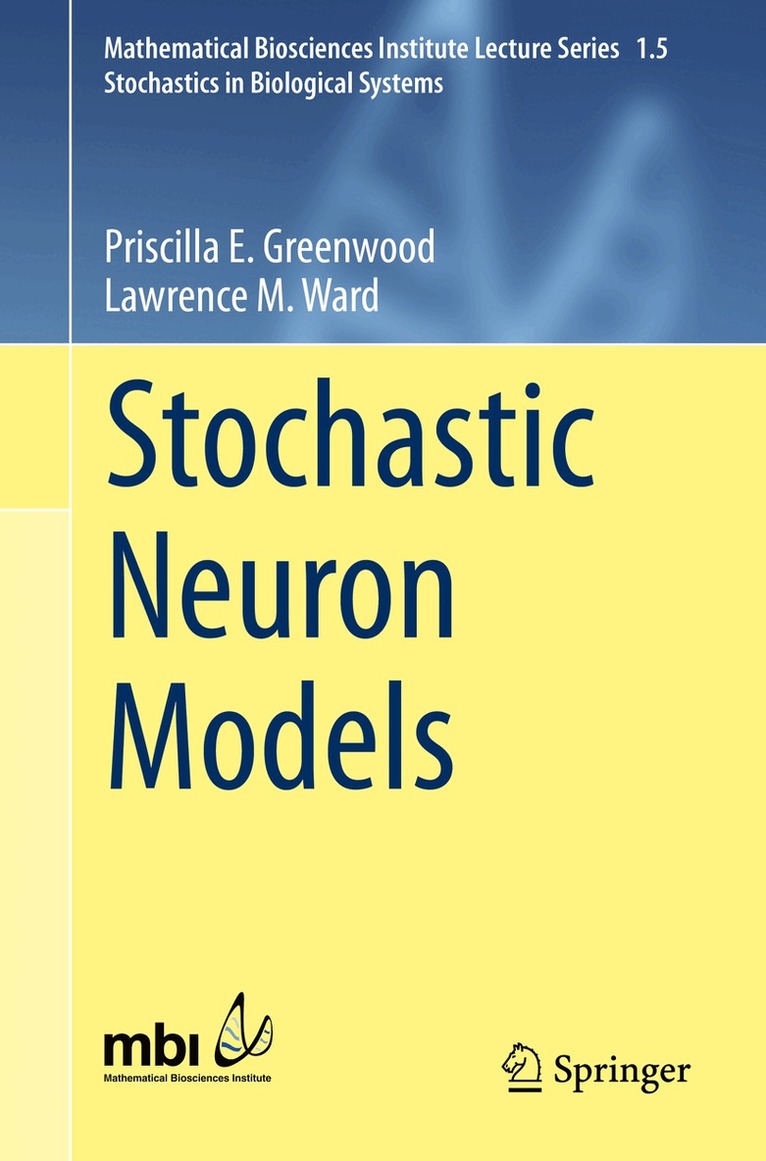
Stochastic Neuron Models
Häftad, Engelska, 2016
549 kr
Skickas inom 10-15 vardagar
This book describes a large number of open problems in the theory of stochastic neural systems, with the aim of enticing probabilists to work on them. This includes problems arising from stochastic models of individual neurons as well as those arising from stochastic models of the activities of small and large networks of interconnected neurons. The necessary neuroscience background to these problems is outlined within the text, so readers can grasp the context in which they arise.This book will be useful for graduate students and instructors providing material and references for applying probability to stochastic neuron modeling. Methods and results are presented, but the emphasis is on questions where additional stochastic analysis may contribute neuroscience insight. An extensive bibliography is included. Dr. Priscilla E. Greenwood is a Professor Emerita in the Department of Mathematics at the University of British Columbia. Dr. Lawrence M. Ward is a Professor in the Department of Psychology and the Brain Research Centre at the University of British Columbia.
Del 1 - Mathematical Biosciences Institute Lecture Series
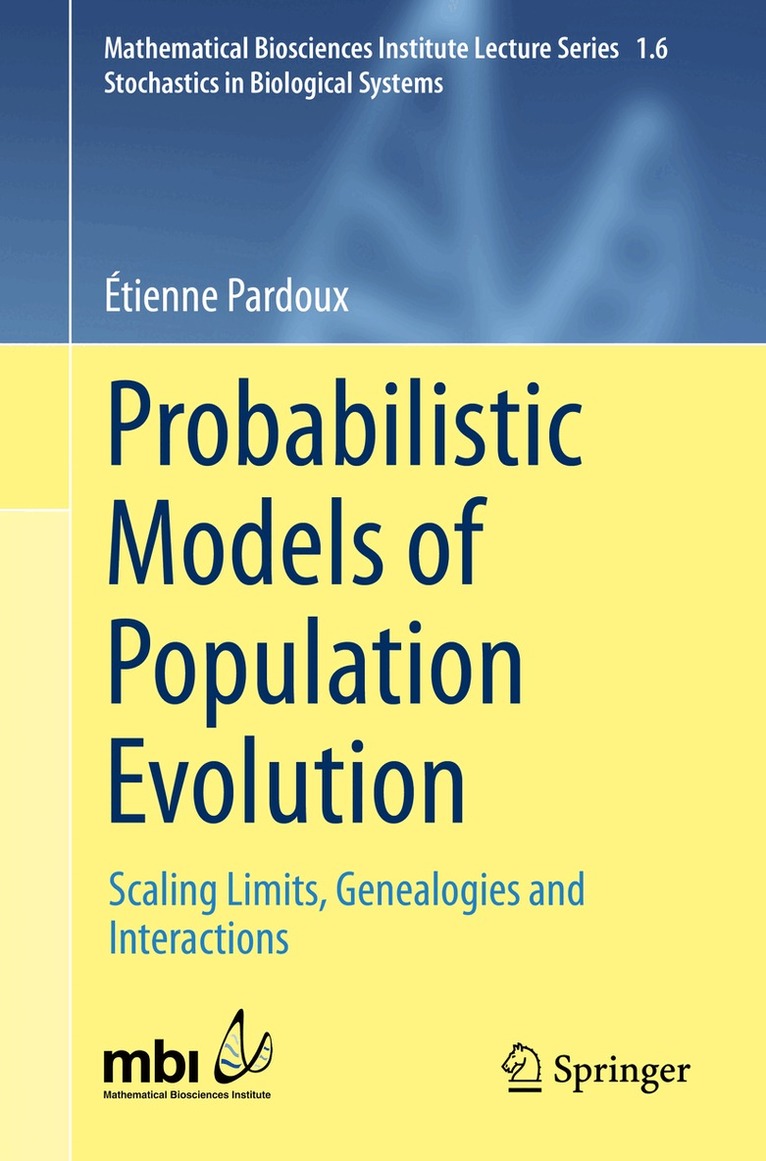
Probabilistic Models of Population Evolution
Scaling Limits, Genealogies and Interactions
Häftad, Engelska, 2016
365 kr
Skickas inom 10-15 vardagar
This expository book presents the mathematical description of evolutionary models of populations subject to interactions (e.g. competition) within the population. The author includes both models of finite populations, and limiting models as the size of the population tends to infinity. The size of the population is described as a random function of time and of the initial population (the ancestors at time 0). The genealogical tree of such a population is given. Most models imply that the population is bound to go extinct in finite time. It is explained when the interaction is strong enough so that the extinction time remains finite, when the ancestral population at time 0 goes to infinity. The material could be used for teaching stochastic processes, together with their applications.Étienne Pardoux is Professor at Aix-Marseille University, working in the field of Stochastic Analysis, stochastic partial differential equations, and probabilistic models in evolutionary biology and population genetics. He obtained his PhD in 1975 at University of Paris-Sud.