Palgrave Studies in Natural Resource Management – serie
Visar alla böcker i serien Palgrave Studies in Natural Resource Management. Handla med fri frakt och snabb leverans.
10 produkter
10 produkter
Häftad, Engelska, 2019
1 200 kr
Skickas inom 10-15 vardagar
This edited collection assesses governance in forestry programmes and projects, including REDD+ governance. It examines political representation, participation and decentralisation in forest governance, providing insight as to how forest governance arrangements can be responsive to the socio-economic interests of local people and communities who live adjacent to and depend on forests.Global Forest Governance and Climate Change argues that inclusive complementary representation of local communities is required for strong participatory processes and democratic decentralisation of forest governance. Responsiveness to local people’s socio-economic interests in forestry initiatives require paying attention to not just the hosting of participatory meetings and activities, but also to the full cast of appointed, self-authorized, and elected representative agents that stand, speak, and act for local people. This book will be of interest to students and academicsacross the fields of climate change governance, forestry, development studies, and political economy. It will also be a useful resource for policy makers and practitioners responsible for forestry and climate change initiatives.
Inbunden, Engelska, 2019
1 525 kr
Skickas inom 10-15 vardagar
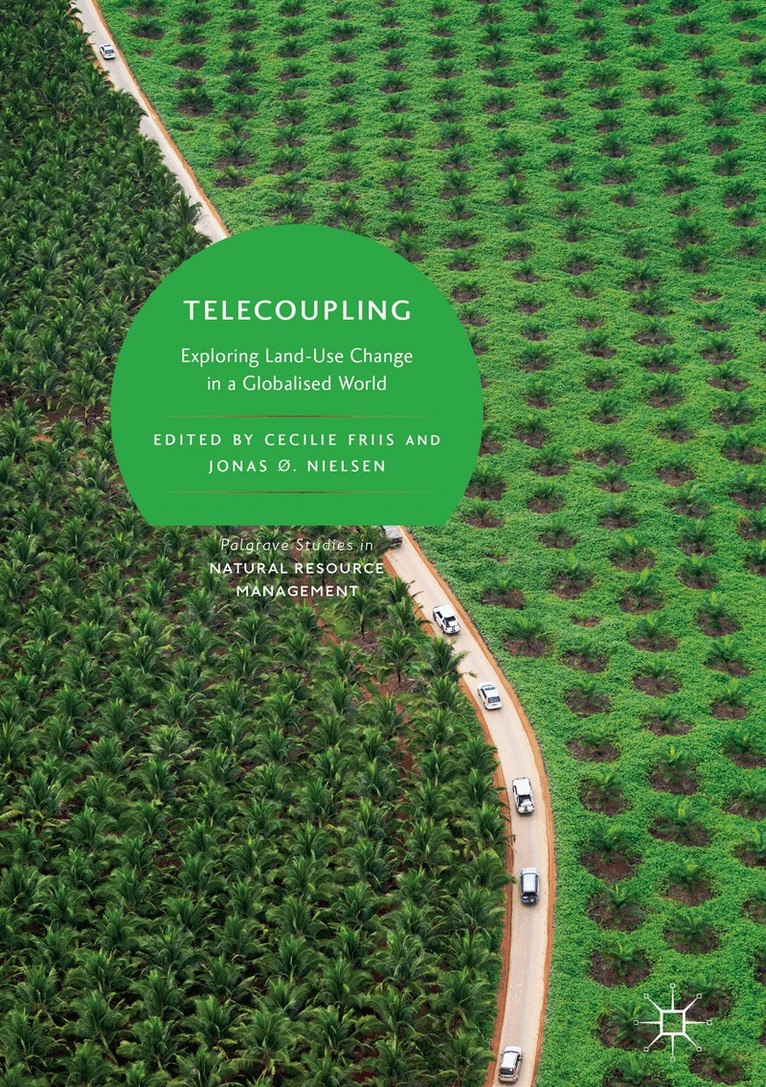
This book presents a comprehensive exploration of the emerging concept and framework of telecoupling and how it can help create a better understanding of land-use change in a globalised world. Land-use change is increasingly characterised by a spatial disconnect between its main environmental, socioeconomic and political drivers and the main impacts and outcomes of those changes. The authors examine how this separation of the production and consumption of land-based resources is driven by population growth, urbanisation, climate change, and biodiversity and carbon conservation efforts. Identifying and fostering more sustainable, just and equitable modes of land use and intervening in unsustainable ones thus constitute substantial, almost overwhelming challenges for science and policy. This book brings together leading scholars on land-use change and sustainability to systematically discuss the relevance of telecoupling research in addressing these challenges. The book presents an overview of the telecoupling approach, reflects on a number of the most pressing issues surrounding land-use change today and discusses the agenda for advancing understanding on sustainable land-use change through interdisciplinary and transdisciplinary research.
Inbunden, Engelska, 2019
983 kr
Skickas inom 10-15 vardagar
This book bridges the gap between economic and ecological theory and practice. Its main focus is on how the principles of the Austrian School of economics could improve the validity of Ecosystem Services.The concept of ‘Ecosystem Services’ is a relatively recent innovation in environmental thought. The current system is dependent upon mainstream economic theory, in which monetary and fiscal policy controls the prevailing health of the economy. The dependence on this approach to finance, Muddiman argues, limits the potential of ecosystem services and exacerbates the effects of the existing flawed economic model. The book highlights the links between ecological and economic methodologies and concepts and outlines how the principles of Austrian Economic theory could provide better environmental outcomes. It then goes on to formulate approaches to ecosystem services which could act as drivers towards a new biodiversity-based economic framework built around distributedledger technology, or ‘blockchain’. The key distinction of this book is its consideration of ecosystem services as a function of the current economic system. Using this as a starting point it investigates how an alternative economic model would achieve the integration of environmental considerations into economic decision making.
Inbunden, Engelska, 2019
820 kr
Skickas inom 10-15 vardagar
This book addresses the complex socio-political context of natural resource management in coastal and marine environments throughout the contemporary Pacific Islands and provides lessons that can be applied around the globe. The author spotlights one particular case in which Native Hawaiians worked successfully to develop a formal policy mechanism through which to advise government agencies in the State of Hawaii on matters regarding traditional and customary use and management of the island’s natural resources. Glazier describes historic-traditional aspects of natural resource use and management in the Hawaiian Islands and the challenging process that was employed to enhance the capacity of modern Hawaiians to influence the course of their future. This process successfully broached and addressed truly difficult challenges, including but not limited to: the convening of representatives of a complex society of indigenous persons in order to elicit traditional place-based knowledge and varying perspectives on the appropriate use and management of natural resources; the incorporation of such knowledge and perspectives into the modern natural resource management and policy context; and the need to balance the interests of indigenous persons and those of more recently-arriving persons around the island chain. The lessons learned were many and varied and are particularly germane for resource managers, scientists, policymakers, and indigenous persons seeking to undertake balanced natural resource policy decisions in island, coastal, and indigenous settings around the Pacific and beyond.
Inbunden, Engelska, 2020
1 091 kr
Skickas inom 10-15 vardagar
Is safe and sustainable water and sanitation for all an unaffordable pipedream? This book surveys the worldwide development of water and sewage services and the challenges in meeting Sustainable Development Goal 6 (SDG6) along with climate change, population growth and urbanisation. It explores the reasons why current SDG6 progress is failing, including weak policy implementation, staff shortages and inadequate funding, as well as the limited impact of aid funding. The author contends that despite a series of innovations, debt finance remains too small to address needs of developing economies. Therefore, instead of advocating new funding, this book proposes addressing the funding gap through technological innovation and more efficient management and procurement through a series of examples that have challenged traditional assumptions. After four decades of good intentions, SDG6 is making a difference in monitoring shortfalls for the first time, allowing for more effective responses. This book outlines the role of innovation in hardware development, procurement and installation, and discusses how network management and operations can most effectively address funding gaps. The potential for savings is considerable, if effectively replicated. New approaches are driving forward affordable resilience, including nature-based solutions such as upstream habitat enhancement to retain water and improve downstream water quality; the circular economy, including water, nutrient, energy and heat recovery from wastewater; and demand management. This book will be of great value to scholars, policy makers and practitioners interested in the global finance of sustainable water and sanitation.
Häftad, Engelska, 2021
1 091 kr
Skickas inom 10-15 vardagar
Is safe and sustainable water and sanitation for all an unaffordable pipedream? This book surveys the worldwide development of water and sewage services and the challenges in meeting Sustainable Development Goal 6 (SDG6) along with climate change, population growth and urbanisation. It explores the reasons why current SDG6 progress is failing, including weak policy implementation, staff shortages and inadequate funding, as well as the limited impact of aid funding. The author contends that despite a series of innovations, debt finance remains too small to address needs of developing economies. Therefore, instead of advocating new funding, this book proposes addressing the funding gap through technological innovation and more efficient management and procurement through a series of examples that have challenged traditional assumptions. After four decades of good intentions, SDG6 is making a difference in monitoring shortfalls for the first time, allowing for more effective responses. This book outlines the role of innovation in hardware development, procurement and installation, and discusses how network management and operations can most effectively address funding gaps. The potential for savings is considerable, if effectively replicated. New approaches are driving forward affordable resilience, including nature-based solutions such as upstream habitat enhancement to retain water and improve downstream water quality; the circular economy, including water, nutrient, energy and heat recovery from wastewater; and demand management. This book will be of great value to scholars, policy makers and practitioners interested in the global finance of sustainable water and sanitation.
Inbunden, Engelska, 2021
549 kr
Skickas inom 10-15 vardagar
This open access book crosses disciplinary boundaries to connect theories of environmental justice with Indigenous people’s experiences of freshwater management and governance. It traces the history of one freshwater crisis – the degradation of Aotearoa New Zealand’s Waipā River– to the settler-colonial acts of ecological dispossession resulting in intergenerational injustices for Indigenous Māori iwi (tribes). The authors draw on a rich empirical base to document the negative consequences of imposing Western knowledge, worldviews, laws, governance and management approaches onto Māori and their ancestral landscapes and waterscapes. Importantly, this book demonstrates how degraded freshwater systems can and are being addressed by Māori seeking to reassert their knowledge, authority, and practices of kaitiakitanga (environmental guardianship). Co-governance and co-management agreements between iwi and the New Zealand Government, over the Waipā River, highlight how Māori are envisioning and enacting more sustainable freshwater management and governance, thus seeking to achieve Indigenous environmental justice (IEJ). The book provides an accessible way for readers coming from a diversity of different backgrounds, be they academics, students, practitioners or decision-makers, to develop an understanding of IEJ and its applicability to freshwater management and governance in the context of changing socio-economic, political, and environmental conditions that characterise the Anthropocene.
Inbunden, Engelska, 2018
1 851 kr
Skickas inom 10-15 vardagar
This book provides insight into how governments are using a variety of innovative fiscal and non-fiscal instruments to develop circular economies with significant economic and environmental benefits. It emphasises the urgent need for these circular economies and to move away from our current, linear model that has led to environmental degradation, volatility of resource prices and supply risks from uneven distribution of natural resources.Natural Resource Management and the Circular Economy illustrates how governments have promoted the development of an economy that can provide substantial net material savings; mitigate price volatility and supply risks; and improve ecosystem health and long-term resilience of the economy. Through a series of case studies, it details the various innovative policy instruments which can be utilised, including regulations; market-based instruments; incentives; research and innovation support; information exchanges; and support for voluntary approaches. The book also proposes a series of best practices for different countries, both developed and developing, who are implementing their circular economy.
Inbunden, Engelska, 2018
1 200 kr
Skickas inom 10-15 vardagar
This edited collection assesses governance in forestry programmes and projects, including REDD+ governance. It examines political representation, participation and decentralisation in forest governance, providing insight as to how forest governance arrangements can be responsive to the socio-economic interests of local people and communities who live adjacent to and depend on forests.Global Forest Governance and Climate Change argues that inclusive complementary representation of local communities is required for strong participatory processes and democratic decentralisation of forest governance. Responsiveness to local people’s socio-economic interests in forestry initiatives require paying attention to not just the hosting of participatory meetings and activities, but also to the full cast of appointed, self-authorized, and elected representative agents that stand, speak, and act for local people. This book will be of interest to students and academicsacross the fields of climate change governance, forestry, development studies, and political economy. It will also be a useful resource for policy makers and practitioners responsible for forestry and climate change initiatives.
Häftad, Engelska, 2019
1 851 kr
Skickas inom 10-15 vardagar
This book provides insight into how governments are using a variety of innovative fiscal and non-fiscal instruments to develop circular economies with significant economic and environmental benefits. It emphasises the urgent need for these circular economies and to move away from our current, linear model that has led to environmental degradation, volatility of resource prices and supply risks from uneven distribution of natural resources.Natural Resource Management and the Circular Economy illustrates how governments have promoted the development of an economy that can provide substantial net material savings; mitigate price volatility and supply risks; and improve ecosystem health and long-term resilience of the economy. Through a series of case studies, it details the various innovative policy instruments which can be utilised, including regulations; market-based instruments; incentives; research and innovation support; information exchanges; and support for voluntary approaches. The book also proposes a series of best practices for different countries, both developed and developing, who are implementing their circular economy.