Radical Thinkers Set 02 - Böcker
Visar alla böcker i serien Radical Thinkers Set 02. Handla med fri frakt och snabb leverans.
6 produkter
6 produkter
314 kr
Skickas inom 3-6 vardagar
In the first two essays of this book, Louis Althusser analyses the work of two of the greatest thinkers of the Enlightenment - Montesquieu and Rousseau. He shows that although they made considerable advances towards establishing a science of politics, particularly in comparison with the theorists of natural law, they nevertheless remained the victims of the ideologies of their day and class. Montesquieu accepted as given the political notions current in French absolutism; Rousseau attempted to impose by moral conversion an already outdated mode of production. The third essay examines Marx's relationship to Hegel and elaborates on the discussions of this theme in Althusser's earlier books, For Marx and Lenin and Philosophy. Althusser argues that Marx was able to establish a theory of historical materialism and the possibility of a Marxist philosophy of dialectical materialism not simply by turning his back on Hegel, but by extracting and converting certain categories from Hegel's Logic and applying them to English political economy and French socialist political theory.
267 kr
Skickas inom 3-6 vardagar
In the name of an assault on "totalization" and "identity," a number of contemporary theorists have been busily washing Marxism's dialectical and utopian projects down the plug-hole of postmodernism and "post-politics." A case in point is recent interpretation of one of the greatest twentieth-century philosophers, Theodor Adorno. In this powerful book, Fredric Jameson proposes a radically different reading of Adorno's work, especially of his major works on philosophy and aesthetics: Negative Dialectics and Aesthetic Theory.Jameson argues persuasively that Adorno's contribution to the development of Marxism remains unique and indispensable. He shows how Adorno's work on aesthetics performs deconstructive operations yet is in sharp distinction to the now canonical deconstructive genre of writing. He explores the complexity of Adorno's very timely affirmation of philosophy - of its possibility after the "end" of grand theory. Above all, he illuminates the subtlety and richness of Adorno's continuing emphasis on late capitalism as a totality within the very forms of our culture. In its lucidity, Late Marxism echoes the writing of its subject, to whose critical, utopian intelligence Jameson remains faithful.
249 kr
Skickas inom 3-6 vardagar
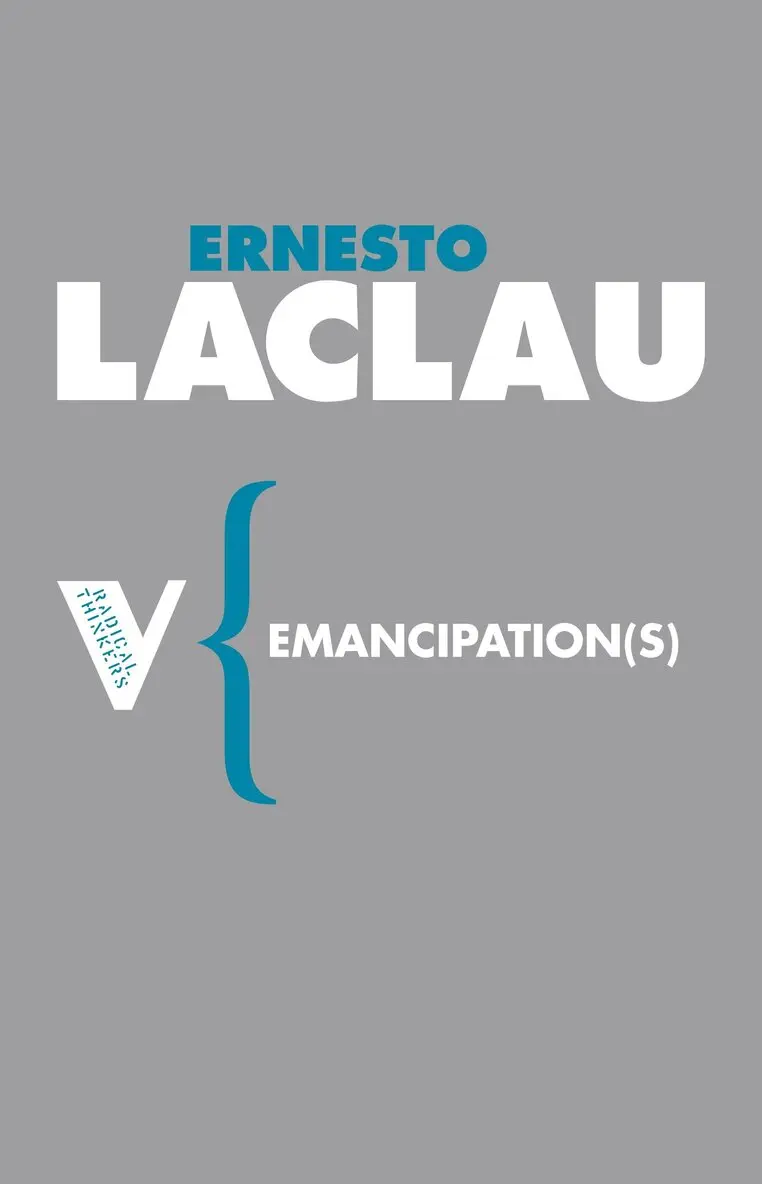
In Emancipation(s), Ernesto Laclau addresses a central question: how have the changes of the last decade, together with the transformation in contemporary thought, altered the classical notion of "emancipation" as formulated since the Enlightenment? Our visions of the future and our expectations of emancipation, have been deeply affected by the changes of recent history: the end of the Cold War, the explosion of new ethnic and national identities, the social fragmentation under late capitalism, and the collapse of universal certainties in philosophy and social and historical thought. Laclau here begins to explore precisely how our visions of emancipation have been recast under these new conditions. Laclau examines the internal contradictions of the notion of "emancipation" as it emerged from the mainstream of modernity, as well as the relation between universalism and particularism which is inherent in it. He explores the making of political identities and the status of central notions in political theory such as "representation" and "power," focusing particularly on the work of Derrida and Rorty. Emancipation(s) is a significant contribution to the reshaping of radical political thought.
152 kr
Skickas
Written with his characteristic flair, Virillo's latest book is a trenchant denunciation of the Kosovo war in which he successfully unites theory with a riveting study of the conflict. Tearing aside the veil of hypocrisy in which the USA and its allies wrapped the war, Virillo demonstrates that the nature of the bombing was set by strategic rather than ethical considerations.Beneath the humanitarian rhetoric, Virillo sees a sinister innovation in the methods of waging war: territorial space is being replaced by orbital space in which a system of global telesurveillance is linked to the destructive power of bombers and missiles. Governments, the military and the media are becoming part of a seamless and self-justifying process linked by new information and arms technologies.Passionate and political, Strategy of Deception is a vital examination not only of the war in Yugoslavia but also what Virillo calls our "fin-de-siécle infantilization" in which the reality of battle is reduced to flickering images on a screen.
267 kr
Skickas inom 3-6 vardagar
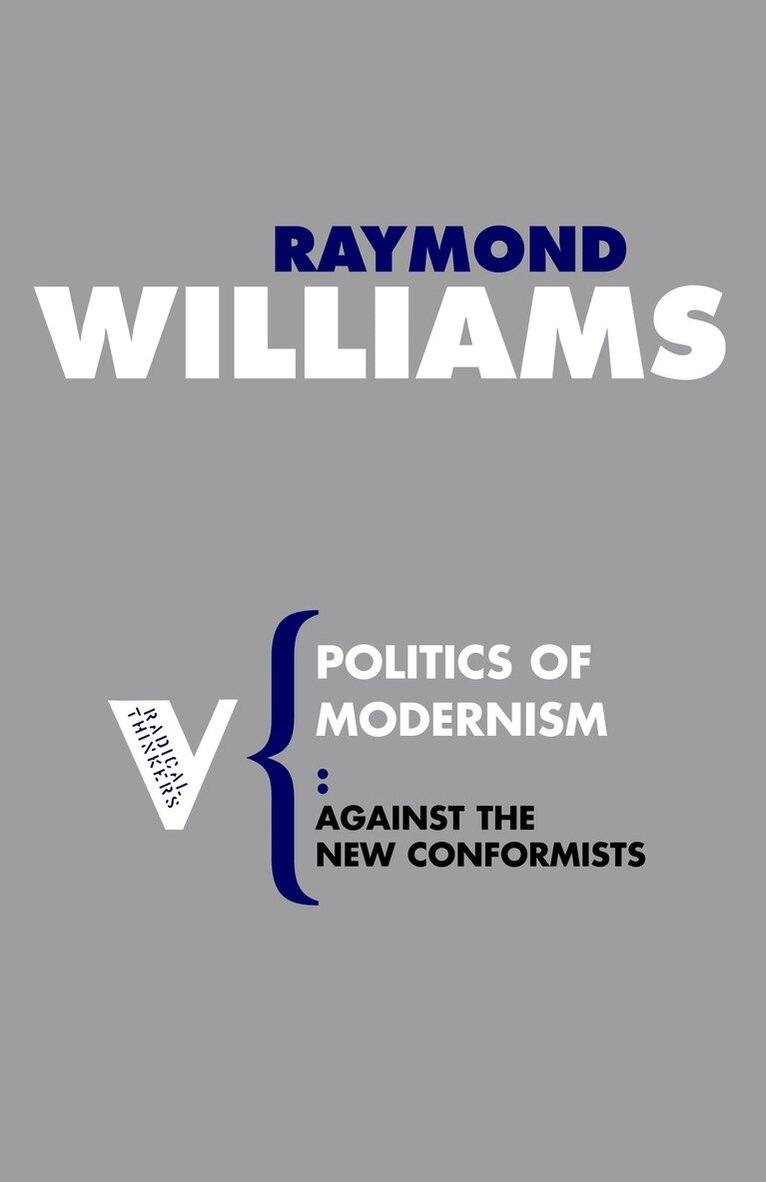
Considered to be the founding father of British cultural theory, Williams was concerned throughout his life to apply a materialist and socialist analysis to all forms of culture, defined generously and inclusively as "structures of feeling." In this major work, Williams applies himself to the problem of modernism. Rejecting stereotypes and simplifications, he is especially preoccupied with the ambivalent relationship between revolutionary socialist politics and the artistic avant-garde. Judiciously assessing the strengths and weaknesses of the modernist project, Williams shifts the framework of discussion from merely formal analysis of artistic techniques to one which grounds these cultural expressions in particular social formations. Animating the whole book is the question which Williams poses and brings us significantly closer to answering: namely, what does it mean to develop a cultural analysis that goes "beyond the modern" and yet avoids the trap of postmodernism's "new conformism"?
267 kr
Skickas inom 3-6 vardagar
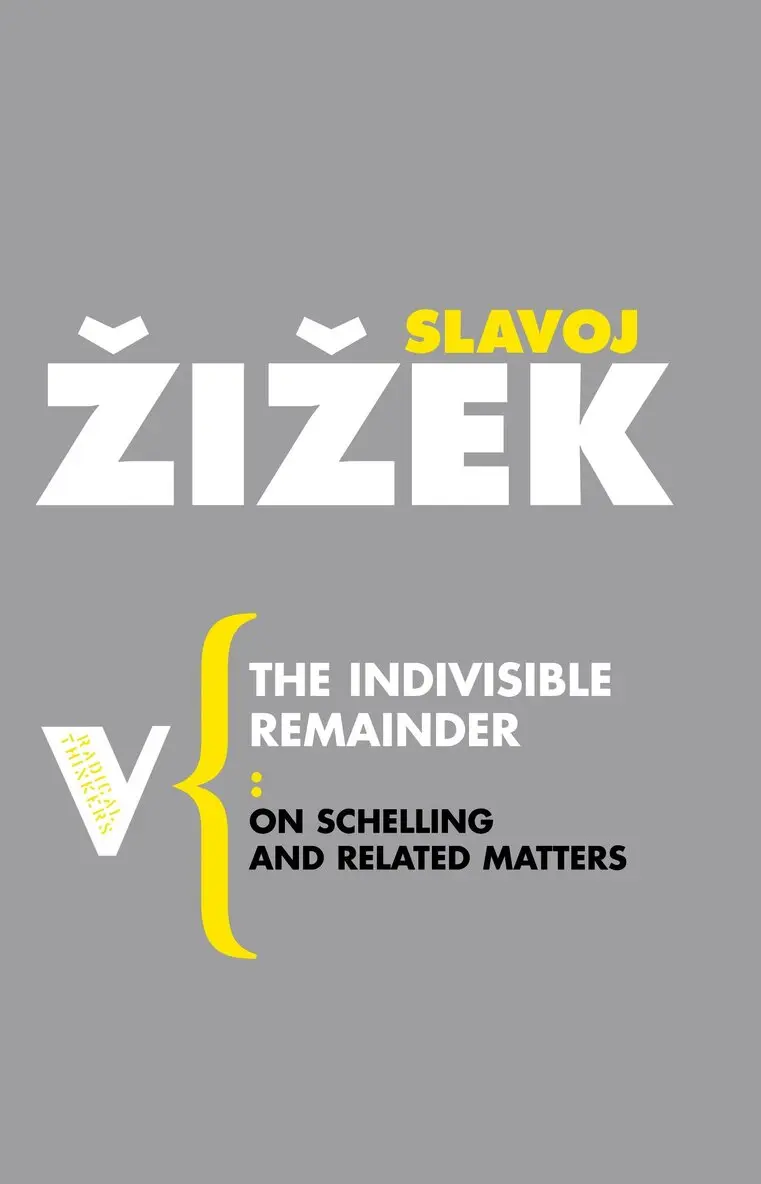
The feature which distinguishes the great works of materialist thought, from Lucretius' De rerum natura through Capital to the writings of Lacan, is their unfinished character: again and again they tackle their chosen problem. Schelling's Weltalter drafts belong to this same series, with their repeated attempt at the formulation of the 'beginning of the world,' of the passage from the pre-symbolic pulsation of the Real to the universe of logos.F.W.J. Schelling, the German idealist who for too long dwelled in the shadow of Kant and Hegel, was the first to formulate the post-idealist motifs of finitude, contingency and temporality. His unique work announces Marx's critique of speculative idealism, as well as the properly Freudian notion of drive, of a blind compulsion to repeat which can never be sublated in the ideal medium of language.The Indivisible Remainder begins with a detailed examination of the two works in which Schelling's speculative audacity reached its peak: his essay on human freedom and his drafts on the "Ages of the World." After reconstituting their line of argumentation, Slavoj Zizek confronts Schelling with Hegel, and concludes by throwing a Schellingian light on some "related matters": the consequences of the computerization of daily life for sexual experience; cynicism as today's predominant form of ideology; the epistemological deadlocks of quantum physics.Although the book is packed with examples from politics and popular culture - the unmistakable token of Zizek's style - from Speed and Groundhog Day to Forrest Gump, it signals a major shift towards a systematic concern with the basic questions of philosophy and the roots of the crisis of our late-capitalist universe, centred around the enigma of modern subjectivity.