Supercritical Fluid Science and Technology - Böcker
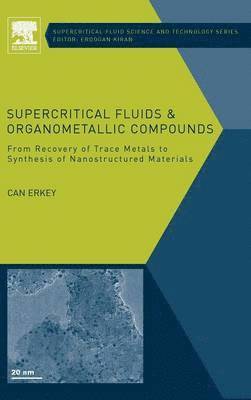
Supercritical Fluids and Organometallic Compounds
From Recovery of Trace Metals to Synthesis of Nanostructured Materials
3 413 kr
Skickas inom 5-8 vardagar
High-Pressure Fluid Phase Equilibria
Phenomenology and Computation
2 020 kr
Skickas inom 7-10 vardagar
High pressures play a more and more important role in modern technology. Examples are the supercritical fluid extraction of medical drugs and dyes from biological material, the handling of compressed or liquefied gases (including natural gas or hydrogen), the operation of modern thermal power plants, and various technical processes for controlled particle formation. High-Pressure Fluid Phase Equilibria, Second Edition enables understanding of the complicated phase behavior that fluid or fluid mixtures (liquids, gases, or supercritical phases) can exhibit at elevated pressures. The underlying thermodynamic equations are explained, and robust algorithms for the computation of such equilibria (including solid-fluid equilibria) are proposed.Since the publication of the first edition of this book, there have been many new developments, for instance, differential equation methods for the computation of phase equilibria, accurate numerical differentiation, and high-precision equations of state (e.g., the GERG model). Moreover, more detail and explanation has been added on important topics that were only briefly examined in the original book to better assist the reader, such as expansion processes and chemical reactions).The book remains invaluable as a single resource for grasping the intricacies of fluid phase behavior. It enables the readers to write or improve their own computer programs for the calculation of phase equilibria. It will appeal to graduate students of chemical engineering and university research staff involved in chemical engineering of supercritical fluids or the physical chemistry of fluids; the book can also serve as the basis of lectures or advanced students' seminars.
Comprehensively presents the complex world of phase equilibria (binary and ternary) and the various methods for computing phase equilibria, whilst carefully considering the relevant pressure and temperature rangesIntroduces phase diagram classes, how to recognize them, and how to identify their characteristic featuresPresents rational nomenclature of binary fluid phase diagramsIncludes problems and solutions for self-testing, exercises, or seminarsNew to this Edition: Presentation of the phase equilibria models is extended and expandedThere are now more descriptions on more equations of state, especially the PCSAFT EoSFeatures new chapter on nonisothermal applications and chemically reactive systems and extensive updates and additions to all existing chaptersDynamic Responses of Supercritical Fluids
Experimental Investigations on Non-Linear Effects Across the Widom Region and Near-Critical Phase Transitions
2 020 kr
Kommande
Dynamic Responses of Supercritical Fluids: Experimental Investigations on Non-Linear Effects Across the Widom Region and Near-Critical Phase Transitions provides comprehensive information on the experimental techniques that can be used to measure the dynamic responses of near-to supercritical fluids, along with an overview of the related physical phenomena involved. This book is ideal for applied physicists, engineers, and graduate and doctoral students in chemical engineering, process engineering, and aerospace engineering.At the transition from liquid or gaseous fluid states into the supercritical regime, the macroscopic fluid response functions experience maxima, which results in a non-linear coupling between small perturbations in pressure and temperature and compressible flow dynamics. By applying laser-induced thermal acoustics, also known as laser-induced (transient) grating spectroscopy, the fluid response to an acoustic, pressure, and thermal perturbation can be investigated. Specifically, speed of sound, thermal diffusivities, and acoustic damping rates, are measured. And, by applying thermodynamic model, the latter are used to determine volume viscosities at near- to supercritical fluid states. Finally, by applying polarized Mie scattering, insights on the type of phase transitions can be inferred together with quantitative data on the average size, and droplet size distribution can be obtained.
Includes clearly presented experimental and theoretical methods for understanding dynamic processes under supercritical conditions and the outcomes that resultGives the reader physical understanding of the supercritical fluid responses and the related anomalous fluid phenomena such as pseudo-boiling and thermo-convective instabilitiesIntroduces measurement techniques, including laser-induced thermal acoustics (LITA), polarized Mie scattering, and applying structured laser illuminated planar imaging (SLIPI) at high pressure conditionsLooks at the experimental values of acoustic attenuation, speed of sound and thermal conductivities at the transition from near- to supercritical fluid conditionsIncludes Macroscopic investigations in the Widom line region and the fluid transitions across the Widom line2 020 kr
Kommande
Introduction to Supercritical Fluids, Second Edition provides an accessible overview of elementary supercritical fluid processes (extraction, particle formation, mass transfer, heat exchangers, phase equilibrium, chemical reaction equilibrium) supported by easy-to-use Excel spreadsheets suitable for both specialized-discipline (chemistry or chemical engineering student) and mixed-discipline (engineering/economic student) classes. Each chapter contains worked examples, tip boxes and end-of-the-chapter problems and projects.Part I covers web-based chemical information resources, applications and simplified theory presented in a way that allows students of all disciplines to delve into the properties of supercritical fluids and to design energy, extraction and materials formation systems for real-world processes that use supercritical water or supercritical carbon dioxide.Part II takes a practical approach and addresses the thermodynamic framework, equations of state, fluid phase equilibria, mass transfer (newly added), heat transfer and cycle analysis (newly added), chemical equilibria and reaction kinetics of supercritical fluids. Spreadsheets are arranged as Visual Basic for Applications (VBA) functions and macros that are completely (source code) accessible for students who have interest in developing their own programs. Programming is not required to solve problems or to complete projects in the text.Introduction to Supercritical Fluids, Second Edition is written primarily for graduate students and researchers in chemistry, chemical engineering, and materials science.
Provides an overview of elementary supercritical fluid processes (extraction, particle formation, heat exchangers, phase equilibrium, chemical reaction equilibrium)Each chapter contains practical activities with worked examples, tip boxes and end-of-the-chapter problems and projects for the readerContains new and updated worked examples suitable for both introductory and advanced level students and fully updated Excel VBA Worksheet functions that can be used "as-is" to perform "hands-on" calculations, simulations and analyses of supercritical fluid processes and allow users to design their own processesIncludes helpful teaching aids that will simplify instruction of both introductory level students and advanced students about the merits and applications of supercritical fluidsFluid phase equilibria and chemical equilibria worksheets allow users to change conditions, study new solutes, co-solvents, chemical systems, or reactionsNew to this edition: New comprehensive chapters or sections on Mass transfer, Heat Transfer, Pinch analysis, AI-assisted approaches, Commercial applications, Phase Behavior, with all previous material and VBA Worksheets being fully updatedNew improved comprehensive property calculation worksheets for water and carbon dioxide that simplify teaching of supercritical fluid properties to large classesPhase Equilibrium Engineering
2 142 kr
Kommande
Phase Equilibrium Engineering, Second Edition, Volume Thirteen offers a comprehensive study on the application of phase equilibrium tools for chemical process development. This updated edition shifts the focus from computing phase equilibria using thermodynamic relationships to designing and controlling phase conditions essential for various processes. The book emphasizes thermodynamic modeling of mixtures crucial for process synthesis, simulation, design, and optimization, providing updated chapters, new sections, case studies, and additional chapters based on the latest experimental work. The book delves into the relationship between mixture molecular properties, the selection of thermodynamic models, and applicable process technologies.It includes a classification of mixtures, separation processes, thermodynamic models, and technologies to guide engineers. The phase conditions required for reacting systems at subcritical and supercritical conditions are studied. The four cardinal points of phase equilibrium engineering-chemical plant/process, laboratory, phase equilibria modeling, and simulation-are harmonized to improve the design and operation of chemical processes.
Includes methodologies that are discussed using relevant industrial examplesProvides phase equilibrium diagrams that are used as a drawing board for process implementationFocuses on high pressure lab work and thermodynamic modeling of behavior of complex mixtures with new chapters includedUpdates existing chapters where appropriate, including new case studies and researchSupercritical Fluid Technology for Food Processing
Fundamentals and Applications
1 934 kr
Kommande
2 349 kr
Kommande
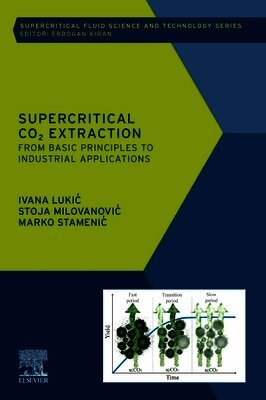
Supercritical fluid extraction (SFE) has become one of the most recognized and widely applied technologies in green processing, with supercritical carbon dioxide (scCO2) leading the way as the fluid of choice. It represents not only the first but also the most established industrial application of supercritical fluids, paving the path from laboratory research to large-scale production.This book brings together and systematizes the current state of knowledge on scCO2 extraction, offering both a comprehensive overview and practical insights. It begins with an accessible introduction to the unique properties of scCO2, followed by a clear explanation of the principles and operation of SFE. A broad spectrum of applications is then explored, ranging from plant materials to non-plant sources, agricultural residues, and food by-products, highlighting the versatility and growing potential of this technology.In addition to practical case studies, the book addresses modelling strategies and scale-up considerations, providing valuable guidance for translating experimental findings into industrial practice. Special emphasis is placed on integrated processes and real-world examples, showcasing how SFE has successfully bridged the gap between science and industry. The final chapter looks toward the future, outlining the challenges and opportunities that will shape the next generation of scCO2-assisted technologies.Supercritical CO2 Extraction is intended for master’s and PhD students in chemical engineering, biotechnology, food engineering, pharmaceutical sciences, and process engineering. It also serves as an essential resource for industry professionals seeking to understand and apply one of the most promising technologies in sustainable extraction.
Book offers a comprehensive and up-to-date overview of scCO2 extraction of bioactive compounds from a wide range of natural sources.Bridges theory and practice by moving from fundamental principles of scCO2 extraction to practical applications across diverse industrial contexts.Provides practical guidelines for modelling and scale-up, supporting the translation of laboratory research into industrial processes.Showcases real-world success stories to illustrate how SFE has transitioned from research innovation to established industrial practice.Highlights emerging opportunities and future directions for the SFE process.Introduction to Supercritical Fluids
A Spreadsheet-based Approach
1 910 kr
Skickas inom 7-10 vardagar
This text provides an introduction to supercritical fluids with easy-to-use Excel spreadsheets suitable for both specialized-discipline (chemistry or chemical engineering student) and mixed-discipline (engineering/economic student) classes. Each chapter contains worked examples, tip boxes and end-of-the-chapter problems and projects.
Part I covers web-based chemical information resources, applications and simplified theory presented in a way that allows students of all disciplines to delve into the properties of supercritical fluids and to design energy, extraction and materials formation systems for real-world processes that use supercritical water or supercritical carbon dioxide.
Part II takes a practical approach and addresses the thermodynamic framework, equations of state, fluid phase equilibria, heat and mass transfer, chemical equilibria and reaction kinetics of supercritical fluids. Spreadsheets are arranged as Visual Basic for Applications (VBA) functions and macros that are completely (source code) accessible for students who have interest in developing their own programs. Programming is not required to solve problems or to complete projects in the text.
Property worksheets/spreadsheets that are easy to use in learning environments Worked examples with Excel VBA Worksheet functions allow users to design their own processes Fluid phase equilibria and chemical equilibria worksheets allow users to change conditions, study new solutes, co-solvents, chemical systems or reactionsPhase Equilibrium Engineering
2 566 kr
Skickas inom 3-6 vardagar
Traditionally, the teaching of phase equilibria emphasizes the relationships between the thermodynamic variables of each phase in equilibrium rather than its engineering applications. This book changes the focus from the use of thermodynamics relationships to compute phase equilibria to the design and control of the phase conditions that a process needs.
Phase Equilibrium Engineering presents a systematic study and application of phase equilibrium tools to the development of chemical processes. The thermodynamic modeling of mixtures for process development, synthesis, simulation, design and optimization is analyzed. The relation between the mixture molecular properties, the selection of the thermodynamic model and the process technology that could be applied are discussed. A classification of mixtures, separation process, thermodynamic models and technologies is presented to guide the engineer in the world of separation processes. The phase condition required for a given reacting system is studied at subcritical and supercritical conditions.
The four cardinal points of phase equilibrium engineering are: the chemical plant or process, the laboratory, the modeling of phase equilibria and the simulator. The harmonization of all these components to obtain a better design or operation is the ultimate goal of phase equilibrium engineering.
Methodologies are discussed using relevant industrial examples The molecular nature and composition of the process mixture is given a key role in process decisions Phase equilibrium diagrams are used as a drawing board for process implementationHydrothermal and Supercritical Water Processes
1 910 kr
Skickas inom 7-10 vardagar
Hydrothermal and Supercritical Water Processes presents an overview on the properties and applications of water at elevated temperatures and pressures. It combines fundamentals with production process aspects. Water is an extraordinary substance. At elevated temperatures (and pressures) its properties change dramatically due to the modifications of the molecular structure of bulk water that varies from a stable three-dimensional network, formed by hydrogen bonds at low and moderate temperatures, to an assembly of separated polar water molecules at high and supercritical temperatures. With varying pressure and temperature, water is turned from a solvent for ionic species to a solvent for polar and non-polar substances. This variability and an enhanced reactivity of water have led to many practical applications and to even more research activities, related to such areas as energy transfer, extraction of functional molecules, unique chemical reactions, biomass conversion and fuel materials processing, destruction of dangerous compounds and recycling of useful ones, growth of monolithic crystals, and preparation of metallic nanoparticles.
This book provides an introduction into the wide range of activities that are possible in aqueous mixtures. It is organized to facilitate understanding of the main features, outlines the main applications, and gives access to further information
Summarizes fundamental properties of water for engineering applications Compares process and reactor designs Evaluates processes from thermodynamic, economic, and social impact viewpointsParticle Formation with Supercritical Fluids
Challenges and Limitations
1 910 kr
Skickas inom 7-10 vardagar
In situ Spectroscopic Techniques at High Pressure
1 446 kr
Skickas inom 7-10 vardagar
In situ Spectroscopic Techniques at High Pressure provides a comprehensive treatment of in-situ applications of spectroscopic techniques at high pressure and their working principles, allowing the reader to develop a deep understanding of which measurements are accessible with each technique, what their limitations are, and for which application each technique is best suited.
Coverage is also given to the instrumental requirements for these applications, with respect to the high pressure instrumentation and the spectroscopic components of the equipment.
The pedagogical style of the book is supplemented by the inclusion of "study questions" which aim to make it useful for graduate-level courses.
Bridges the gap between supercritical fluid science/technology and in-situ spectroscopic techniques Provides a powerful guide to applying spectroscopic techniques as gainful sensors at high pressure Highlights the influence of a high pressure environment and high pressure equipment on spectroscopic techniques Presents a deep understanding of which measurements are accessible with each technique, what their limitations are, and for which application each technique is best suitedFoaming with Supercritical Fluids
2 142 kr
Skickas inom 7-10 vardagar
Foaming with Supercritical Fluids, Volume Nine provides a comprehensive description of the use of supercritical fluids as blowing agents in polymer foaming. To this aim, the fundamental issues on which the proper design and control of this process are rooted are discussed in detail, with specific attention devoted to the theoretical and experimental aspects of sorption thermodynamics of a blowing agent within a polymer, the effect of the absorbed blowing agent on the thermal, interfacial and rheological properties of the expanding matter, and the phase separation of the gaseous phase, and of the related bubble nucleation and growth phenomena.
Several foaming technologies based on the use of supercritical blowing agents are then described, addressing the main issues in the light of the underlying chemical-physical phenomena.
Offers strong fundamentals on polymer properties important on foaming Outlines the use of supercritical fluids for foaming Covers theoretical points-of-view, including foam formation of the polymer/gas solution to the setting of the final foam Discusses the several processing technologies and applicationsSynthesis of Nanostructured Materials in Near and/or Supercritical Fluids
Methods, Fundamentals and Modeling
1 898 kr
Skickas inom 7-10 vardagar
Synthesis of Nanostructured Materials in Near and/or Supercritical Fluids: Methods, Fundamentals and Modeling offers a comprehensive review of the current status of research, development and insights on promising future directions, covering the synthesis of nanostructured materials using supercritical fluid-based processes. The book presents fundamental aspects such as high-pressure phase behavior of complex mixtures, thermodynamics and kinetics of adsorption from supercritical solutions, mechanisms of particle formation phenomena in supercritical fluid-based processes, and models for further development. It bridges the gap between theory and application, and is a valuable resource for scientists, researchers and students alike.
Includes thermodynamic and mass transfer data necessary for industrial plant design Explains the mechanisms of reactions in a supercritical fluid environment Lists numerous industrial processes for the production of many consumer products