The Collected Works of Rudolf Carnap – Serie
Visar alla böcker i serien The Collected Works of Rudolf Carnap. Handla med fri frakt och snabb leverans.
2 produkter
2 produkter
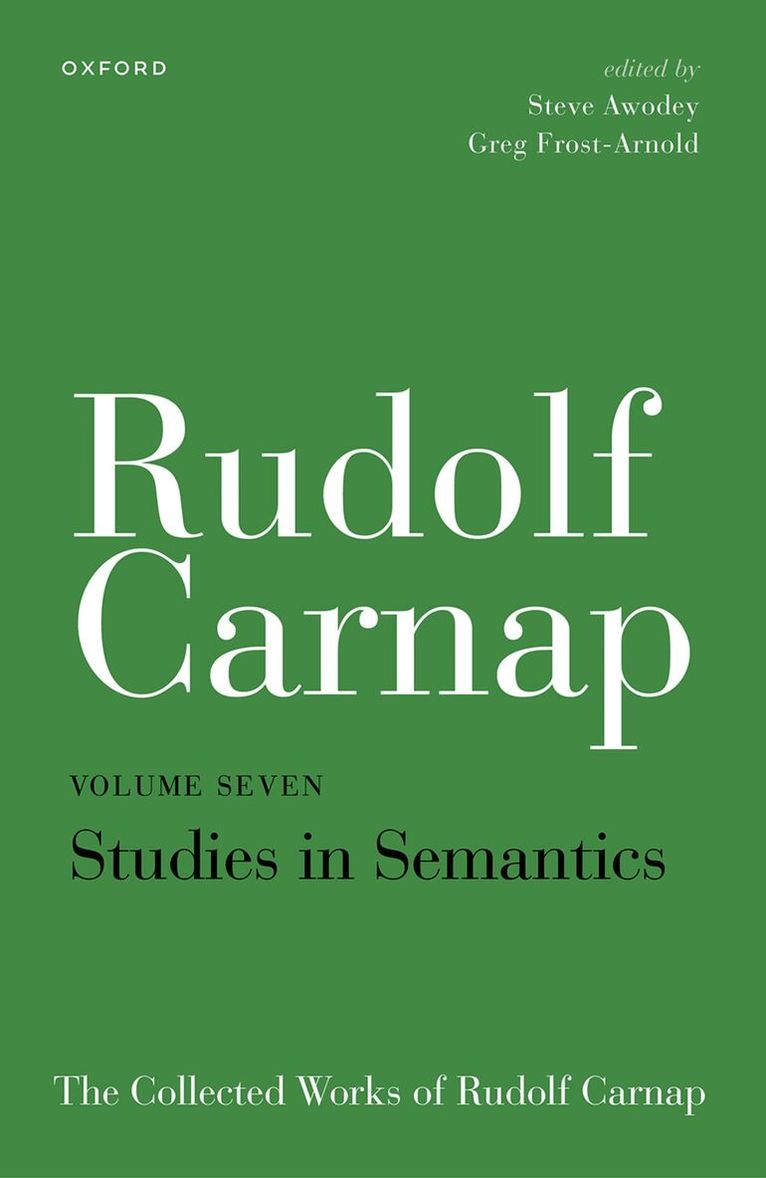
Rudolf Carnap: Studies in Semantics
The Collected Works of Rudolf Carnap, Volume 7
Inbunden, Engelska, 2024
1 661 kr
Skickas inom 5-8 vardagar
This volume contains Carnap's Studies in Semantics, a series of three interlocking books: Introduction to Semantics (1942), Formalization of Logic (1942), and Meaning and Necessity (1947). They were extremely influential in their time, especially the third, and shaped the direction of analytic philosophy during the 1950s and 1960s. They constitute the background to a number of celebrated controversies of that period, especially those between Carnap and Quine. Most of the philosophical debates today in philosophical logic and the philosophy of language ultimately had their origins here. This new edition situates these works in their context, both within Carnap's philosophical development and within the philosophical debates they responded to and influenced.The editors' introduction explains how Carnap arrived at the project of semantics in the 1930s and how it developed into these three successive publications, how the three books fit together, and how the project developed and changed in the course of the 1940s. It also describes the reception of the books as they appeared, as well as Carnap's response. The editorial and textual notes give variant readings, Carnap's own marginal notes on these texts in his personal copies, and elucidatory commentary where Carnap's terminology or notation are no longer familiar. This will be an indispensable volume for anyone interested in the origins and preoccupations of present-day analytic philosophy, especially philosophical logic and philosophy of language.
1 498 kr
Skickas inom 5-8 vardagar
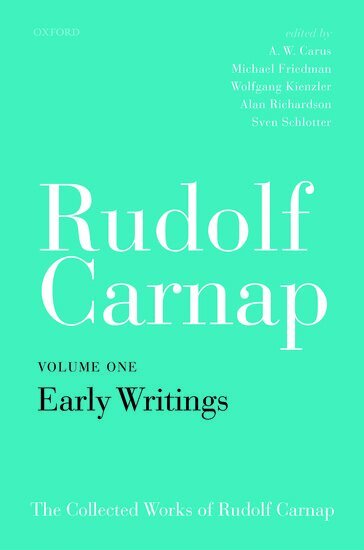
Rudolf Carnap (1891-1970) is generally acknowledged to have been one of the central figures of twentieth-century philosophy. He was the leading philosopher of the Vienna Circle, a group that was central to the international movement known as logical empiricism, which pursued the goal of making philosophy scientific and eliminating metaphysics that went beyond the limits of what humans can coherently comprehend. Carnap was not only well-versed in this area of thought but also contrary ideas; he interacted philosophically with Gottlob Frege, Bertrand Russell, Ludwig Wittgenstein, Edmund Husserl, and Martin Heidegger, and in his formative years he was influenced by the positivists Mach and Ostwald, neo-Kantians such as Cassirer and Natorp, and Husserl's phenomenology. Interest in logical empiricism waned in the decades following Carnap's death but was revived towards the end of the twentieth century; the wave of new scholarship that resulted identified Carnap as far more subtle and interesting than was previously understood.The complete fourteen-volume edition of Carnap's published writings builds upon these more recent interpretations of his philosophy. This first book contains Carnap's early publications up until 1928, none of which have previously been translated from their original German. The introduction and notes place the text in the relevant scientific and historical contexts, in addition to explaining obscure references or outdated notation and terminology. Carnap's neo-Kantian origins are more obvious in these works than in his later writings, and the overall figure which emerges from this volume is a very different Carnap to the caricature that many philosophers will know.