Values in Italian Philosophy – serie
Visar alla böcker i serien Values in Italian Philosophy. Handla med fri frakt och snabb leverans.
2 produkter
2 produkter
779 kr
Skickas inom 5-8 vardagar
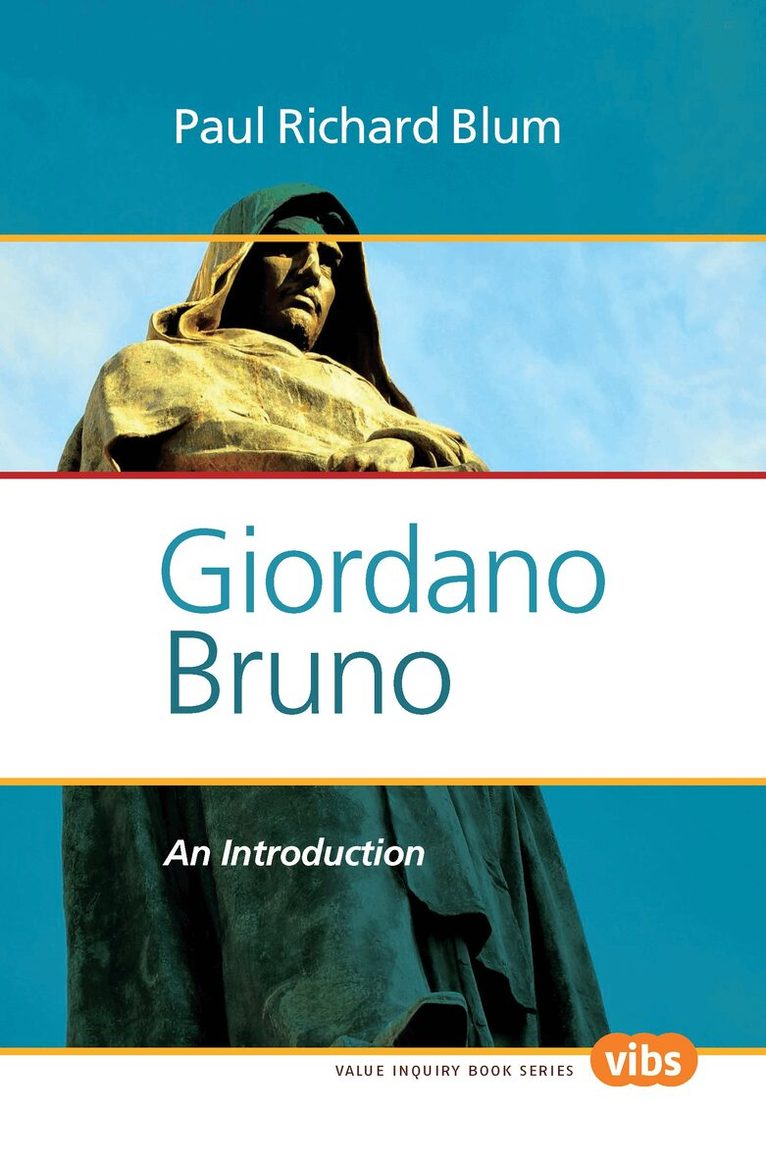
Giordano Bruno (1548-1600) was a philosopher in his own right. However, he was famous through the centuries due to his execution as a heretic. His pronouncements against teachings of the Catholic Church, his defence of the cosmology of Nicholas Copernicus, and his provocative personality, all this made him a paradigmatic figure of modernity. Bruno’s way of philosophizing is not looking for outright solutions but rather for the depth of the problems; he knows his predecessors and their strategies as well as their weaknesses, which he exposes satirically. This introduction helps to identify the original thought of Bruno who proudly said about himself: “Philosophy is my profession!” His major achievements concern the creativity of the human mind studied through the theory of memory, the infinity of the world, and the discovery of atomism for modernity. He never held a permanent office within or without the academic world. Therefore, the way of thinking of this “Knight Errant of Philosophy” will be presented along the stations of his journey through Western Europe.
Del 37 - Values in Italian Philosophy
Art of Rhetoric (Institutiones Oratoriae, 1711-1741)
From the definitive Latin text and notes, Italian commentary and introduction by Giuliano Crifò. Translated and Edited by Giorgio A. Pinton and Arthur W. Shippee
Häftad, Engelska, 1996
916 kr
Skickas inom 3-6 vardagar
Gustavo Costa reviewing the Italian edition of Vico's Institutiones Oratoriae in New Vico Studies 9 (1991), has written that Rhetoric is the mainspring of an important trend of Vichian studies which initiated at the beginning of the twentieth century and had its manifestation in John D. Schaeffer's Sensus Communis: Vico, Rhetoric, and the Limits of Relativism (Durham: Duke University Press, 1990), where Schaeffer aptly noted, summing up a long exegetic tradition, Vico was imbued with rhetoric and convinced of its centrality to Western civilization. Unfortunately, the editions of Vico's works published in English have not yet included the Institutiones Oratoriae, which more or less reflects the lectures on rhetoric given by Vico at the University of Naples, starting with the academic year 1699-1700 and going through 1739-1741. The manual on rhetoric was used in Italy up to the end of the nineteenth century and established the common curriculum in rhetoric to be followed in all Universities. This English edition offers a text of the Institutiones complete on the base of the four known extant manuscripts. It offers the marginal glosses made by Vico's students, a collection of Vico's phrases and explanations of terms collected by some of the students, a glossary of Latin words and rhetorical terms from the Latin text, and a wealth of information in the commentary. The Art of Rhetoric is the manual for everyone who wants to know what rhetoric is, how it was employed in the forum or the courts, how it could be learned from the classic orators, and how it can be used whenever we speak for convincing, praising or motivating.