What Do I Do Now Emergency Medicine - Böcker
Visar alla böcker i serien What Do I Do Now Emergency Medicine. Handla med fri frakt och snabb leverans.
9 produkter
9 produkter
607 kr
Skickas inom 5-8 vardagar
Part of the "What Do I Do Now?: Emergency Medicine" series, Legal and Ethical Issues in Emergency Medicine uses a case-based approach to cover common and important topics in the legal and ethical dilemmas that surface in the practice of emergency medicine. Each unique case draws upon the four well-established principles of bioethics: beneficence, non-maleficence, respect for autonomy, and justice. Other ethical principles, such as honesty and personal integrity, are also addressed. Chapters are rounded out by key points to remember and selected references for further reading. Legal and Ethical Issues in Emergency Medicine addresses a wide range of topics including HIPPA and confidentiality, advance directives, suicidal patients, refusal of care, expert witness testimony, and more. This book is an engaging collection of thought-provoking cases which clinicians can utilize when they encounter difficult situations in the emergency department. The volume is also a self-assessment tool that tests the reader's ability to answer the question, "What do I do now?"
661 kr
Skickas
Many emergency clinicians encounter a gap in knowledge and skills when presented with serious life-threatening illness, particularly in patients with advanced and terminal illness. Over the last decade, studies have shown that patients who receive palliative care in the emergency setting have improved clinical outcomes with better symptom management, improved goal concordant care, and more effective resource utilization that delivers improved patient centered outcomes. Palliative Care in Emergency Medicine is intended to serve as a practical resource to the essential clinicians on the frontlines of emergency care.Dr. Quest brings together emergency medicine clinicians and palliative care subspecialists to discuss common, challenging cases that clinicians struggle with daily regarding care for patients and families experiencing serious, life threatening, and terminal illnesses. Each chapter opens with a typical emergency department clinical case, followed by a discussion, conclusion, and suggested readings that explore the topic in more depth. Palliative Care in Emergency Medicine equips emergency clinicians to meet seriously ill patients and family wherever they are and provide the best care possible.
709 kr
Skickas inom 5-8 vardagar
Written for residents and practicing community emergency physicians, this volume on critical care emergencies in the What Do I Do Now: Emergency Medicine series uses a case-based approach to cover both common and unique scenarios in critical care emergencies. Featuring chapters written by critical care and emergency medicine trained physicians, this volume provides a unique perspective on the ongoing management of critical illness with a focus on guideline-based protocol care based on national and local recommendations for common presentations such as pneumonia, acute myocardial infarction, or trauma. This volume reviews frequently-encountered diagnoses, procedures, clinical recommendations, and management problems. Brief summaries included at the end of each chapter supply the practicing clinician a quick point-of-care reference during a shift.Critical Care Emergencies is an engaging collection of thought-provoking cases which provides relevant reading for on-clinical shift trainees and for practicing EM physicians who need a refresher. The volume is also a self-assessment tool that tests the reader's ability to answer the question, "What do I do now?"
769 kr
Skickas inom 5-8 vardagar
Part of the “What Do I Do Now?: Emergency Medicine” series, Pediatric Traumatic Emergencies uses a case-based approach to cover common and important topics in the examination, investigation, and management of injured children. Each chapter provides a discussion of the diagnosis, key points to remember, and selected references for further reading. Areas of controversy are clearly delineated with a discussion regarding evidence-based options and a balanced view of treatment and disposition decisions. The book addresses a wide range of topics including hemorrhage, chest trauma, abdominal marks, clavicle fractures, and more. Pediatric Traumatic Emergencies is an engaging collection of thought-provoking cases which clinicians can utilize when they encounter difficult pediatric patients. The volume is also a self-assessment tool that tests the reader's ability to answer the question, "What do I do now?"Advance Praise for Pediatric Traumatic Emergencies“The book contains an excellent review of the most common pediatric traumatic emergency cases and provides practitioners to a succinct and effective reference on hand that will help with the tricky nuances of pediatric traumas that are often glossed over. As an ATLS instructor I found the descriptions of the traumatic presentations and follow-up questions to ask concerning patients with head injuries an extremely accurate section. As pediatric trauma is the number one cause of mortality in the age range, having this information available for reference to those less familiar may be vital to saving lives.” -- Ian Hoffman, MD FAAP, Attending Physician, Pediatric Emergency Medicine, Weill Cornell Medical College - New York Presbyterian, New York, NY
607 kr
Skickas inom 5-8 vardagar
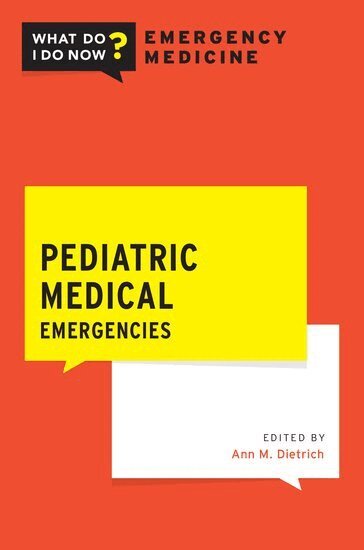
The first volume in the "What Do I Do Now?: Emergency Medicine" series, Pediatric Medical Emergencies uses a case-based approach to cover common and important topics in the examination, investigation, and management of acutely ill children. Each chapter provides a discussion of the diagnosis, key points to remember, and selected references for further reading. Areas of controversy are clearly delineated with a discussion regarding evidence-based options and a balanced view of treatment and disposition decisions. The book addresses a wide range of topics including neonatal fever, pediatric sepsis, intussusception, and more, and is suited for emergency medicine providers and pediatricians. Pediatric Medical Emergencies is an engaging collection of thought-provoking cases which clinicians can utilize when they encounter difficult pediatric patients. The volume is also a self-assessment tool that tests the reader's ability to answer the question, "What do I do now?"
613 kr
Skickas inom 5-8 vardagar
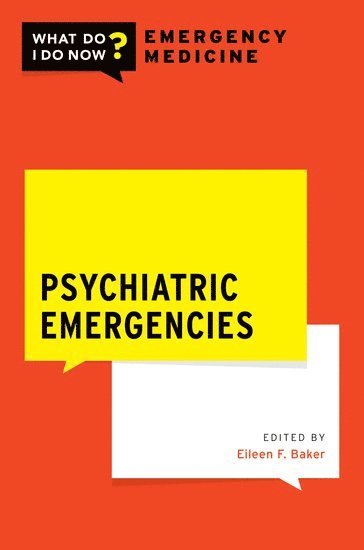
Part of the "What Do I Do Now?: Emergency Medicine" series, Psychiatric Emergencies uses a case-based approach to cover common and important topics in the examination, investigation, and management of psychiatric emergencies. Each chapter provides a discussion of the diagnosis, key points to remember, and selected references for further reading. The book addresses a wide range of topics including chemical sedation, suicide risk, personality disorders, malingering, cross-cultural issues, and more. Psychiatric Emergencies is an engaging collection of thought-provoking cases which clinicians can utilize when they encounter challenging situations and difficult psychiatric patients. The volume is also a self-assessment tool that tests the reader's ability to answer the question, "What do I do now?"
709 kr
Skickas inom 5-8 vardagar
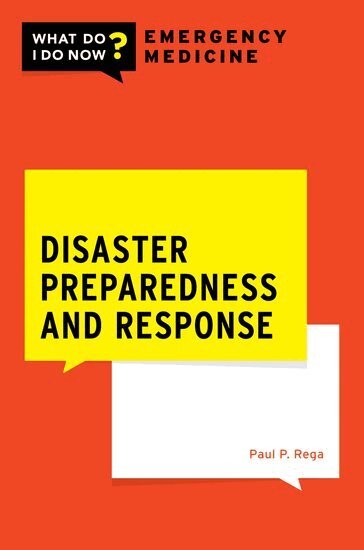
Disaster medicine has occupied an increasingly important niche within the specialty of emergency medicine over the latter half of the 20th century. Regardless of whether an event was natural, anthropogenic, or a combination of both, emergency medicine was and is the ideal discipline to develop the human resources, the strategies, the tactics, and the evidence- based research to elevate the field of disaster medicine. It began, organizationally speaking, with Hurricane Hugo in 1989 and it is continuing through the 2019 COVID- 19 pandemic and beyond.Now that we are well into the 21st century, we must steady our footing as a specialty on the 20th century's foundation so that we can wrestle with the more intricate challenges of the future. In the past two decades our global populations have experienced sectarian violence, wars, genocide, migration, terrorism, emerging infectious diseases, and pandemics. These natural and anthropogenic events will only worsen exponentially as we become intrinsically trapped by the effects of climate change. The United Nation's Intergovernmental Panel on Climate Change has recently concluded that regardless of how we try to reverse the effects of global warming, what we are experiencing now in terms of hurricanes, floods, and droughts will continue to worsen over the next 30 years. Should we, as a species, continue to equivocate and as global temperatures climb, these events will become more frequent and more catastrophic. "Catastrophic" may even be too mild a term. It is possible that over the next few years, the academic arm of emergency medicine may need to consider developing a curriculum devoted to "Cataclysmic Medicine."To confront these possibilities, there first needs to be a knowledge of disaster medicine and disaster management at its most basic level. It begins with crisis leadership, command and control, communications, and coordination. When all these pieces of the jigsaw puzzle are fitted together properly and enclosed by a proper ethical frame, then the best and most ethical and moral disaster medical can will be provided to the patient and to the community.The intent of this book is to introduce these concepts using diverse viewpoints and scenarios. Readers are challenged to cogitate, create, and layer their own set of building blocks upon the preexisting foundation, thereby reinforcing and sustaining their own capacity to prepare for and respond to any adverse eventuality, mass casualty or otherwise. I hope that the experiential and evidence- based contents of this book will inspire readers to delve deeper into the nuances of disaster medicine and will serve as an impetus for a more profound quest for knowledge and a desire to serve those who will be experiencing the worst moments of their lives.The intent of this book is to introduce these concepts using diverse viewpoints and scenarios. Readers are challenged to cogitate, create, and layer their own set of building blocks upon the preexisting foundation, thereby reinforcing and sustaining their own capacity to prepare for and respond to any adverse eventuality, mass casualty or otherwise. It is hoped that the experiential and evidence- based contents of this book will inspire readers to delve deeper into the nuances of disaster medicine and it will serve as an impetus for a more profound quest for knowledge and a desire to serve those who will be experiencing the worst moments of their lives.
677 kr
Skickas inom 5-8 vardagar
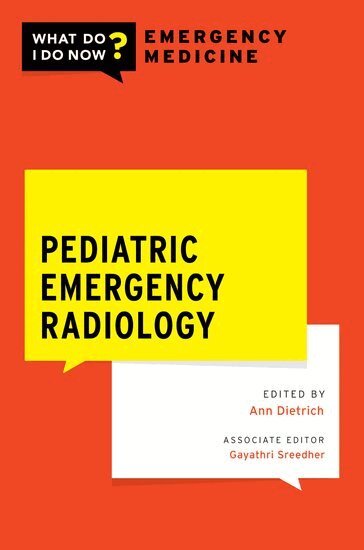
Part of the "What Do I Do Now?: Emergency Medicine" series, Pediatric Emergency Radiology uses a case-based approach to cover common and important topics in radiology imaging for pediatric emergency care. Each chapter provides a discussion of the diagnosis, key points to remember, and selected references for further reading. Areas of controversy are clearly delineated with a discussion regarding evidence-based options and a balanced view of treatment and disposition decisions. The book addresses a wide range of topics including neonatal respiratory distress, foreign body ingestion, Bronchiolitis, and related radiology issues faced by emergency medicine providers and pediatricians. Pediatric Emergency Radiology is an engaging collection of thought-provoking cases which clinicians can utilize for effective imaging of pediatric patients. The volume is also a self-assessment tool that tests the reader's ability to answer the question, "What do I do now?"
1 056 kr
Skickas inom 3-6 vardagar
Part of the “What Do I Do Now: Emergency Medicine” series, Medical Toxicology is an interactive, case-based book that covers content not found in most general specialty textbooks, and gives readers the opportunity to prepare for board certification and recertification, and to gain medical toxicology expertise without the need to perform a deep dive into the literature. The 34 chapters go beyond the basics of common and dangerous toxicities and provide the next step of care for complicated cases, as well as backgrounds to the pathophysiology of severe overdoses. It also addresses multiple overdoses, poisonings, and envenomations and supplements the information and recommendations of a poison center or toxicologist by providing background reasoning when a deep dive into a particular topic is not possible. Readers who are medical students, residents, advanced practice providers, staff physicians in emergency departments, hospitalists, and critical care providers will all find the content in this book stimulating, interactive, and a reliable resource that replicates a curbside consult with an expert.