World Bank Training Series - Böcker
Visar alla böcker i serien World Bank Training Series. Handla med fri frakt och snabb leverans.
3 produkter
3 produkter
327 kr
Skickas inom 10-15 vardagar
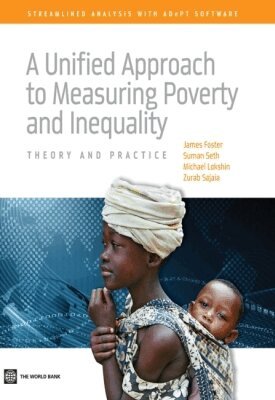
A Unified Approach to Measuring Poverty and Inequality: Theory and Practice is an introduction to the theory and practice of measuring poverty and inequality, as well as a user's guide for analyzing income or consumption distribution for any standard household dataset using the World Bank's ADePT software. The approach taken here considers income standards as building blocks for basic measurement, then uses them to construct inequality and poverty measures. This unified approach provides advantages in interpreting and contrasting the measures and in understanding the way measures vary over time and space. Several recent initiatives have lowered the cost of accessing household datasets. The ADePT software enables users to analyze microdata from household surveys and other sources and generate print-ready, standardized tables and charts. It can also be used to simulate the impact of economic shocks, cash transfers and other policy instruments on poverty, and inequality. The software automates analysis, helps minimize human errors, and encourages development of new economic analysis methods. Of interest to teachers and students as well as to policy practitioners, A Unified Approach to Measuring Poverty and Inequality will empower researchers to plumb greater depths in searching for regularity in larger and larger datasets. This book should help to enrich discussion and analysis relating to the World Bank's recent effort toward defining new targets and indicators for promoting work on eradicating poverty and enhancing shared prosperity.
501 kr
Skickas inom 10-15 vardagar
This book offers an accessible introduction to the topic of impact evaluation and its practice in development. While the book is geared principally towards development practitioners and policymakers designing prospective impact evaluations, we trust that it will be a valuable resource for students and others interested in using impact evaluation. Prospective impact evaluations should be used selectively to assess whether or not a program has achieved its intended results, or to test alternatives for achieving those results. We consider that more and better impact evaluation will help strengthen the evidence base for development policies and programs around the world. If governments and development practitioners can make policy decisions based on evidence - including evidence generated through impact evaluation - our hope is that development resources will be spent more effectively, and ultimately have a greater impact on reducing poverty and improving people’s lives. The three chapters in this handbook provide a non-technical introduction to impact evaluations, including “Why Evaluate” in Chapter 1, “How to Evaluate” in Chapter 2 and “How to Implement Impact Evaluations” in Chapter 3. These elements are the basic ‘tools’ needed in order to successfully carry out an impact evaluation.From a methodological standpoint our approach to impact evaluation is largely pragmatic: we think that the most appropriate methods should be identified to fit the operational context, and not the other way around. This is best achieved at the outset of the program, through the design of prospective impact evaluation that can be built into the project’s implementation. We argue that gaining consensus between key stakeholders and identifying an evaluation design that fits the political and operational context is as important as the method itself. We also believe strongly that impact evaluations should be upfront about their limitations and caveats. Finally, we strongly encourage policymakers and program managers to consider impact evaluations in a logical framework that clearly sets out the causal pathways by which the program works to produce outputs and influence final outcomes, and to combine impact evaluations with monitoring and selected complementary evaluation approach to gain a full picture of performance.
Building Better Policies
The Nuts and Bolts of Monitoring and Evaluation Systems
Häftad, Engelska, 2012
273 kr
Skickas inom 10-15 vardagar
Governments around the world face ongoing pressures from citizens to provide more and better services, and to do this while restraining taxation levels. This provides the context for government efforts to ensure their policies and programs are as effective, and as efficient, as possible. An emphasis on government performance has led a number of governments to create formal systems for monitoring and evaluating their performance-on a regular, planned, and systematic basis - with the objective of improving it.The focus of this book is on these government monitoring and evaluation (M&E) systems: what they comprise, how they are built and managed, and how they can be used to improve government performance.