• Fri frakt över 249 kr
  • •
  • Snabba leveranser
  • •
  • Billiga böcker
Kundservice

Du är på sajten för privatpersoner.

Företag, bibliotek eller offentlig verksamhet?

Du handlar på classic.bokus.com, där alla dina funktioner finns intakta.
Till classic.bokus.com
Bokus logotyp. Gå till startsidan.
  • Erbjudanden
  • Nyheter
  • Student
  • Topplistor
  • Barn & ungdom
  • Bokus Play
  • E-böcker
  • Pocketböcker
  • Spel & pussel

10% rabatt på allt med kod: NYSTART10 →

Sidfot

Mina sidor

    Hjälp

    • Kundservice
    • Vanliga frågor och svar
    • Frakt och leverans
    • Retur vid ångerrätt
    • Reklamera vara
    • Betalning
    • Köpvillkor
    • Allmänna villkor
    • Information om webbplatsens tillgänglighet

    Om Bokus

    • Om oss
    • Pressrum
    • För studenter
    • För företag
    • För bibliotek och offentlig verksamhet
    • För leverantörer
    • Hållbarhet

    Populärt

    • Aktuella erbjudanden
    • Presentkort
    • Studentlitteratur
    • Nya böcker
    • Topplistor
    • Signerade böcker
    • Engelska böcker

    Inspiration

    • Boktips
    • BookTok
    • Populära bokserier
    • Barnbokskaraktärer
    • Populära författare
    Logotyp för Bokus
    Följ oss på Facebook (extern länk)Följ oss på Instagram (extern länk)Följ oss på YouTube (extern länk)Följ oss på TikTok (extern länk)
    bokus @ CookiesAnpassa cookiesIntegritetspolicyKöpvillkor
    Till Citymail hemsida (extern länk)Till Budbee hemsida (extern länk)Till Postnord hemsida (extern länk)Till Schenker hemsida (extern länk)Till Early Bird hemsida (extern länk)Till Walleys hemsida (extern länk)
    1. Data och IT
    2. Programmeringsböcker

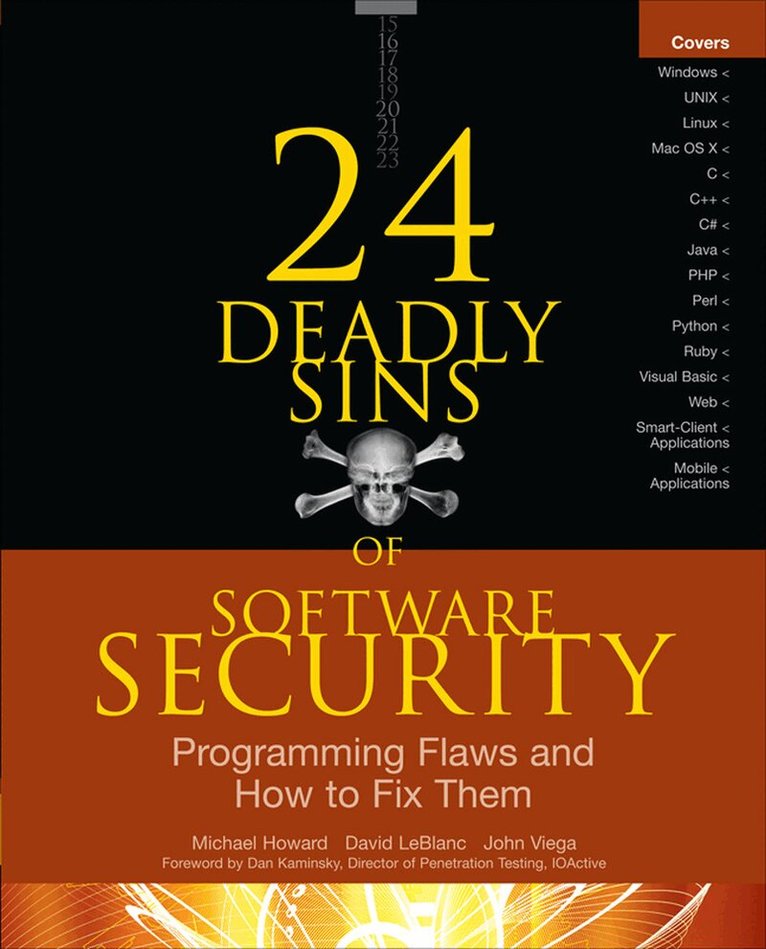
    24 Deadly Sins of Software Security: Programming Flaws and How to Fix Them

    AvMichael Howard,David LeBlanc

    Häftad, Engelska, 2009

    599 kr

    Beställningsvara. Skickas inom 3-6 vardagar. Fri frakt över 249 kr.

    Beskrivning

    Publisher's Note: Products purchased from Third Party sellers are not guaranteed by the publisher for quality, authenticity, or access to any online entitlements included with the product.


    Eradicate the Most Notorious Insecure Designs and Coding Vulnerabilities

    Fully updated to cover the latest security issues, 24 Deadly Sins of Software Security reveals the most common design and coding errors and explains how to fix each one-or better yet, avoid them from the start. Michael Howard and David LeBlanc, who teach Microsoft employees and the world how to secure code, have partnered again with John Viega, who uncovered the original 19 deadly programming sins. They have completely revised the book to address the most recent vulnerabilities and have added five brand-new sins. This practical guide covers all platforms, languages, and types of applications. Eliminate these security flaws from your code:

    • SQL injection
    • Web server- and client-related vulnerabilities
    • Use of magic URLs, predictable cookies, and hidden form fields
    • Buffer overruns
    • Format string problems
    • Integer overflows
    • C++ catastrophes
    • Insecure exception handling
    • Command injection
    • Failure to handle errors
    • Information leakage
    • Race conditions
    • Poor usability
    • Not updating easily
    • Executing code with too much privilege
    • Failure to protect stored data
    • Insecure mobile code
    • Use of weak password-based systems
    • Weak random numbers
    • Using cryptography incorrectly
    • Failing to protect network traffic
    • Improper use of PKI
    • Trusting network name resolution

    Produktinformation

    • Utgivningsdatum:2009-10-16
    • Mått:188 x 233 x 22 mm
    • Vikt:727 g
    • Format:Häftad
    • Språk:Engelska
    • Antal sidor:432
    • Förlag:McGraw-Hill Education
    • ISBN:9780071626750

    Utforska kategorier

    • Programmeringsböcker inom Data och IT
    • IT-säkerhet inom Data och IT

    Mer om författaren

    MICHAEL HOWARD PRINCIPAL CYBERSECURITY ARCHITECT MICROSOFT PUBLIC SECTOR SERVICESMichael Howard is a principal cybersecurity architect in the Public Sector Services group. Prior to that, he was a principal security program manager on the Trustworthy Computing (TwC) Group’s Security Engineering team at Microsoft, where he was responsible for managing secure design, programming, and testing techniques across the company.Howard is an architect of the Security Development Lifecycle (SDL), a process for improving the security of Microsoft’s software. Howard began his career with Microsoft in 1992 at the company’s New Zealand office, working for the first two years with Windows and compilers on the Product Support Services team, and then with Microsoft Consulting Services, where he provided security infrastructure support to customers and assisted in the design of custom solutions and development of software. In 1997, Howard moved to the United States to work for the Windows division on Internet Information Services, Microsoft’s next-generation web server, before moving to his current role in 2000. Howard is an editor of IEEE Security & Privacy, a frequent speaker at security-related conferences and he regularly publishes articles on secure coding and design, Howard is the co-author of six security books, including the award-winning Writing Secure Code, 19 Deadly Sins of Software Security, The Security Development Lifecycle, Writing Secure Code for Windows Vista and his most recent release 24 Deadly Sins of Software Security. David LeBlanc, Ph.D., is currently Chief Software Architect for Webroot Software. Prior to joining Webroot, he served as security architect for Microsoft's Office division, was a founding member of the Trustworthy Computing Initiative, and worked as a white-hat hacker in Microsoft's network security group. David is also co-author of Writing Secure Code and Assessing Network Security, as well as numerous articles. On good days, he'll be found riding the trails on his horse with his wife, Jennifer. John Viega discovered the 19 deadly programming flaws that received such press and media attention, and this book is based on his discovery. He is the Founder and Chief Scientist of Secure Software (www.securesoftware.com), is a well-known security expert, and coauthor of Building Secure Software (Addison-Wesley), Network Security with OpenSSL (O'Reilly) an Adjunct Professor of Computer Science at Virginia Tech (Blacksburg, VA) and Senior Policy Researcher at the Cyberspace Policy Institute, and he serves on the Technical Advisory Board for the Open Web Applications Security Project. He also founded a Washington, D.C. area security interest group that conducts monthly lectures presented by leading experts in the field. John is responsible for numerous software security tools, and is the original author of Mailman, the GNU mailing list manager. He holds a B.A. and M.S. in Computer Science from the University of Virginia. He is the author or coauthor of nearly 80 technical publications, including numerous refereed research papers and trade articles. He is coauthor of Building Secure Software, Network Security and Cryptography with OpenSSL and The Secure Programming Cookbook for C and C++.

    Innehållsförteckning

    • Part I: Web Application Sins; Chapter 1: SQL Injection; Chapter 2: Server Side Cross-Site Scripting; Chapter 3: Web-Client Related Vulnerabilities; Part II: Implementation Sins; Chapter 4: Use of Magic URLsChapter 5: Buffer Overruns; Chapter 6: Format String Problems; Chapter 7: Integer Overflows; Chapter 8: C++ Catastrophes; Chapter 9: Catching All Exceptions; Chapter 10: Command Injection; Chapter 11: Failure to Handle Errors; Chapter 12: Information Leakage; Chapter 13: Race Conditions; Chapter 14: Poor Usability; Chapter 15: Not Updating Easily; Part III: Cryptographic Sins; Chapter 16: Not Using Least Priveleges; Chapter 17: Weak Password Systems; Chapter 18: Unauthenticated Key Exchange; Chapter 19: Random Numbers;Part IV: Networking Sins;Chapter 20: Wrong Algorithm; Chapter 21: Failure to Protect Network Traffic; Chapter 22: Trusting Name Resolution; Part V: Stored Data Sins; Chapter 23: Improper Use of SSL/TLS; Chapter 24: Failure to Protect Stored Data