• Fri frakt över 249 kr
  • •
  • Snabba leveranser
  • •
  • Billiga böcker
Kundservice

Du är på sajten för privatpersoner.

Företag, bibliotek eller offentlig verksamhet?

Du handlar på classic.bokus.com, där alla dina funktioner finns intakta.
Till classic.bokus.com
Bokus logotyp. Gå till startsidan.
  • Erbjudanden
  • Nyheter
  • Student
  • Topplistor
  • Barn & ungdom
  • Bokus Play
  • E-böcker
  • Pocketböcker
  • Spel & pussel

Må bättre, för mindre! Upp till 50% rabatt på hälsoböcker

Sidfot

Mina sidor

    Hjälp

    • Kundservice
    • Vanliga frågor och svar
    • Frakt och leverans
    • Retur vid ångerrätt
    • Reklamera vara
    • Betalning
    • Köpvillkor
    • Allmänna villkor
    • Information om webbplatsens tillgänglighet

    Om Bokus

    • Om oss
    • Pressrum
    • För studenter
    • För företag
    • För bibliotek och offentlig verksamhet
    • För leverantörer
    • Hållbarhet

    Populärt

    • Aktuella erbjudanden
    • Presentkort
    • Studentlitteratur
    • Nya böcker
    • Topplistor
    • Signerade böcker
    • Engelska böcker

    Inspiration

    • Boktips
    • BookTok
    • Populära bokserier
    • Barnbokskaraktärer
    • Populära författare
    Logotyp för Bokus
    Följ oss på Facebook (extern länk)Följ oss på Instagram (extern länk)Följ oss på YouTube (extern länk)Följ oss på TikTok (extern länk)
    bokus @ CookiesAnpassa cookiesIntegritetspolicyKöpvillkor
    Till Citymail hemsida (extern länk)Till Budbee hemsida (extern länk)Till Postnord hemsida (extern länk)Till Schenker hemsida (extern länk)Till Early Bird hemsida (extern länk)Till Walleys hemsida (extern länk)
    1. Ekonomi och Ledarskap
    2. Företagsekonomi
    3. Redovisning och finansiering
    4. Finansiering

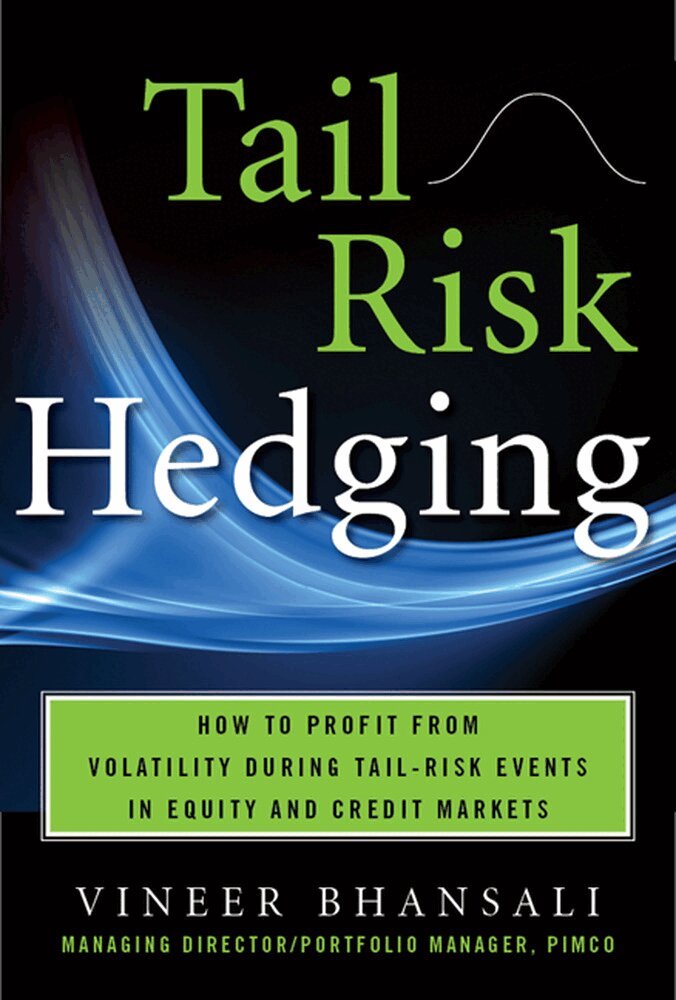
    TAIL RISK HEDGING: Creating Robust Portfolios for Volatile Markets

    AvVineer Bhansali

    Inbunden, Engelska, 2014

    1 148 kr

    Beställningsvara. Skickas inom 3-6 vardagar. Fri frakt över 249 kr.

    Fler format och utgåvor

    E-bok

    1 453 kr

    Beskrivning

    "TAIL RISKS" originate from the failure of mean reversion and the idealized bell curve of asset returns, which assumes that highly probable outcomes occur near the center of the curve and that unlikely occurrences, good and bad, happen rarely, if at all, at either "tail" of the curve. Ever since the global financial crisis, protecting investments against these severe tail events has become a priority for investors and money managers, but it issomething Vineer Bhansali and his team at PIMCO have been doing for over a decade. In one of the first comprehensive and rigorous books ever written on tail risk hedging, he lays out a systematic approach to protecting portfolios from, and potentially benefiting from, rare yet severe market outcomes.

    Tail Risk Hedging is built on the author'spractical experience applying macroeconomic forecasting and quantitative modeling techniques across asset markets. Using empirical data and charts, he explains the consequences of diversification failure in tail events andhow to manage portfolios when this happens. He provides an easy-to-use, yet rigorous framework for protecting investment portfolios against tail risk and using tail hedging to play offense. Tail Risk Hedging exploreshow to:

    • Generate profits from volatility and illiquidity during tail-risk events in equity and credit markets
    • Buy attractively priced tail hedges that add value to a portfolio and quantify basis risk
    • Interpret the psychology of investors in option pricing and portfolio construction
    • Customize explicit hedges for retirement investments
    • Hedge risk factors such as duration risk and inflation risk

    Managing tail risk is today's most significant development in risk management, and this thorough guide helps you access every aspect of it. With the time-tested and mathematically rigorous strategies described here, including pieces of computer code, you get access to insights to help mitigate portfolio losses in significant downturns, create explosive liquidity while unhedged participants are forced to sell, and create more aggressive yet tail-risk-focused portfolios. The book also gives you a unique, higher level view of how tail risk is related to investing in alternatives, and of derivatives such as zerocost collars and variance swaps. Volatilityand tail risks are here to stay, and so should your clients' wealth when you use Tail Risk Hedging for managing portfolios.

    PRAISE FOR TAIL RISK HEDGING:

    "Managing, mitigating, and even exploiting the risk of bad times are the most important concerns in investments. Bhansali puts tail risk hedging and tail risk management under a microscope--pricing, implementation, and showing how we can fine-tune our risk exposures, which are all crucial ways in how we can better weather our bad times." -- ANDREW ANG, Ann F. Kaplan Professor of Business at Columbia University

    "This book is critical and accessible reading for fiduciaries, financial consultants and investors interested in both theoretical foundations and practical considerations for how to frame hedging downside risk in portfolios. It is a tremendous resource for anyoneinvolved in asset allocation today." -- CHRISTOPHER C. GECZY, Ph.D., Academic Director, Wharton Wealth Management Initiative and Adj. Associate Professor of Finance, The Wharton School

    "Bhansali's book demonstrates how tail risk hedging can work, be concretely implemented, and lead to higher returns so that it is possible to have your cake and eat it too! A must read for the savvy investor." -- DIDIER SORNETTE, Professor on the Chair of Entrepreneurial Risks, ETH Zurich

    Produktinformation

    • Utgivningsdatum:2014-02-16
    • Mått:162 x 236 x 25 mm
    • Vikt:460 g
    • Format:Inbunden
    • Språk:Engelska
    • Antal sidor:272
    • Förlag:McGraw-Hill Education
    • ISBN:9780071791755

    Utforska kategorier

    • Finansiering inom Ekonomi och Ledarskap

    Mer om författaren

    VINEER BHANSALI, PH.D., is a managing director and portfolio manager in the Newport Beach office of PIMCO, where he oversees the company's quantitativeinvestment portfolios.

    Innehållsförteckning

    • Foreword by Mohamed El-Erian xiIntroduction xvAcknowledgments xixChapter 1: Introduction to Tail Risk and TailRisk Management 1Lessons Learned 1Distressed Liquidation and Failure of Diversification 18Chapter 2: Basics- Tail Risk Hedging for Defense 25Formal Derivation of Portfolio Hedges Using Factor Hedges 30Rolling Tail Hedges 32Benchmarking Tail Risk Management 37Cash Versus Explicit Tail Hedging 43Chapter 3 Offensive Tail Risk Hedging 51A Model to Compute the Value of Tail Hedging 56Model Calibration 57Chapter 4: Active Tail Risk Management 71Creating a Long History 78Active Monetization Rules 84Chapter 5: Indirect Hedging and Basis Risk 93Quantifying Basis Risk 95Hedge Matching at the Attachment Point 98“Soft” Indirects: Comparing Puts versus Put Spreads 104Basis Risk from Correlated Asset Classes 107Chapter 6: Other Tail Risk Management Strategies 129Tail Risk Hedging versus Asset Allocation in a Multimodal World 129The Hedging Value in Trends and Momentum 134A Look at the Risks and Rewards of Costless Collars 138Variance Swaps and Direct Volatility-Based Hedging 141Dynamic Hedging 146Chapter 7: A Behavioral Perspective on Tail Risk Hedging 153Narrow Framing and Tail Risk Hedging 154Pricing of Put Options on a Standalone Basis 161Multiple Equilibria and Expected Returns on Tail Hedges 165Precommitment and Procyclicality 169Chapter 8: Tail Risk Hedging for Retirement Investments 179Chapter 9: Inflation and Duration Tail Risk Hedging 193Hedging at the Money Inflation versus Inflation Tails 195Tail Hedging Realized Inflation versus Inflation Expectations 198Inflation Dynamics and Inflation Spikes 202Framework for Inflation Tail Hedging 210Benchmarking Inflation Tail Hedges 211Pricing of Inflation Options 212Options on CPI 212Options on the Breakeven Inflation Rate 215Indirect Inflation Tail Risk Hedging and Basis Risk 217Pricing of Tail Interest-Rate Swaptions 219Indirect Hedges 221Example of Gold Options as Proxy Tail Hedge 222Notes 225Bibliography 231Index 235