• Fri frakt över 249 kr
  • •
  • Snabba leveranser
  • •
  • Billiga böcker
Kundservice

Du är på sajten för privatpersoner.

Företag, bibliotek eller offentlig verksamhet?

Du handlar på classic.bokus.com, där alla dina funktioner finns intakta.
Till classic.bokus.com
Bokus logotyp. Gå till startsidan.
  • Erbjudanden
  • Nyheter
  • Student
  • Topplistor
  • Barn & ungdom
  • Bokus Play
  • E-böcker
  • Pocketböcker
  • Spel & pussel

10% rabatt på allt med kod NYSTART10 →

Sidfot

Mina sidor

    Hjälp

    • Kundservice
    • Vanliga frågor och svar
    • Frakt och leverans
    • Retur vid ångerrätt
    • Reklamera vara
    • Betalning
    • Köpvillkor
    • Allmänna villkor
    • Information om webbplatsens tillgänglighet

    Om Bokus

    • Om oss
    • Pressrum
    • För studenter
    • För företag
    • För bibliotek och offentlig verksamhet
    • För leverantörer
    • Hållbarhet

    Populärt

    • Aktuella erbjudanden
    • Presentkort
    • Studentlitteratur
    • Nya böcker
    • Topplistor
    • Signerade böcker
    • Engelska böcker

    Inspiration

    • Boktips
    • BookTok
    • Populära bokserier
    • Barnbokskaraktärer
    • Populära författare
    Logotyp för Bokus
    Följ oss på Facebook (extern länk)Följ oss på Instagram (extern länk)Följ oss på YouTube (extern länk)Följ oss på TikTok (extern länk)
    bokus @ CookiesAnpassa cookiesIntegritetspolicyKöpvillkor
    Till Citymail hemsida (extern länk)Till Budbee hemsida (extern länk)Till Postnord hemsida (extern länk)Till Schenker hemsida (extern länk)Till Early Bird hemsida (extern länk)Till Walleys hemsida (extern länk)
    1. Psykologi och pedagogik
    2. Pedagogik
    3. Pedagogisk psykologi

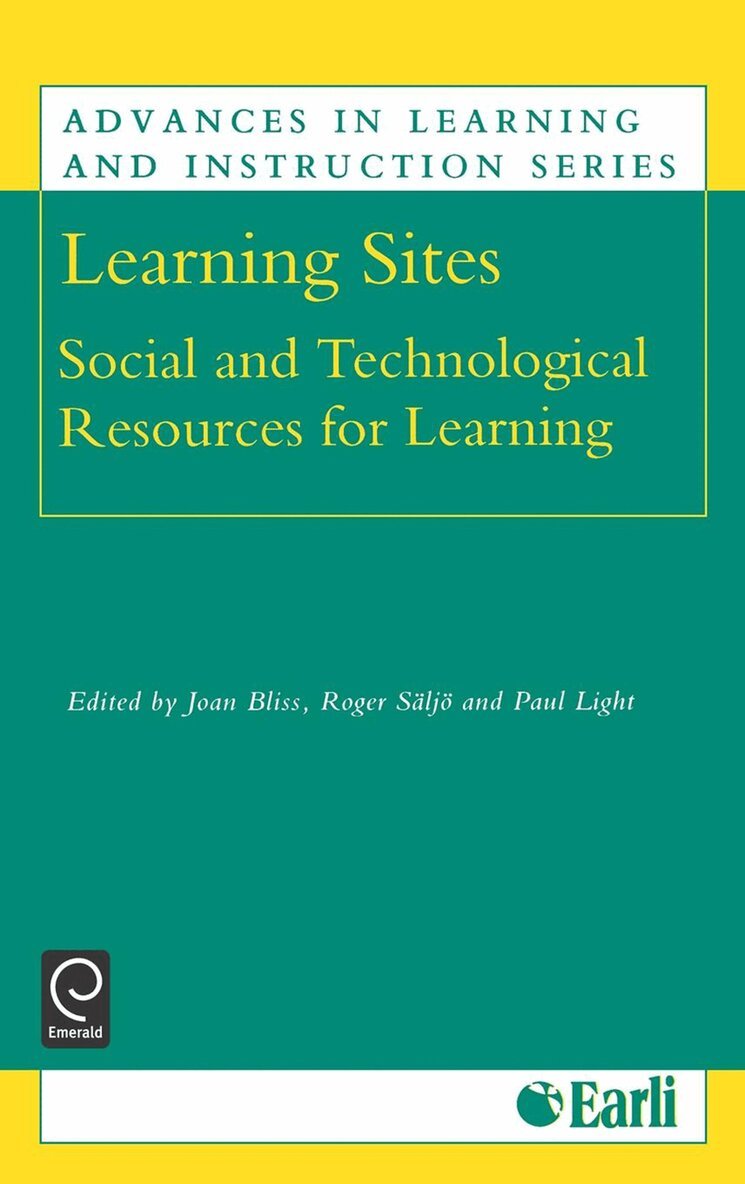
    Learning Sites

    Social and Technological Resources for Learning

    AvJoan Bliss,R. Saljo

    Inbunden, Engelska, 1999

    Del 3 i serien Advances in Learning and Instruction Series

    1 757 kr

    Beställningsvara. Skickas inom 5-8 vardagar. Fri frakt över 249 kr.

    Beskrivning

    Human learning, reasoning and thinking, and the different sites in which these activities take place, are the focus of this book. It presents the results of research into the nature of learning and the influence of different contexts and factors within the context of learning, the constraints that contexts place on reasoning and learning, and the nature of learning when using the tools and artefacts. It also addresses the nature of the influence of technology on learning, focusing especially on information technology and how it can influence any type of learning situation. The book begins by asking whether the context determines the nature of the knowledge to be learned, such that different sets of contextual practices related to the knowledge in question need to be acquired in order for learning to be successful. Next, it describes the forms of reasoning and learning in social and physical contexts, including but not limiting itself to logical reasoning, and asks how particular types of context constrain or activate different forms of reasoning and learning. It then looks at people learning with computers, examining how IT resources enhance or hinder learning. Finally, it compares human learning with learning done by machines in specific contexts.

    Produktinformation

    • Utgivningsdatum:1999-10-13
    • Mått:156 x 234 x 19 mm
    • Vikt:637 g
    • Format:Inbunden
    • Språk:Engelska
    • Serie:Advances in Learning and Instruction Series
    • Antal sidor:328
    • Förlag:Emerald Publishing Limited
    • ISBN:9780080433509

    Utforska kategorier

    • Pedagogisk psykologi inom Psykologi och pedagogik
    • Material och digital teknik i undervisningen inom Psykologi och pedagogik

    Innehållsförteckning

    • Part headings and selected papers: The human--technological dialectic (J. Bliss, R. Saljo). Learning and the Negotiation of Meaning. Introduction (R. Saljo). Learning mathematics in and outside school: two views on situated learning (G. de Abreu). Situated selves: learning to be a learner (C. Sinha). Negotiating identities and meanings in the transmission of knowledge: analysis of interactions in the context of a knowledge exchange network (N. Muller, A.-N. Perret-Clermont). Real-world knowledge and mathematical problem-solving in upper primary school children (E. De Corte et al.). Quantifying time as a discursive practice: arithmetics, calendars, fingers and group discussions as structuring resources (J. Wyndhamn, R. Saljo). Learning and Reasoning in Context. Introduction (P. Light). Situated learning in instructional settings: from euphoria to feasibility (A. Renkl et al.). Engaging with organisational memory (A. Rizzo et al.). The relevance of relevance in children's cognition (A. Blaye et al.). Empirical abstraction and imaginative denial of rules (J. Bliss et al.). Enactive representations in learning: pretence, models and machines (E.K. Ackermann). Contextual knowledge in the development of design expertise (A. Etelapelto, P. Light). Learning with and by Machines. Introduction (J. Bliss). Gender and IT: contextualising differences (K. Littleton, M. Bannert). Information technology and the culture of student learning (C. Crook, P. Light). Assisting child-computer collaboration in the zone of proximal development (The Vygotskian Inspired System (VIS)) (R. Luckin). Learning and discovering with computational aids (V. Corruble, J. Bliss). Situated cognition: a challenge to artificial intelligence? (D. Canamero, V. Corruble). Situated learning in autonomous agents (B. de Boer, D. Canamero). References. Author index. Subject index.