• Fri frakt över 249 kr
  • •
  • Snabba leveranser
  • •
  • Billiga böcker
Kundservice

Du är på sajten för privatpersoner.

Företag, bibliotek eller offentlig verksamhet?

Du handlar på classic.bokus.com, där alla dina funktioner finns intakta.
Till classic.bokus.com
Bokus logotyp. Gå till startsidan.
  • Erbjudanden
  • Nyheter
  • Student
  • Topplistor
  • Barn & ungdom
  • Bokus Play
  • E-böcker
  • Pocketböcker
  • Spel & pussel

10% rabatt på allt med kod: NYSTART10 →

Sidfot

Mina sidor

    Hjälp

    • Kundservice
    • Vanliga frågor och svar
    • Frakt och leverans
    • Retur vid ångerrätt
    • Reklamera vara
    • Betalning
    • Köpvillkor
    • Allmänna villkor
    • Information om webbplatsens tillgänglighet

    Om Bokus

    • Om oss
    • Pressrum
    • För studenter
    • För företag
    • För bibliotek och offentlig verksamhet
    • För leverantörer
    • Hållbarhet

    Populärt

    • Aktuella erbjudanden
    • Presentkort
    • Studentlitteratur
    • Nya böcker
    • Topplistor
    • Signerade böcker
    • Engelska böcker

    Inspiration

    • Boktips
    • BookTok
    • Populära bokserier
    • Barnbokskaraktärer
    • Populära författare
    Logotyp för Bokus
    Följ oss på Facebook (extern länk)Följ oss på Instagram (extern länk)Följ oss på YouTube (extern länk)Följ oss på TikTok (extern länk)
    bokus @ CookiesAnpassa cookiesIntegritetspolicyKöpvillkor
    Till Citymail hemsida (extern länk)Till Budbee hemsida (extern länk)Till Postnord hemsida (extern länk)Till Schenker hemsida (extern länk)Till Early Bird hemsida (extern länk)Till Walleys hemsida (extern länk)
    1. Naturvetenskap och teknik
    2. Teknik och industri
    3. Energiteknik

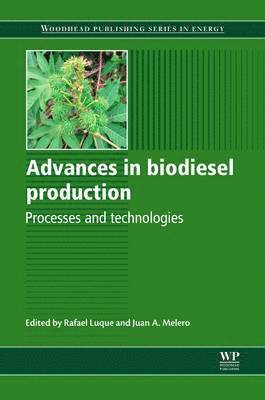
    Advances in Biodiesel Production

    Processes and Technologies

    AvR Luque,J A Melero

    Häftad, Engelska, 2016

    Del i serien Woodhead Publishing Series in Energy

    1 901 kr

    Beställningsvara. Skickas inom 10-15 vardagar. Fri frakt över 249 kr.

    Beskrivning

    Biodiesel is one of the main biofuels capable of substituting fossil fuel usage in compression ignition vehicles, and is used in a variety of fuel blends worldwide. First-generation biodiesel has been used in national markets for some time, with fuel quality standards in place for this purpose. There remain, however, several restrictions to sustainable and long term market development, which is influenced by many factors, including food vs. fuel pressures. The development of new generations of biodiesel, aimed at more sustainable and effective feedstock utilisation alongside improved production efficiency and fuel quality, is critical to the future both of this industry and of the continuing use of biodiesel fuels in transportation.

    This book provides a timely reference on the advances in the development of biodiesel fuels, production processes and technologies. Part one reviews the life cycle sustainability assessment and socio-economic and environmental policy issues associated with advanced biodiesel production, as well as feedstocks and fuel quality standards. This coverage is extended in Part two, with chapters focussing on the development of methods and catalysts essential to the improvement and optimisation of biodiesel production processes and technologies.

    With its distinguished editors and international team of contributors, Advances in biodiesel production a standard reference for chemical, biochemical and industrial process engineers, as well as scientists and researchers in this important field.

    • Provides a timely reference on the advances in the development of biodiesel fuels, production processes and technologies
    • Reviews the life cycle sustainability assessment and socio-economic and environmental policy issues associated with advanced biodiesel production, as well as feedstocks and fuel quality standards
    • Discusses the development of methods and catalysts essential to the improvement and optimisation of biodiesel production processes and technologies

    Produktinformation

    • Utgivningsdatum:2016-08-19
    • Mått:156 x 234 x 16 mm
    • Vikt:430 g
    • Format:Häftad
    • Språk:Engelska
    • Serie:Woodhead Publishing Series in Energy
    • Antal sidor:304
    • Förlag:Elsevier Science
    • ISBN:9780081016640

    Utforska kategorier

    • Energiteknik inom Naturvetenskap och teknik

    Mer om författaren

    Dr Rafael Luque is a Ramon y Cajal Fellow at the University of Córdoba, Spain. He is noted for his research and publications in the fields of biofuels production and green chemistry. Professor Juan A. Melero is an academic researcher at Rey Juan Carlos University, Madrid, Spain. The editors are internationally renowned for their research into biomass conversion and biofuels production.

    Innehållsförteckning

    • Contributor contact detailsWoodhead Publishing Series in EnergyChapter 1: Introduction to advanced biodiesel productionAbstract:1.1 Introduction1.2 Processes and technologies for advanced biodiesel production1.3 New feedstocks for second generation biodiesel production1.4 Glycerol as by-product of biodiesel production1.5 Conclusions and outlook1.6 AcknowledgementsPart I: Fundamental issues and assessment in advanced biodiesel productionChapter 2: Life cycle sustainability assessment of second generation biodieselAbstract:2.1 Introduction2.2 Environmental sustainability of biodiesel2.3 Socio-economic sustainability of biodiesel2.4 Conclusions and future trends2.5 Acknowledgements2.6 Sources of further information and adviceChapter 3: Socio-economic, environmental, and policy perspectives of advanced biodiesel productionAbstract:3.1 Introduction3.2 Socio-economic, environmental and policy limitations of first generation biodiesels3.3 Economic potential and limitations of second and third generation biodiesels3.4 New impacts on energy security3.5 New impacts on land and food safety3.6 Effects on international trade and sustainable development3.7 What are the right policies for next generation biodiesels?3.8 ConclusionsChapter 4: Feedstocks for advanced biodiesel productionAbstract:4.1 Introduction4.2 Feedstocks for first generation biodiesel4.3 Feedstocks for second generation biodiesel4.4 Other feedstocks for biodiesel production4.5 Feedstocks for advanced biodiesel production4.6 Future trends: the biorefinery concept4.7 AcknowledgementsChapter 5: Advances in biodiesel quality control, characterisation and standards developmentAbstract:5.1 Introduction5.2 Characterisation, analysis techniques and quality control of feedstocks5.3 Characterisation, analysis techniques and quality control of biodiesel5.4 Development of standards for biodiesel quality and use5.5 Future trendsPart II: Advanced biodiesel production processes and technologiesChapter 6: Advances in biodiesel catalysts and processing technologiesAbstract:6.1 Introduction6.2 Current production technology for biodiesel6.3 New types of catalysts6.4 Innovative reaction conditions6.5 Advanced biodiesel reactor design6.6 Production of biodiesel with simultaneous derivation of glycerol6.7 In situ transesterification6.8 ConclusionsChapter 7: Biodiesel from waste oils and fatsAbstract:7.1 Introduction7. 2 Waste oils and fats7.3 Technology for biodiesel production from waste lipids7.4 Advantages and limitations7.5 Concluding remarks and future trendsChapter 8: Biodiesel from microbial oilAbstract:8.1 Introduction8.2 Heterotrophic microorganisms for oil production8.3 Carbon sources for microorganism production8.4 Biodiesel production from heterotrophic microorganisms8.5 Suitability of biodiesel8.6 Enhancement of microbial oil production8.7 Conclusions and future trendsChapter 9: Microalgae processing for biodiesel productionAbstract:9.1 Introduction9.2 Microalgae biomass downstream processing9.3 Cell disruption methods9.4 Lipids extraction from microalgae9.5 Advanced biodiesel production from microalgae9.6 Process integration: the biorefinery concept9.7 ConclusionsChapter 10: Valorization of the glycerol by-product of biodiesel productionAbstract:10.1 Introduction10.2 Composition and purification of glycerol produced from biodiesel10.3 Applications and valorization of glycerol10.4 Advantages and limitations of the use of crude glycerol from biodiesel production10.5 Future trendsSupply chains, techno-economic assessment and market development for second generation biodieselIndex