• Fri frakt över 249 kr
  • •
  • Snabba leveranser
  • •
  • Billiga böcker
Kundservice

Du är på sajten för privatpersoner.

Företag, bibliotek eller offentlig verksamhet?

Du handlar på classic.bokus.com, där alla dina funktioner finns intakta.
Till classic.bokus.com
Bokus logotyp. Gå till startsidan.
  • Erbjudanden
  • Nyheter
  • Student
  • Topplistor
  • Barn & ungdom
  • Bokus Play
  • E-böcker
  • Pocketböcker
  • Spel & pussel

10% rabatt på allt med kod: NYSTART10 →

Sidfot

Mina sidor

    Hjälp

    • Kundservice
    • Vanliga frågor och svar
    • Frakt och leverans
    • Retur vid ångerrätt
    • Reklamera vara
    • Betalning
    • Köpvillkor
    • Allmänna villkor
    • Information om webbplatsens tillgänglighet

    Om Bokus

    • Om oss
    • Pressrum
    • För studenter
    • För företag
    • För bibliotek och offentlig verksamhet
    • För leverantörer
    • Hållbarhet

    Populärt

    • Aktuella erbjudanden
    • Presentkort
    • Studentlitteratur
    • Nya böcker
    • Topplistor
    • Signerade böcker
    • Engelska böcker

    Inspiration

    • Boktips
    • BookTok
    • Populära bokserier
    • Barnbokskaraktärer
    • Populära författare
    Logotyp för Bokus
    Följ oss på Facebook (extern länk)Följ oss på Instagram (extern länk)Följ oss på YouTube (extern länk)Följ oss på TikTok (extern länk)
    bokus @ CookiesAnpassa cookiesIntegritetspolicyKöpvillkor
    Till Citymail hemsida (extern länk)Till Budbee hemsida (extern länk)Till Postnord hemsida (extern länk)Till Schenker hemsida (extern länk)Till Early Bird hemsida (extern länk)Till Walleys hemsida (extern länk)
    1. Medicin
    2. Omvårdnad och medicinska stödfunktioner
    3. Biomedicinsk teknik

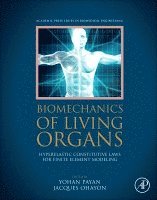
    Biomechanics of Living Organs

    Hyperelastic Constitutive Laws for Finite Element Modeling

    AvYohan Payan,Jacques Ohayon

    Inbunden, Engelska, 2017

    Del i serien Biomechanics of Living Organs

    2 060 kr

    Beställningsvara. Skickas inom 10-15 vardagar. Fri frakt över 249 kr.

    Beskrivning

    Biomechanics of Living Organs: Hyperelastic Constitutive Laws for Finite Element Modeling is the first book to cover finite element biomechanical modeling of each organ in the human body. This collection of chapters from the leaders in the field focuses on the constitutive laws for each organ.

    Each author introduces the state-of-the-art concerning constitutive laws and then illustrates the implementation of such laws with Finite Element Modeling of these organs. The focus of each chapter is on instruction, careful derivation and presentation of formulae, and methods.

    When modeling tissues, this book will help users determine modeling parameters and the variability for particular populations. Chapters highlight important experimental techniques needed to inform, motivate, and validate the choice of strain energy function or the constitutive model.

    Remodeling, growth, and damage are all covered, as is the relationship of constitutive relationships of organs to tissue and molecular scale properties (as net organ behavior depends fundamentally on its sub components). This book is intended for professionals, academics, and students in tissue and continuum biomechanics.


    • Covers hyper elastic frameworks for large tissue deformations
    • Considers which strain energy functions are the most appropriate to model the passive and active states of living tissue
    • Evaluates the physical meaning of proposed energy functions

    Produktinformation

    • Utgivningsdatum:2017-06-16
    • Mått:191 x 235 x 40 mm
    • Vikt:1 450 g
    • Format:Inbunden
    • Språk:Engelska
    • Serie:Biomechanics of Living Organs
    • Antal sidor:602
    • Förlag:Elsevier Science
    • ISBN:9780128040096

    Utforska kategorier

    • Biomedicinsk teknik inom Medicin

    Mer om författaren

    Yohan Payan is Director of Research at the French National Center for Scientific Research (CNRS). In 1997, he received an award from the University of Grenoble for his doctoral research on the biomechanics of speech production. In 2012, the French Biomechanics Society awarded him the Senior Prize for his research on the biomechanics for computer-assisted surgery. His main research interests concern the biomechanical modeling of soft tissues and their integration into medical devices used to assist surgeons for planning or to guide them during surgery. The corresponding applications concern plastic and maxillofacial surgery, breast cancer treatment, neurosurgery, orthopedics and pressure ulcer prevention, based on organs or musculoskeletal models. He was a Research Affiliate at the Massachusetts Institute of Technology (1999, Boston, USA) and visiting professor at University of Chile (2004, Santiago de Chile) and University of British Columbia (2010, Vancouver, Canada). Yohan Payan is the co-head of the Biomechanics TIMC research team (Univ. Grenoble Alpes) and the Associate Editor of the Clinical Biomechanics journal (Elsevier).Jacques Ohayon is Professor of Mechanics at the Engineering school Polytech, Univ. Savoie Mont-Blanc, France. From 1985 to 1988, he was visiting fellow at the Biomedical Engineering Branch of the National Institutes of Health (NIH), Bethesda MD, USA. He received the 1998 Junior Prize of the French Biomechanics Society (SB) for his research on the biomechanics of the left ventricle. His current research focuses on the biomechanics of atherosclerotic plaque and the development of new clinical tools for imaging the elasticity of vulnerable plaques. From 2006 to 2007, he was visiting professor at the National Institute of Biomedical Imaging and Bioengineering at the NIH, USA. Jacques Ohayon was the Chairman of the SB, which also awarded him the Senior Prize in 2016 for his work on the biomechanics of coronary plaque rupture. In 2020, he was a visiting professor at Texas A & M University and conducted his research in the field of endothelial cell mechanobiology at the Houston Methodist Research Institute (HMRI). Since 2020, he is also Adjunct Professor of Cardiovascular Sciences at HMRI, Texas, USA.

    Innehållsförteckning

    • Part 1: Constitutive laws for biological living tissues1. Hyperelasticity Modeling for Incompressible Passive Biological Tissues2. Current Hyperelastic Models for Contractile Tissues: Application to Cardiovascular Mechanics3. Visco-hyperelastic strain energy function4. Constitutive Formulations for Soft Tissue Growth and Remodeling5. Strain energy function for damaged tissuesPart 2: Passive soft organs6. Brain – Biomechanical modeling of brain soft tissues for medical applications7. Oesophagus – Modeling of esophageal structure and function in health and disease8. Aorta – Mechanical properties, histology, and biomechanical modeling9. Arteries and Coronaries Arterial – Wall Stiffness and Atherogenesis in Human Coronaries10. Breast – Clinical applications of breast biomechanics11. Liver – Non linear Biomechanical model of the Liver12. Abdomen – Mechanical modeling and clinical applications13. Small Intestine14. Bladder/prostate/rectum – Biomechanical Models of the Mobility of Pelvic Organs in the Context of Prostate Radiotherapy15. Uterus – Biomechanical modeling of uterus. Application to a childbirth simulation16. Skin – Skin mechanicsPart 3: Active soft organs17. Skeletal muscle – Three-dimensional modeling of active muscle tissue: The why, the how, and the future18. Face – Computational modelling of the passive and active components of the face19. Tongue – Human tongue biomechanical modeling20. Upper airways – FRANK: a Hybrid 3D Biomechanical Model of the Head and Neck21. Heart – Adaptive reorientation of myofiber orientation in a model of biventricular cardiac mechanics: the effect of triaxial active stress, passive shear stiffness, and activation sequencePart 4: Musculo-skeletal models22. Spine – Relative contribution of structure and materials in the biomechanical behavior of the human spine23. Thigh – Modeling of the Thigh: a 3D deformable approach considering muscle interactions24. Calf – Subject-specific computational prediction of the effects of elastic compression in the calf 25. Foot – Biomechanical modeling of the foot