• Fri frakt över 249 kr
  • •
  • Snabba leveranser
  • •
  • Billiga böcker
Kundservice

Du är på sajten för privatpersoner.

Företag, bibliotek eller offentlig verksamhet?

Du handlar på classic.bokus.com, där alla dina funktioner finns intakta.
Till classic.bokus.com
Bokus logotyp. Gå till startsidan.
  • Erbjudanden
  • Student
  • Topplistor
  • Barn & ungdom
  • Bokus Play
  • E-böcker
  • Ljudböcker
  • Pocketböcker
  • Spel och pussel

5% studentrabatt – använd koden KURSBOK27 →

Sidfot

Mina sidor

    Hjälp

    • Kundservice
    • Vanliga frågor och svar
    • Frakt och leverans
    • Retur vid ångerrätt
    • Reklamera vara
    • Betalning
    • Köpvillkor
    • Allmänna villkor
    • Information om webbplatsens tillgänglighet

    Om Bokus

    • Om oss
    • Pressrum
    • För studenter
    • För företag
    • För bibliotek och offentlig verksamhet
    • För leverantörer
    • Hållbarhet

    Populärt

    • Aktuella erbjudanden
    • Presentkort
    • Studentlitteratur
    • Nya böcker
    • Topplistor
    • Signerade böcker
    • Engelska böcker

    Inspiration

    • Boktips
    • BookTok
    • Barnbokskaraktärer
    • Populära författare
    Logotyp för Bokus
    Följ oss på Facebook (extern länk)Följ oss på Instagram (extern länk)Följ oss på YouTube (extern länk)Följ oss på TikTok (extern länk)
    bokus @ CookiesAnpassa cookiesIntegritetspolicyKöpvillkor
    Till Citymail hemsida (extern länk)Till Budbee hemsida (extern länk)Till Postnord hemsida (extern länk)Till Schenker hemsida (extern länk)Till Early Bird hemsida (extern länk)Till Walleys hemsida (extern länk)
    1. Naturvetenskap och teknik
    2. Teknik och industri
    3. Teknik: allmänt

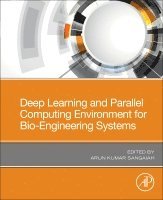
    Deep Learning and Parallel Computing Environment for Bioengineering Systems

    AvArun Kumar Sangaiah

    Häftad, Engelska, 2019

    1 565 kr

    Beställningsvara. Skickas inom 10-15 vardagar. Fri frakt över 249 kr.

    Beskrivning

    Deep Learning and Parallel Computing Environment for Bioengineering Systems delivers a significant forum for the technical advancement of deep learning in parallel computing environment across bio-engineering diversified domains and its applications. Pursuing an interdisciplinary approach, it focuses on methods used to identify and acquire valid, potentially useful knowledge sources. Managing the gathered knowledge and applying it to multiple domains including health care, social networks, mining, recommendation systems, image processing, pattern recognition and predictions using deep learning paradigms is the major strength of this book. This book integrates the core ideas of deep learning and its applications in bio engineering application domains, to be accessible to all scholars and academicians. The proposed techniques and concepts in this book can be extended in future to accommodate changing business organizations' needs as well as practitioners' innovative ideas.


    • Presents novel, in-depth research contributions from a methodological/application perspective in understanding the fusion of deep machine learning paradigms and their capabilities in solving a diverse range of problems
    • Illustrates the state-of-the-art and recent developments in the new theories and applications of deep learning approaches applied to parallel computing environment in bioengineering systems
    • Provides concepts and technologies that are successfully used in the implementation of today's intelligent data-centric critical systems and multi-media Cloud-Big data

    Produktinformation

    • Utgivningsdatum:2019-07-27
    • Mått:191 x 235 x 14 mm
    • Vikt:570 g
    • Format:Häftad
    • Språk:Engelska
    • Antal sidor:280
    • Förlag:Elsevier Science
    • ISBN:9780128167182

    Utforska kategorier

    • Teknik: allmänt inom Naturvetenskap och teknik
    • Biokemisk teknik inom Naturvetenskap och teknik
    • Hårdvara inom Data och IT

    Mer om författaren

    Prof. Arun Kumar Sangaiah received his PhD from the School of Computer Science and Engineering, VIT University, Vellore, India. He is currently a Full Professor with National Yunlin University of Science and Technology, Taiwan. He is also a Professor at the School of Computing Science and Engineering, VIT University, Vellore, India. His areas of research interest include machine learning, Internet of Things, Sustainable Computing. He has published more than 300 research articles in refereed journals, 11 edited books, one patent (held and filed), as well as four projects funded by MOST-TAIWAN, one funded by Ministry of IT of India, and several international projects (CAS, Guangdong Research fund, Australian Research Council). Dr. Sangaiah has received many awards, Yushan Young Scholar, Clarivate Top 1% Highly Cited Researcher (2021,2022, 2023), Top 2% Scientist (Standord Report-2020,2021,2022, 2023), PIFI-CAS fellowship, Top-10 outstanding researcher, CSI significant Contributor etc. He is also serving as Editor-in-Chief and/or Associate Editor of various reputed ISI journals. Dr. Sangaiah is a visiting scientist (2018-2019) with Chinese Academy of Sciences (CAS), China and visiting researcher of Université Paris-Est (UPEC), France (2019-2020) and etc.

    Innehållsförteckning

    • 1. Introductory2. Theoretical results on representation of deep learning and parallel architectures for bioengineering3. Parallel Machine Learning and Deep Learning approaches for Bio-informatics4. Parallel programming, architectures and machine intelligence for bioengineering5. Deep Randomized Neural Networks for Bioengineering applications6. Artificial Intelligence enhance parallel computing environments7. Parallel computing, graphics processing units (GPU) and new hardware for deep learning in Computational Intelligence research8. Novel feature representation using deep learning, dictionary learning for face, fingerprint, ocular, and/or other biometric modalities9. Novel distance metric learning algorithms for biometrics modalities10. Machine learning techniques (e.g., Deep Learning) with cognitive knowledge acquisition frameworks for sustainable energy aware systems11. Deep learning and semi-supervised and transfer learning algorithms for medical imaging12. Biological plausibility/inspiration of Randomized Neural Networks13. Genomic data visualisation and representation for medical information14. Applications of deep learning and unsupervised feature learning for prediction of sustainable engineering tasks15. Inference and optimization with bioengineering problems