• Fri frakt över 249 kr
  • •
  • Snabba leveranser
  • •
  • Billiga böcker
Kundservice

Du är på sajten för privatpersoner.

Företag, bibliotek eller offentlig verksamhet?

Du handlar på classic.bokus.com, där alla dina funktioner finns intakta.
Till classic.bokus.com
Bokus logotyp. Gå till startsidan.
  • Erbjudanden
  • Nyheter
  • Student
  • Topplistor
  • Barn & ungdom
  • Bokus Play
  • E-böcker
  • Pocketböcker
  • Spel & pussel

10% rabatt på allt med kod: NYSTART10 →

Sidfot

Mina sidor

    Hjälp

    • Kundservice
    • Vanliga frågor och svar
    • Frakt och leverans
    • Retur vid ångerrätt
    • Reklamera vara
    • Betalning
    • Köpvillkor
    • Allmänna villkor
    • Information om webbplatsens tillgänglighet

    Om Bokus

    • Om oss
    • Pressrum
    • För studenter
    • För företag
    • För bibliotek och offentlig verksamhet
    • För leverantörer
    • Hållbarhet

    Populärt

    • Aktuella erbjudanden
    • Presentkort
    • Studentlitteratur
    • Nya böcker
    • Topplistor
    • Signerade böcker
    • Engelska böcker

    Inspiration

    • Boktips
    • BookTok
    • Populära bokserier
    • Barnbokskaraktärer
    • Populära författare
    Logotyp för Bokus
    Följ oss på Facebook (extern länk)Följ oss på Instagram (extern länk)Följ oss på YouTube (extern länk)Följ oss på TikTok (extern länk)
    bokus @ CookiesAnpassa cookiesIntegritetspolicyKöpvillkor
    Till Citymail hemsida (extern länk)Till Budbee hemsida (extern länk)Till Postnord hemsida (extern länk)Till Schenker hemsida (extern länk)Till Early Bird hemsida (extern länk)Till Walleys hemsida (extern länk)
    1. Naturvetenskap och teknik
    2. Teknik och industri
    3. Agronomi och lantbruk
    4. Djurhållning

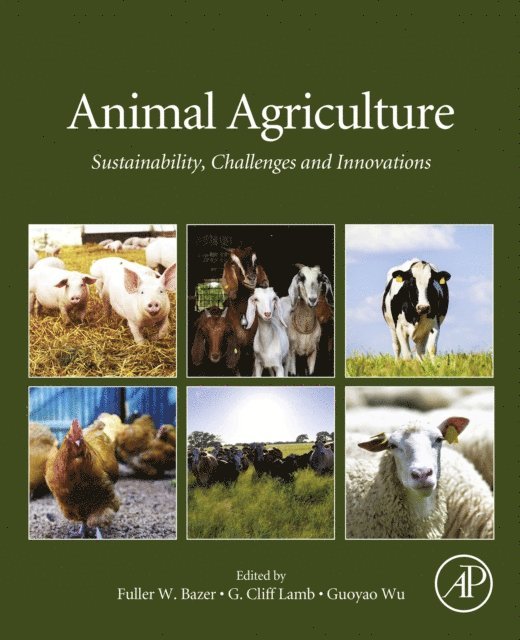
    Animal Agriculture

    Sustainability, Challenges and Innovations

    AvFuller W. Bazer,G. Cliff Lamb

    Häftad, Engelska, 2019

    1 963 kr

    Beställningsvara. Skickas inom 10-15 vardagar. Fri frakt över 249 kr.

    Beskrivning

    Animal Agriculture: Sustainability, Challenges and Innovations discusses the land-based production of high-quality protein by livestock and poultry and how it plays an important role in improving human nutrition, growth and health. With exponential growth of the global population and marked rises in meat consumption per capita, demands for animal-source protein are expected to increase 72% between 2013 and 2050. This raises concerns about the sustainability and environmental impacts of animal agriculture. An attractive solution to meeting increasing needs for animal products and mitigating undesirable effects of agricultural practices is to enhance the efficiency of animal growth, reproduction, and lactation.

    Currently, there is no resource that offers specific knowledge of both animal science and technology, including biotechnology for the sustainability of animal agriculture for the expanding global demand of food in the face of diminishing resources. This book fills that gap, giving readers all the necessary information on important issues facing modern animal agriculture, namely its sustainability, challenges and innovative solutions.

    • Integrates new knowledge in animal breeding, biotechnology, nutrition, reproduction and management
    • Addresses the urgent issue of sustainability in modern animal agriculture
    • Provides practical solutions on how to solve the current and future problems that face animal agriculture worldwide

    Produktinformation

    • Utgivningsdatum:2019-10-26
    • Mått:191 x 235 x 33 mm
    • Vikt:1 090 g
    • Format:Häftad
    • Språk:Engelska
    • Antal sidor:558
    • Förlag:Elsevier Science
    • ISBN:9780128170526

    Utforska kategorier

    • Djurhållning inom Naturvetenskap och teknik
    • Tillverkningsteknik inom Naturvetenskap och teknik

    Mer om författaren

    Dr. Fuller W. Bazer. Regents fellow, distinguished university professor and presidential impact fellow in the Department of Animal Science at Texas A&M University. Dr. Bazer has published 596 refereed scientific journal papers, edited 5 books, and published 60 chapters in books in addition to many published abstracts. He has received many prestigious awards including American Society of Animal Science Physiology and Endocrinology Award, L.E. Casida Award for Graduate Education and Morrison Award; Fellow in the American Association for the Advancement of Science; Society for the Study of Reproduction Research Awards for Research, Distinguished Service, Trainee Mentoring, and Carl Hartman Award; Biotechnology 94 Award; Gamma Sigma Delta International Distinguished Achievement Award in Agriculture; Association of Former Students Distinguished Achievement Award in Research; Alexander von Humboldt Research Award in Agriculture; Vice Chancellor for Agriculture Award in Excellence for Research; Wolf Prize in Agriculture; Vice Chancellor for Agriculture Award for Team Research in Uterine Biology and Pregnancy; Society for Reproduction and Fertility Distinguished Research Award; Pioneer Award from International Ruminant Reproduction Society; and Doctor of Science, honoris causa, University of Guelph and University of Florida Dr. G. Cliff Lamb, professor and head of the Department of Animal Science at Texas A&M University. Formerly, Dr. Lamb served as the Assistant Director and Research Foundation Professor at the University of Florida North Florida Research and Education Center in Marianna, FL. His primary Extension and research efforts are focused on applied reproductive physiology in cattle. His programs have received more than $10 million in grant funds or gifts. He has published 102 refereed journal articles, along with more than 609 extension and research reports. Dr. Lamb has received many prestigious awards including the: Thrush Foundation Scholarship (1989 - 1992); MTSU Outstanding Animal Science Senior Award (1992); Block and Bridle Outstanding Senior Award (1992); American Society of Animal Science Scholarship Award (1992); Gamma Sigma Delta Outstanding Masters Student Award (1996); Rotary Club Outstanding International Graduate Student Award (1997); Animal Sciences and Industry Outstanding Ph.D. Student Award (1997); Minnesota Junior Angus Association Outstanding Service Award (2004); Minnesota State Cattlemen’s Association Outstanding Service Award (2006); American Society of Animal Science – Midwest Section Outstanding Young Extension Specialist Award (2007); Outstanding Animal Science Graduate Faculty Member – Animal Science Graduate Student Club (2007); American Society of Animal Science – Early Career Achievement Award (2009); Florida Association of County Agricultural Agents - Excellence in Sustainable Agriculture Award Team Award (2011); National Association of County Agricultural Agents – USDA SARE/NACAA Excellence in Sustainable Agriculture Award Team Award (2011); LEAD21 Land Grant Leadership Program Fellow (2011); USDA National Institute of Food and Agriculture (NIFA) Partnership Award for Multistate Efforts (2013); University of Florida Research Foundation Professor (2014); Florida Association of County Agricultural Agents Outstanding State Specialist (2014); Florida Cattlemen’s Association Researcher of the Year (2015); American Society of Animal Science Animal Management Award (2015); and Dallas Townsend Extension Professional Enhancement Award (2015). Dr. Guoyao Wu is a University Distinguished Professor and University Faculty Fellow. His research focuses on the biochemistry, nutrition and physiology of amino acids and related nutrients in animals (particularly swine, sheep, cattle, chickens, rats and fish). Dr. Wu has published 565 papers in peer-reviewed journals, 58 book chapters, and 2 professional books (Principles of Animal Nutrition, and Amino Acids: Biochemistry and Nutrition). With > 41,500 citations and an H-index of 103, he is among the Most Cited Authors worldwide. Dr. Wu has received numerous prestigious awards, including China National Scholarship for Graduate Studies Abroad (1984), The University of Alberta Andrew Stewart Graduate Prize (1989), Medical Research Council of Canada Postdoctoral Fellowship (1989), American Heart Association Established Investigator Award (1998), Nonruminant Nutrition Research Award from the American Society of Animal Science (2004), Changjiang Scholar Award from China (2008), FASS-AFIA New Frontiers in Animal Nutrition Research Awardfrom the Federation of Animal Science Societies and American Feed Industry Association (2009), the Samburu Collaboration Award from the International Association of Giraffe Care Professionals (2010), Fellow of the American Association for the Advancement of Science (2012), and Distinguished Scientist of Sigma Xi Honor Society - Texas A&M University Chapter (2013).

    Innehållsförteckning

    • 1. Introduction: Significance and challenges of animal productionPart 1: Beef cattle production2. Genetics and breeding of beef cattle3. Physiology and pregnancy of beef cattle4. Reproductive management of beef cattle5. Nutrition and feeding of confined and grazing beef cattlePart 2: Lactation and management of dairy cattle6. Genetics and genomics of dairy cattle7. Physiology of lactation in dairy cattle8. Reproductive management of dairy cattle9. Nutrition and feeding of dairy cattlePart 3: Sheep and goat production10. Genetics and breeding of sheep and goats11. Reproductive physiology of sheep and goats12. Reproductive management of sheep and goats13. Nutrition and feeding of sheep and goatsPart 4: Swine production14. Swine genetics and breeding15. Reproductive physiology of swine16. Reproductive management of swine17. Nutrition and feeding of swinePart 5: Poultry production18. Poultry genetics and breeding19. Reproductive physiology and hatching of poultry20. Reproductive management of poultry21. Nutrition and feeding of poultryPart 6: Biotechnologies and others in animal production22. Muscle biology and meat quality23. Production of transgenic animals24. Fermentation techniques in feed production25. Mathematical modelling in animal production26. Manure utilization in production systemsPart 7: Management of animal diseases in livestock and production27. Management of metabolic diseases in ruminants and nonruminants28. Management of pathogens in cattle 29. Management of pathogens in swine 30. Management of pathogens in poultry