• Fri frakt över 249 kr
  • •
  • Snabba leveranser
  • •
  • Billiga böcker
Kundservice

Du är på sajten för privatpersoner.

Företag, bibliotek eller offentlig verksamhet?

Du handlar på classic.bokus.com, där alla dina funktioner finns intakta.
Till classic.bokus.com
Bokus logotyp. Gå till startsidan.
  • Erbjudanden
  • Student
  • Topplistor
  • Barn & ungdom
  • Bokus Play
  • E-böcker
  • Ljudböcker
  • Pocketböcker
  • Spel och pussel

Upp till 25% på utvalda nyheter →

Sidfot

Mina sidor

    Hjälp

    • Kundservice
    • Vanliga frågor och svar
    • Frakt och leverans
    • Retur vid ångerrätt
    • Reklamera vara
    • Betalning
    • Köpvillkor
    • Allmänna villkor
    • Information om webbplatsens tillgänglighet

    Om Bokus

    • Om oss
    • Pressrum
    • För studenter
    • För företag
    • För bibliotek och offentlig verksamhet
    • För leverantörer
    • Hållbarhet

    Populärt

    • Aktuella erbjudanden
    • Presentkort
    • Studentlitteratur
    • Nya böcker
    • Topplistor
    • Signerade böcker
    • Engelska böcker

    Inspiration

    • Boktips
    • BookTok
    • Barnbokskaraktärer
    • Populära författare
    Logotyp för Bokus
    Följ oss på Facebook (extern länk)Följ oss på Instagram (extern länk)Följ oss på YouTube (extern länk)Följ oss på TikTok (extern länk)
    bokus @ CookiesAnpassa cookiesIntegritetspolicyKöpvillkor
    Till Citymail hemsida (extern länk)Till Budbee hemsida (extern länk)Till Postnord hemsida (extern länk)Till Schenker hemsida (extern länk)Till Early Bird hemsida (extern länk)Till Walleys hemsida (extern länk)
    1. Naturvetenskap och teknik
    2. Matematik och naturvetenskap
    3. Matematik
    4. Tillämpad matematik

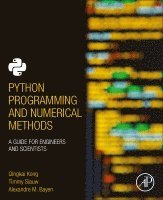
    Python Programming and Numerical Methods

    A Guide for Engineers and Scientists

    AvQingkai Kong,Timmy Siauw

    Häftad, Engelska, 2020

    816 kr

    Beställningsvara. Skickas inom 10-15 vardagar. Fri frakt över 249 kr.

    Beskrivning

    Python Programming and Numerical Methods: A Guide for Engineers and Scientists introduces programming tools and numerical methods to engineering and science students, with the goal of helping the students to develop good computational problem-solving techniques through the use of numerical methods and the Python programming language. Part One introduces fundamental programming concepts, using simple examples to put new concepts quickly into practice. Part Two covers the fundamentals of algorithms and numerical analysis at a level that allows students to quickly apply results in practical settings.

    • Includes tips, warnings and "try this" features within each chapter to help the reader develop good programming practice
    • Summaries at the end of each chapter allow for quick access to important information
    • Includes code in Jupyter notebook format that can be directly run online

    Produktinformation

    • Utgivningsdatum:2020-12-02
    • Mått:191 x 235 x 32 mm
    • Vikt:970 g
    • Format:Häftad
    • Språk:Engelska
    • Antal sidor:480
    • Förlag:Elsevier Science
    • ISBN:9780128195499

    Utforska kategorier

    • Tillämpad matematik inom Naturvetenskap och teknik
    • Grafik och bildbehandling inom Data och IT
    • Företagsekonomi inom Ekonomi och Ledarskap

    Mer om författaren

    Qingkai Kong is currently a seismologist at Lawrence Livermore National Laboratory. He is actively working on using machine learning approaches for seismic simulations and explosion discrimination. Dr. Kong has a Master’s degree in Structural Engineering and a PhD. in Earth Science. Before joining the lab, he worked at Berkeley Division of Data Sciences and Berkeley Seismology Lab as a researcher to develop the MyShake project. He also worked as a visiting researcher at Google's visiting Faculty program to help build the Android Earthquake Alerting system. In his spare time, he loves playing soccer and kayaking in SF bay. Play better, work better. Alexandre Bayen is the Liao-Cho Professor of Engineering at UC Berkeley. He is a Professor of Electrical Engineering and Computer Science, and Civil and Environmental Engineering. He is currently the Director of the Institute of Transportation Studies (ITS). He is also a Faculty Scientist in Mechanical Engineering, at the Lawrence Berkeley National Laboratory (LBNL). He received the Engineering Degree in applied mathematics from the Ecole Polytechnique, France, in 1998, the M.S. and Ph.D. in aeronautics and astronautics from Stanford University in 1998 and 1999 respectively. He was a Visiting Researcher at NASA Ames Research Center from 2000 to 2003. Between January 2004 and December 2004, he worked as the Research Director of the Autonomous Navigation Laboratory at the Laboratoire de Recherches Balistiques et Aerodynamiques, (Ministere de la Defense, Vernon, France), where he holds the rank of Major. He has been on the faculty at UC Berkeley since 2005. Bayen has authored two books and over 200 articles in peer reviewed journals and conferences. He is the recipient of the Ballhaus Award from Stanford University, 2004, of the CAREER award from the National Science Foundation, 2009 and he is a NASA Top 10 Innovators on Water Sustainability, 2010. His projects Mobile Century and Mobile Millennium received the 2008 Best of ITS Award for ‘Best Innovative Practice’, at the ITS World Congress and a TRANNY Award from the California Transportation Foundation, 2009. Mobile Millennium has been featured more than 200 times in the media, including TV channels and radio stations (CBS, NBC, ABC, CNET, NPR, KGO, the BBC), and in the popular press (Wall Street Journal, Washington Post, LA Times). Bayen is the recipient of the Presidential Early Career Award for Scientists and Engineers (PECASE) award from the White House, 2010. He is also the recipient of the Okawa Research Grant Award, the Ruberti Prize from the IEEE, and the Huber Prize from the ASCE.

    Innehållsförteckning

    • PART 1 INTRODUCTION TO PYTHON PROGRAMMINGCHAPTER 1 Python Basics CHAPTER 2 Variables and Basic Data Structures CHAPTER 3 Functions CHAPTER 4 Branching Statements CHAPTER 5 Iteration CHAPTER 7 Object-Oriented Programming CHAPTER 8 Complexity CHAPTER 9 Representation of Numbers CHAPTER 10 Errors, Good Programming Practices, and Debugging CHAPTER 11 Reading and Writing Data CHAPTER 12 Visualization and Plotting CHAPTER 13 Parallelize Your Python PART 2 INTRODUCTION TO NUMERICAL METHODSCHAPTER 14 Linear Algebra and Systems of Linear Equations CHAPTER 15 Eigenvalues and Eigenvectors CHAPTER 16 Least Squares Regression CHAPTER 17 Interpolation CHAPTER 18 Taylor Series CHAPTER 19 Root Finding CHAPTER 20 Numerical Differentiation CHAPTER 21 Numerical Integration CHAPTER 22 Ordinary Differential Equations (ODEs) Initial-Value Problems CHAPTER 23 Boundary-Value Problems for Ordinary Differential Equations (ODEs)CHAPTER 24 Fourier Transform