• Fri frakt över 249 kr
  • •
  • Snabba leveranser
  • •
  • Billiga böcker
Kundservice

Du är på sajten för privatpersoner.

Företag, bibliotek eller offentlig verksamhet?

Du handlar på classic.bokus.com, där alla dina funktioner finns intakta.
Till classic.bokus.com
Bokus logotyp. Gå till startsidan.
  • Erbjudanden
  • Nyheter
  • Student
  • Topplistor
  • Barn & ungdom
  • Bokus Play
  • E-böcker
  • Pocketböcker
  • Spel & pussel

10% rabatt på allt med kod: NYSTART10 →

Sidfot

Mina sidor

    Hjälp

    • Kundservice
    • Vanliga frågor och svar
    • Frakt och leverans
    • Retur vid ångerrätt
    • Reklamera vara
    • Betalning
    • Köpvillkor
    • Allmänna villkor
    • Information om webbplatsens tillgänglighet

    Om Bokus

    • Om oss
    • Pressrum
    • För studenter
    • För företag
    • För bibliotek och offentlig verksamhet
    • För leverantörer
    • Hållbarhet

    Populärt

    • Aktuella erbjudanden
    • Presentkort
    • Studentlitteratur
    • Nya böcker
    • Topplistor
    • Signerade böcker
    • Engelska böcker

    Inspiration

    • Boktips
    • BookTok
    • Populära bokserier
    • Barnbokskaraktärer
    • Populära författare
    Logotyp för Bokus
    Följ oss på Facebook (extern länk)Följ oss på Instagram (extern länk)Följ oss på YouTube (extern länk)Följ oss på TikTok (extern länk)
    bokus @ CookiesAnpassa cookiesIntegritetspolicyKöpvillkor
    Till Citymail hemsida (extern länk)Till Budbee hemsida (extern länk)Till Postnord hemsida (extern länk)Till Schenker hemsida (extern länk)Till Early Bird hemsida (extern länk)Till Walleys hemsida (extern länk)
    1. Naturvetenskap och teknik
    2. Teknik och industri
    3. Maskinteknik och material

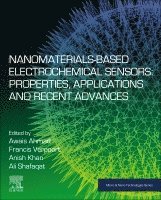
    Nanomaterials-Based Electrochemical Sensors: Properties, Applications, and Recent Advances

    AvAwais Ahmad,Francis Verpoort

    Häftad, Engelska, 2023

    Del i serien Micro and Nano Technologies

    2 267 kr

    Beställningsvara. Skickas inom 10-15 vardagar. Fri frakt över 249 kr.

    Beskrivning

    As opposed to conventional electrochemical sensors, nanomaterials-based sensors are active and effective in their action with even a minute concentration of analyte. A number of research studies are bringing about an evolution in their development and advancement because of their unique and effective properties.

    Nanoscale electrochemical sensors have applications in almost every field of life including the detection of neurochemicals, heavy metals, energy components, body fluids, biological matrices, cancer relevant biomolecules, aromatic hydrocarbons, also in playing their role in food science because of their capability in providing quality control and safety. There is a need to develop these nanomaterials-based electrochemical sensors to be more widely available for accurate sensing of minute concentrations especially in the case of heavy metal detection, biofluids, and other biomaterials. This book outlines the major preparation, fabrication and manufacture of nanomaterials-based electrochemical sensors, as well as detailing their principle medical, environmental and industrial applications in an effort to meet this need.

    This book is a valuable reference source for materials scientists, engineers, electrochemists, environmental engineers and biomedical engineers who want to understand how nanomaterials-based electrochemical sensors are made, and how they are used.

    • Explains the techniques used for the fabrication and manufacture of nanomaterials-based electrochemical sensors
    • Discusses the major applications of nanomaterials-based electrochemical sensors in biomedicine and environmental science
    • Assesses the potential toxicity and other challenges associated with using nanomaterials-based electrochemical sensors

    Produktinformation

    • Utgivningsdatum:2023-11-17
    • Mått:191 x 235 x 19 mm
    • Vikt:450 g
    • Format:Häftad
    • Språk:Engelska
    • Serie:Micro and Nano Technologies
    • Antal sidor:340
    • Förlag:Elsevier Science
    • ISBN:9780128225127

    Utforska kategorier

    • Maskinteknik och material inom Naturvetenskap och teknik

    Mer om författaren

    Dr. Awais Ahmad is a Researcher at the Department of Organic Chemistry, University of Cordoba in Spain. He completed his graduation from Government College University Faisalabad, Pakistan, and obtained his master's degree from the University of Lahore, Pakistan. Dr. Ahmad's research focuses on various areas including nanomaterials, composite materials, coated materials, heterogeneous catalysis, MOF, self-sacrifice MOF, single atom catalysis, photocatalysis, and electrochemical sensor formulations. He has applied these materials to address challenges in wastewater treatment, heavy metal removal, organic pollutant degradation, CO2 conversion, supercapacitors, dye-sensing solar cells, gel electrolytes, hazardous metal sensing in wastewater, conversion of hazardous gases, nitrogen fixation, catalysis for organic transformation, Li-S batteries, GCE nafion fiber, and water splitting. For about two decades, Prof. Francis Verpoort has carried out broad and fruitful teaching and research activity at Ghent University in various areas of materials chemistry, including organometallics, catalysis, molecular spectroscopy, related with notable applications in the production of fine chemicals and advanced polymeric materials. He has developed an extensive international scientific cooperation with scientists worldwide, taking part as an active member in different international scientific organizations, as well as in numerous successful bilateral collaboration projects with foreign academic institutions and universities across Europe, China, Russia, India, and in the UAE. In 2011, he was also appointed as Chair Professor at Wuhan University of Technology, China, where he established a research group covering organometallics and materials chemistry. Prof. Verpoort’s main research interests concern the structure and mechanisms of organometallic material chemistry, homogeneous and heterogeneous catalysis, MOFs and MOPs, Porous Organic Polymers (POPs), water splitting, olefin metathesis and its applications in fine chemicals and polymers, CO2 conversion, polymers. A particular specialism is the application of MOFs, POPs for the environment, water purification, and downstream upgrading applications. Dr. Anish Khan is currently working as Assistant Professor in Chemistry Department, Centre of Excellence for Advanced Materials Research (CEAMR), Faculty of Science, King Abdulaziz University, Jeddah, Saudi Arabia. Completed Ph.D. from Aligarh Muslim University, India in 2010. Completed Postdoctoral from School of Chemical Sciences, University Sains Malaysia (USM) in Electroanalytical chemistry in 2010. Working in the field of synthetic biosensor, polymer composites, organic–inorganic electrically conducting nanocomposites. More than 200 research articles, 70 book chapters 30 books published in referred international publisher and more than 20 international conferences/ workshop. More than 30 research projects completed. Editorial board member of more than 11 international journals. Member of American Nano Society.Dr Shafaqat Ali is an Associate Professor at GC University in Pakistan. He received his PhD in Crop Science from Zhejiang University, China, in 2010. He was previously the Agricultural Officer for the Government of Pakistan and has been a visiting scientist to the Institute of Soil Science in the Chinese Academy of Sciences since May 2017. He has almost 250 publications and over 6,000 citations.

    Innehållsförteckning

    • 1. Introduction: Nanomaterials and electrochemical sensors2. Process manufacturing techniques for nanomaterials3. Biological methods for preparing nanomaterials4. Chemical methods for preparing nanomaterials5. Toxicity of nanomaterials6. Types of electrochemical Sensors7. Electrochemical sensors using nanotechnology8. Nanotechnology-based sensing methods9. Metal oxides and their sensing application10. Silicate and its sensing applications11. RFID sensors based on nanomaterials12. Electrochemical sensors a pure process for environment and energy applications13. Biological and biomedical applications of electrochemical sensors14. Electrochemical sensors for organic compounds15. Electrochemical sensor for heavy metal detection16. Electrochemical sensor for detection of nitric oxides17. Nanomaterials-based electrochemical sensing of histamine18. Nanostructured complexes of gold(I) in sensing19. Analyte sensing with self-healing materials