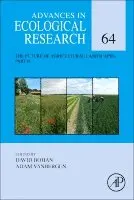
Inbunden, Engelska, 2021
The Future of Agricultural Landscapes, Part II
Av David Bohan
Del 64 i serien Advances in Ecological Research
2451 kr
Beställningsvara. Skickas inom 11-20 vardagar. Fri frakt över 249 kr.
Beskrivning
Advances in Ecological Research, Part Two, Volume 64, the latest release in this ongoing series, includes specific chapters on Tropical Ecosystems in the 21st Century. Chapters in this volume cover topics such as landscape-scale expansion of agroecology to enhance natural pest control, a systematic review and ecosystem services, and the resilience of agricultural landscapes.
- Provides information that relates to a thorough understanding of the field of ecology
- Deals with topical and important reviews on the physiologies, populations and communities of plants and animals
Produktinformation
- Utgivningsdatum: 2021-03-18
- Mått: 152 x 229 x undefined mm
- Vikt: 730 g
- Format: Inbunden
- Språk: Engelska
- Serie: Advances in Ecological Research
- Antal sidor: 388
- Förlag: Elsevier Science
- Medarbetare: Adam Vanbergen
- ISBN: 9780128229798
Utforska kategorier
Mer om författaren
Dave Bohan is an agricultural ecologist with an interest in predator-prey regulation interactions. Dave uses a model system of a carabid beetle predator and two agriculturally important prey; slugs and weed seeds. He has shown that carabids find and consume slug prey, within fields, and that this leads to regulation of slug populations and interesting spatial ‘waves’ in slug and carabid density. The carabids also intercept weed seeds shed by weed plants before they enter the soil, and thus carabids can regulate the long-term store of seeds in the seedbank on national scales. What is interesting about this system is that it contains two important regulation ecosystem services delivered by one group of service providers, the carabids. This system therefore integrates, in miniature, many of the problems of interaction between services.Dave has most recently begun to work with networks. He developed, with colleagues, a learning methodology to build networks from sample date. This has produced the largest, replicated network in agriculture. One of his particular interests is how behaviours and dynamics at the species level, as studied using the carabid-slug-weed system, build across species and their interactions to the dynamics of networks at the ecosystem level.
Betyg & recensioner
0 recensioner
Inga recensioner tillgängliga.