• Fri frakt över 249 kr
  • •
  • Snabba leveranser
  • •
  • Billiga böcker
Kundservice

Du är på sajten för privatpersoner.

Företag, bibliotek eller offentlig verksamhet?

Du handlar på classic.bokus.com, där alla dina funktioner finns intakta.
Till classic.bokus.com
Bokus logotyp. Gå till startsidan.
  • Erbjudanden
  • Nyheter
  • Student
  • Topplistor
  • Barn & ungdom
  • Bokus Play
  • E-böcker
  • Pocketböcker
  • Spel & pussel

10% rabatt på allt med kod: NYSTART10 →

Sidfot

Mina sidor

    Hjälp

    • Kundservice
    • Vanliga frågor och svar
    • Frakt och leverans
    • Retur vid ångerrätt
    • Reklamera vara
    • Betalning
    • Köpvillkor
    • Allmänna villkor
    • Information om webbplatsens tillgänglighet

    Om Bokus

    • Om oss
    • Pressrum
    • För studenter
    • För företag
    • För bibliotek och offentlig verksamhet
    • För leverantörer
    • Hållbarhet

    Populärt

    • Aktuella erbjudanden
    • Presentkort
    • Studentlitteratur
    • Nya böcker
    • Topplistor
    • Signerade böcker
    • Engelska böcker

    Inspiration

    • Boktips
    • BookTok
    • Populära bokserier
    • Barnbokskaraktärer
    • Populära författare
    Logotyp för Bokus
    Följ oss på Facebook (extern länk)Följ oss på Instagram (extern länk)Följ oss på YouTube (extern länk)Följ oss på TikTok (extern länk)
    bokus @ CookiesAnpassa cookiesIntegritetspolicyKöpvillkor
    Till Citymail hemsida (extern länk)Till Budbee hemsida (extern länk)Till Postnord hemsida (extern länk)Till Schenker hemsida (extern länk)Till Early Bird hemsida (extern länk)Till Walleys hemsida (extern länk)
    1. Språk och ordböcker
    2. Språkundervisning och språkinlärning

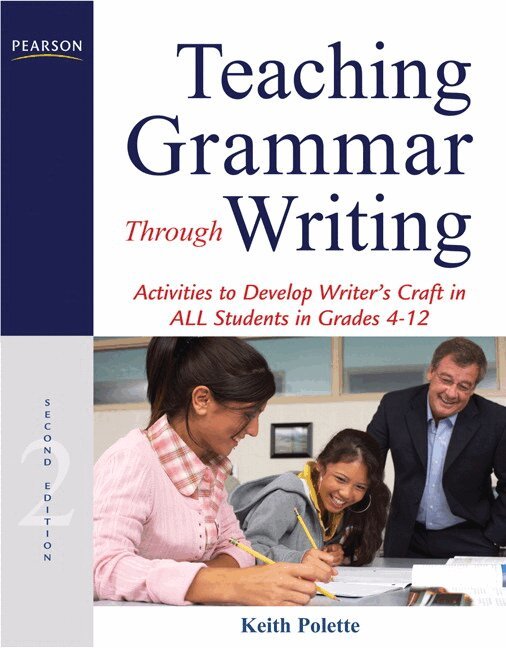
    Teaching Grammar Through Writing

    Activities to Develop Writer's Craft in ALL Students in Grades 4-12

    AvKeith Polette

    Häftad, Engelska, 2011

    924 kr

    Beställningsvara. Skickas inom 7-10 vardagar. Fri frakt över 249 kr.

    Beskrivning

    Teaching Grammar through Writing is the ideal springboard to teaching grammar to students in grades four through twelve. In a flexible, adaptable approach filled with ready to use activities, author Keith Polette shows teachers how to teach students to learn to recognize, and then consciously use in their writing, 16 essential grammatical elements.


    Rather than overwhelming students with too many structures, constructions, and rules, the book’s goal is simplification, showing teachers what the essential elements of grammar are that students need to learn to use to become better writers.

    Produktinformation

    • Utgivningsdatum:2011-06-24
    • Mått:220 x 275 x 15 mm
    • Vikt:471 g
    • Format:Häftad
    • Språk:Engelska
    • Antal sidor:192
    • Upplaga:2
    • Förlag:Pearson Education
    • ISBN:9780132565998

    Utforska kategorier

    • Språkundervisning och språkinlärning inom Språk och ordböcker
    • Lärarutbildning inom Psykologi och pedagogik

    Mer om författaren

    Dr. Keith Polette is a Professor of English at the University of Texas at El Paso. Dr. Polette received the UTEP College of Liberal Arts Award for Excellence in Teaching and Research, the UT System Chancellor’s Council Award for Excellence in Teaching, and was recognized by the Texas State Reading Association as an Outstanding Texas Author. Prior to moving to El Paso in 1995, Dr. Polette was a Mentor Teacher and an English/Language Arts teacher for both remedial and gifted students in St. Louis, Missouri. Dr. Polette has published over thirty articles in professional journals, eight books on teaching, and two books for children. His most recent publications are Read and Write It Out Loud: Guided Oral Literacy Strategies, Isabel and the Hungry Coyote, Paco and the Giant Chile Plant, and Moon Over The Mountain (Raven Tree Press). For the past twenty years, Dr. Polette has given keynote addresses and been a featured speaker at national, regional, and state literacy conferences, and at schools throughout the United States and Canada.

    Innehållsförteckning

    • ContentsIntroduction Chapter 1       Word Works I: Nouns Word Works II: Verbs Word Works III: Pronouns Word Works IV: Adjectives Word Works V: Adverbs Word Works VI: Prepositions Word Works VII: Conjunctions Chapter 2       Sentence Works I: Absolute Phrases Sentence Works II: Gerund Phrases Sentence Works III: Infinitive Phrases Sentence Works IV: Prepositional Phrases Sentence Works V: Participial Phrases Sentence Works VI: Appositive Phrases Sentence Works VII: Adjective Clauses Sentence Works VIII: Adverbial Clauses Sentence Works IX: Noun Clauses Sentence Expanding Sentence Combining Sentence Matching Sentence Sense Chapter 3       Punctuation Points The Comma The Apostrophe The Colon The Exclamation Point Quotation Marks The Semicolon Special Focus: The Comma Splice The Hyphen The Dash What Is a Sentence? Sentence Subjects Sentence Predicates Compound Subjects and Predicates Direct Object Indirect Object Predicate Noun Predicate Adjective Parallel Structure in Sentences Sentence Structures Ten Sentence Patterns to Imitate Sixteen Kinds of Sentences: Different Constructions for Different Purposes Figurative LanguageA Note on Voice  Chapter 4       Passages to Edit Reading Closely and Carefully to Find and Fix Errors Chapter 5       Poetry Patterns Build-a-Name Poetry Diamante Wishing upon a Poem Bio-Poem Night Poem Alliterative Poem Alliterative Character Poem Parts of Speech Poem Adverb Poem Another Parts of Speech Poem Prepositional Phrase Poem Participial Phrase Poem Sentence Pattern Poems Syllable Poems Syllable Question Poem Text Message Poem Chapter 6       Acts of Writing: Putting It All Together with Process Writing Five Recursive Steps in the Writing Process Activities and Ideas to Support Poetry Writing Writing Extensions Appendix A    Ideas for Writing in the Content Areas Writing about a Nonfiction Topic Using an Alliterative Pattern Writing about Frogs (or a person, animal, object, or place): Alternative Acrostic Poems Writing about Two Animals with a Contrast Pattern Writing about People, Things, or Animals: So You Want to Be The Five Good Things Pattern Writing about a Nonfiction Topic Using an Informational Paragraph The Contrast Paragraph Writing a Character Analysis/Personality Trait Paragraph Multi-Modal Character/Person Analysis Paragraph Biographical Writing: Who Is the Real Walter Frederick Morrison? Appendix B    Writing in Response to a Prompt: What Is a Hero? Appendix C    Reproducible Masters Works Cited