• Fri frakt över 249 kr
  • •
  • Snabba leveranser
  • •
  • Billiga böcker
Kundservice

Du är på sajten för privatpersoner.

Företag, bibliotek eller offentlig verksamhet?

Du handlar på classic.bokus.com, där alla dina funktioner finns intakta.
Till classic.bokus.com
Bokus logotyp. Gå till startsidan.
  • Erbjudanden
  • Nyheter
  • Student
  • Topplistor
  • Barn & ungdom
  • Bokus Play
  • E-böcker
  • Pocketböcker
  • Spel & pussel

10% rabatt på allt med kod NYSTART10 →

Sidfot

Mina sidor

    Hjälp

    • Kundservice
    • Vanliga frågor och svar
    • Frakt och leverans
    • Retur vid ångerrätt
    • Reklamera vara
    • Betalning
    • Köpvillkor
    • Allmänna villkor
    • Information om webbplatsens tillgänglighet

    Om Bokus

    • Om oss
    • Pressrum
    • För studenter
    • För företag
    • För bibliotek och offentlig verksamhet
    • För leverantörer
    • Hållbarhet

    Populärt

    • Aktuella erbjudanden
    • Presentkort
    • Studentlitteratur
    • Nya böcker
    • Topplistor
    • Signerade böcker
    • Engelska böcker

    Inspiration

    • Boktips
    • BookTok
    • Populära bokserier
    • Barnbokskaraktärer
    • Populära författare
    Logotyp för Bokus
    Följ oss på Facebook (extern länk)Följ oss på Instagram (extern länk)Följ oss på YouTube (extern länk)Följ oss på TikTok (extern länk)
    bokus @ CookiesAnpassa cookiesIntegritetspolicyKöpvillkor
    Till Citymail hemsida (extern länk)Till Budbee hemsida (extern länk)Till Postnord hemsida (extern länk)Till Schenker hemsida (extern länk)Till Early Bird hemsida (extern länk)Till Walleys hemsida (extern länk)
    1. Naturvetenskap och teknik
    2. Teknik och industri
    3. Teknik: allmänt

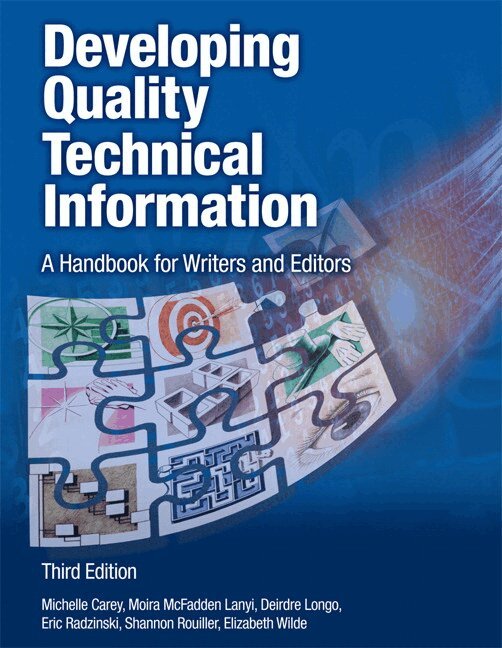
    Developing Quality Technical Information

    A Handbook for Writers and Editors

    AvMichelle Carey,Moira Lanyi

    Häftad, Engelska, 2014

    Del i serien IBM Press

    335 kr

    Beställningsvara. Skickas inom 7-10 vardagar. Fri frakt över 249 kr.

    Beskrivning

    The #1 Guide to Excellence in Technical Communication—Fully Updated for Embedded Assistance, Mobile, Search, Multimedia, and More


    Direct from IBM’s own content design experts, this guide shows you how to design product interfaces and technical information that always place users front and center. This edition has been fully revised to help you consistently deliver the right content at the right time.


    You’ll master today’s best practices to apply nine essential characteristics of high-quality technical information: accuracy, clarity, completeness, concreteness, organization, retrievability, style, task orientation, and visual effectiveness.


    Coverage Includes

    • Advocating for users throughout the entire product development process
    • Delivering information in an ordered manner by following progressive disclosure techniques
    • Optimizing content so that users can find it from anywhere
    • Streamlining information for mobile delivery
    • Helping users right where they are

    Whether you’re a writer, editor, information architect, user experience professional, or reviewer, this book shows you how to create great technical information, from the product design to the user interface, topics, and other media.

    • Thoroughly revised and updated
    • Extensive new coverage of self-documenting interfaces and embedded assistance
    • Updated practical guidelines and checklists
    • Hundreds of new examples


    Produktinformation

    • Utgivningsdatum:2014-07-17
    • Mått:176 x 231 x 34 mm
    • Vikt:980 g
    • Format:Häftad
    • Språk:Engelska
    • Serie:IBM Press
    • Antal sidor:624
    • Upplaga:3
    • Förlag:Pearson Education
    • ISBN:9780133118971

    Utforska kategorier

    • Teknik: allmänt inom Naturvetenskap och teknik
    • Grafik och bildbehandling inom Data och IT
    • Skrivande och redigering inom Språk och ordböcker

    Mer om författaren

    The authors are all long-standing and respected members of the information development community at IBM. Although the authors have served in various roles throughout their careers, information quality has always been and continues to be their primary focus.  Michelle Carey is an information architect and technical editor at IBM and has taught technical communication at University of California Santa Cruz Extension. Michelle is the co-author of the book DITA Best Practices: A Roadmap for Writing, Editing, and Architecting in DITA. She is an expert on topic-based information systems, software product error messages, grammar, embedded assistance for user interfaces, and writing for international audiences. She also writes computational linguistic rules for a grammar, style, and terminology management tool. Michelle enjoys teaching, grammar, herding cats, and riding and driving anything with a lot of horsepower.  Moira McFadden Lanyi is an information architect and technical editor at IBM. She has experience with topic-based writing, DITA, embedded assistance, user interface design, and visual design. She created 99% of the artwork in this book. She is a co-author of the book An Introduction to IMS. Moira enjoys visiting San Francisco with her family as often as possible, cooking fresh, healthy meals, and watching her courageous son ride his unicycle and surf.  Deirdre Longo is an information architect and strategist at IBM. She has been a pioneer for embedded assistance in IBM: defining the scope of that term, developing standards for embedded assistance, and modeling how to work effectively in cross-disciplinary teams. She has taught webinars for the Society of Technical Communication (STC) and published articles on information architecture topics in STC’s Intercom. She is an avid yoga practitioner.  Eric Radzinski is a technical editor and information architect for industry-leading mainframe database software at IBM. He is a co-author of The IBM Style Guide: Conventions for Writers and Editors and is well versed in topic-based writing, embedded assistance, DITA, and writing for a global audience. Eric makes his home in San Jose, California, with his wife and their three children.  Shannon Rouiller is an information architect and technical editor at IBM. She has experience with quality metrics, topic-based information systems, DITA, videos, embedded assistance, and user interface design. She is a co-author of the book Designing Effective Wizards. Shannon dabbles in sports photography and likes to solve puzzles.  Elizabeth Wilde is an information quality strategist at IBM, developing strategies and education for developing high-quality content. She develops Acrolinx computational linguistic rules that enforce grammar, style, and DITA tagging rules. She teaches an extension course in technical writing at the University of California Santa Cruz. Her hobbies include growing cacti and succulents and collecting tattoos.

    Innehållsförteckning

    • Preface     Acknowledgments    About the authors     Part 1. Introduction    Chapter 1. Technical information continues to evolve    Embedded assistance   Progressive disclosure of information    The technical writer’s role today    Redefining quality technical information    Chapter 2. Developing quality technical information    Preparing to write: understanding users, goals, and product tasks    Writing and rewriting    Reviewing, testing, and evaluating technical information    Part 2. Easy to use    Chapter 3. Task orientation    Write for the intended audience    Present information from the users’ point of view    Focus on users’ goals    Identify tasks that support users’ goals    Write user-oriented task topics, not function-oriented task topics    Avoid an unnecessary focus on product features    Indicate a practical reason for information    Provide clear, step-by-step instructions    Make each step a clear action for users to take    Group steps for usability    Clearly identify steps that are optional or conditional    Task orientation checklist    Chapter 4. Accuracy    Research before you write    Verify information that you write    Maintain information currency    Keep up with technical changes    Avoid writing information that will become outdated    Maintain consistency in all information about a subject    Reuse information when possible