• Fri frakt över 249 kr
  • •
  • Snabba leveranser
  • •
  • Billiga böcker
Kundservice

Du är på sajten för privatpersoner.

Företag, bibliotek eller offentlig verksamhet?

Du handlar på classic.bokus.com, där alla dina funktioner finns intakta.
Till classic.bokus.com
Bokus logotyp. Gå till startsidan.
  • Erbjudanden
  • Nyheter
  • Student
  • Topplistor
  • Barn & ungdom
  • Bokus Play
  • E-böcker
  • Pocketböcker
  • Spel & pussel

10% rabatt på allt med kod NYSTART10 →

Sidfot

Mina sidor

    Hjälp

    • Kundservice
    • Vanliga frågor och svar
    • Frakt och leverans
    • Retur vid ångerrätt
    • Reklamera vara
    • Betalning
    • Köpvillkor
    • Allmänna villkor
    • Information om webbplatsens tillgänglighet

    Om Bokus

    • Om oss
    • Pressrum
    • För studenter
    • För företag
    • För bibliotek och offentlig verksamhet
    • För leverantörer
    • Hållbarhet

    Populärt

    • Aktuella erbjudanden
    • Presentkort
    • Studentlitteratur
    • Nya böcker
    • Topplistor
    • Signerade böcker
    • Engelska böcker

    Inspiration

    • Boktips
    • BookTok
    • Populära bokserier
    • Barnbokskaraktärer
    • Populära författare
    Logotyp för Bokus
    Följ oss på Facebook (extern länk)Följ oss på Instagram (extern länk)Följ oss på YouTube (extern länk)Följ oss på TikTok (extern länk)
    bokus @ CookiesAnpassa cookiesIntegritetspolicyKöpvillkor
    Till Citymail hemsida (extern länk)Till Budbee hemsida (extern länk)Till Postnord hemsida (extern länk)Till Schenker hemsida (extern länk)Till Early Bird hemsida (extern länk)Till Walleys hemsida (extern länk)
    1. Språk och ordböcker
    2. Språkvetenskap och lingvistik

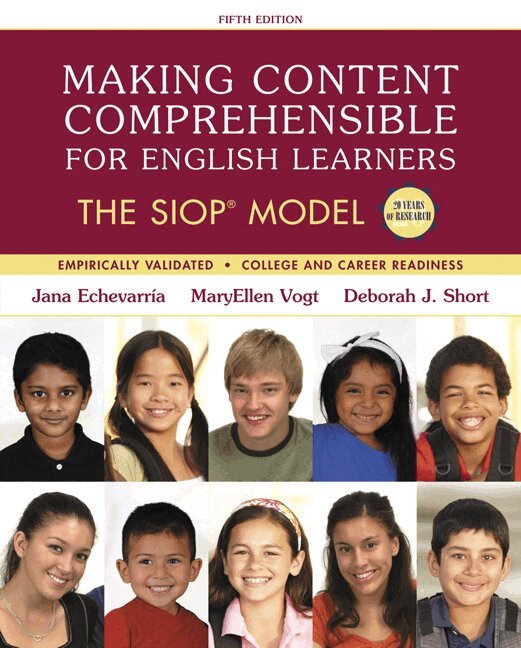
    Making Content Comprehensible for English Learners

    The SIOP Model

    AvJana Echevarria,MaryEllen Vogt

    Häftad, Engelska, 2016

    Del i serien SIOP Series

    980 kr

    Beställningsvara. Skickas inom 7-10 vardagar. Fri frakt över 249 kr.

    Fler format och utgåvor

    Övrigt

    Tillf. slut

    Beskrivning

    Note: This is the bound book only and does not include access to the Enhanced Pearson eText. To order the Enhanced Pearson eText packaged with a bound book, use ISBN 0134403290.

    Using a writing style that is practical and applicable to all kinds of classrooms, this widely popular book presents a user-friendly approach for planning and implementing lessons for teaching English learners and other students. It provides students with access to grade-level content, develops their academic English skills, and prepares them to be college and career ready. The SIOP model is a comprehensive, coherent, research-validated, success-proven model for improving teaching effectiveness and ensuring academic gains for students. It can be implemented in all content areas at all grade levels and English proficiency levels. Making Content Comprehensible for English Learners provides specific application of the SIOP to the Common Core and other state standards and includes a Reflect and Apply eText feature in which readers explain their rating of teachers’ lessons, and Teaching with Technology vignettes that describe how to infuse technology into many different SIOP lessons. The Enhanced Pearson eText features new video links inserted throughout to illustrate chapter topics and discussion points. Check for Understanding and end-of-chapter quizzes provide a comprehensive means for gauging student understanding.

    Improve mastery and retention with the Enhanced Pearson eText*
    The Enhanced Pearson eText provides a rich, interactive learning environment designed to improve student mastery of content. The Enhanced Pearson eText is:

    • Engaging. The new interactive, multimedia learning features were developed by the authors and other subject-matter experts to deepen and enrich the learning experience.
    • Convenient. Enjoy instant online access from your computer or download the Pearson eText App to read on or offline on your iPad® and Android® tablet.*
    • Affordable. The Enhanced Pearson eText may be purchased stand-alone for 50-60% less than a print bound book.

    *The Enhanced eText features are only available in the Pearson eText format. They are not available in third-party eTexts or downloads.

    *The Pearson eText App is available on Google Play and in the App Store. It requires Android OS 3.1-4, a 7” or 10” tablet, or iPad iOS 5.0 or later.

    Produktinformation

    • Utgivningsdatum:2016-05-19
    • Mått:10 x 10 x 10 mm
    • Vikt:735 g
    • Format:Häftad
    • Språk:Engelska
    • Serie:SIOP Series
    • Antal sidor:384
    • Upplaga:5
    • Förlag:Pearson Education
    • ISBN:9780134045238

    Utforska kategorier

    • Språkvetenskap och lingvistik inom Språk och ordböcker
    • Lärarutbildning inom Psykologi och pedagogik
    • Pedagogik inom Psykologi och pedagogik

    Mer om författaren

    Jana Echevarría, Ph.D., is Professor Emerita at California State University, Long Beach where she was selected as Outstanding Professor. She has taught in elementary, middle, and high school in general education, special education, ESL, and bilingual programs. An internationally known expert on second language learners, she has lived and worked in Taiwan, Mexico, and Spain. Her research and publications focus on effective instruction for English learners, including those with learning disabilities. She has presented her research across the U.S. and internationally including Oxford University (England), Wits University (South Africa), Harvard University (U.S.), Stanford University (U.S.), University of Barcelona (Spain) and South East Europe University (Macedonia) where she was a Fulbright Specialist. A founding researcher of the SIOP Model her publications include multiple books, book chapters and journal articles.MaryEllen Vogt, Ed.D., is Professor Emerita of Education at California State University, Long Beach. Dr. Vogt, a former classroom teacher, reading specialist, curriculum coordinator, and teacher educator, received her doctorate from the University of California, Berkeley. She is an author of over 60 articles and chapters, and is co-author of seventeen books for teachers and administrators, including Making Content Comprehensible for English Learners: The SIOP Model. Her research interests include improving comprehension in the content areas, teacher change and development, and content literacy and language acquisition for English learners. Dr. Vogt has provided professional development in all fifty states and in several other countries, including Germany, where she was invited to serve as a Visiting Scholar at the University of Cologne. She was inducted into the California Reading Hall of Fame, received her university’s Distinguished Faculty Teaching Award, and served as President of the International Reading Association.Deborah J. Short, Ph.D., founded and directs Academic Language Research & Training, a consulting company, and provides professional development on sheltered instruction, content-based language teaching, and academic literacy worldwide. Formerly she was a Division Director at the Center for Applied Linguistics, Washington, DC, where she directed quasi-experimental and experimental studies on English learners funded by the Carnegie Corporation of New York, Rockefeller Foundation, and U.S. Department of Education, among others. Her publications include journal articles, the SIOP® Model book series, and several ESL textbook series for National Geographic/Cengage. She taught English as a second/foreign language in New York, California, Virginia, and the Democratic Republic of the Congo. She has served on the Board of Directors of the TESOL International Association and has presented research in the U.S., Canada, New Zealand, Brazil, Europe, and the Middle East.

    Innehållsförteckning

    • Brief Table of Contents1 Introducing the SIOP® Model2 Lesson Preparation3 Building Background4 Comprehensible Input5 Strategies6 Interaction7 Practice & Application8 Lesson Delivery9 Review & Assessment10 Issues of Reading, RTI, and Special Education for English Learners11 Effective Use of the SIOP® Protocol12 Frequently Asked Questions: Getting Started with the SIOP® ModelDetailed Table of Contents1 Introducing the SIOP® Model 1Background on English Learners 3Demographic Trends 3Diverse Characteristics 4School Reform, Standards, and Accountability 8Achievement Gaps 10Academic Language and Literacy 12Research on Academic Language and Literacy 13Role in Schooling 13Effective Instructional Practice for English Learners: The SIOP® Model 15Content-based ESL and Sheltered Content Instruction 15Research and Development of the Sheltered Instruction ObservationProtocol (SIOP®) Model 17Effective SIOP® Model Instruction 20Implementing the SIOP® Model 24Summary 25Discussion Questions 252 Lesson Preparation 27Background 28Selecting and Writing Content and Language Objectives 35Teaching Ideas for Lesson Preparation 50Differentiating Ideas for Multi-level Classes 53Rating Lessons with the SIOP® Protocol 54The Lesson 55Teaching Scenarios 56Discussion of Lessons 62Teaching with Technology 66Summary 68Discussion Questions 683 Building Background 70Background 71Something to Think About 74Academic Vocabulary 76Word Consciousness 80Teaching Academic Vocabulary 80Teaching Ideas for Building Background 81Differentiating Ideas for Multi-level Classes 88The Lesson 89Teaching Scenarios 90Discussion of Lessons 96Teaching with Technology 99Summary 100Discussion Questions 1004 Comprehensible Input 102Background 104Teaching Ideas for Comprehensible Input 111Differentiating Ideas for Multi-level Classes 112The Lesson 113Teaching Scenarios 113Discussion of Lessons 118Teaching with Technology 122Summary 124Discussion Questions 1245 Strategies 125Background 126Things to Consider When Teaching Learning Strategies 128Three Types of Scaffolding 131Teaching Ideas for Strategies 133Differentiating Ideas for Multi-level Classes 136The Lesson 137Teaching Scenarios 138Discussion of Lessons 145Teaching with Technology 149Summary 150Discussion Questions 1506 Interaction 152Background 154Typical Lesson 155SIOP® Lesson 156Oral Language Development 158Teaching Ideas for Interaction 167Differentiating Ideas for Multi-level Classes 169The Lesson 171Teaching Scenarios 171Discussion of Lessons 176Teaching with Technology 179Summary 180Discussion Questions 1817 Practice & Application 182Background 183Teaching Ideas for Practice & Application 189Differentiating Ideas for Multi-level Classes 190The Lesson 192Teaching Scenarios 193Discussion of Lessons 198Teaching with Technology 201Summary 202Discussion Questions 2028 Lesson Delivery 204Background 205Linking Lesson Preparation and Lesson Delivery 210Teaching Ideas for Lesson Delivery 212Differentiating Ideas for Multi-level Classes 213The Lesson 214Teaching Scenarios 215Discussion of Lessons 218Teaching with Technology 222Summary 223Discussion Questions 2239 Review & Assessment 225Background 226Classroom Context and the Review & Assessment Component 227Formative and Summative Assessment 228Informal Assessment 228Formal Assessment 229Teaching Ideas for Review & Assessment 235Differentiating Ideas for Multi-level Classes 238The Lesson 240Teaching Scenarios 240Discussion of Lessons 246Teaching with Technology 250Summary 251Discussion Questions 25210 Issues of Reading, RTI, and Special Education for English Learners 254Issues of Reading Development and Assessment 255Estimating Students’ Reading Levels 257English Learners and the Common Core State Standards for Reading, Writing, Listening, and Speaking 259Assisting Struggling Learners: Response to Intervention 262Issues Related to Special Education 264Special Education Services: When Are They Appropriate? 267Search for Intervention Rather than Disability 269Teaching Ideas for Students with Special Needs 270Summary 272Discussion Questions 27211 Effective Use of the SIOP® Protocol 274Best Practice in Using the SIOP® Protocol 275Scoring and Interpreting the SIOP® Protocol 277Assigning Scores 278Not Applicable (NA) Category 278Calculating Scores 279Using Non-Numeric Rating 280Sample Lesson 280Using SIOP® Scores and Comments 284Reliability and Validity of the SIOP® 293Summary 293Discussion Questions 29312 Frequently Asked Questions: Getting Started with the SIOP® Model 294General SIOP® Questions 295Questions About Getting Started with SIOP® in the Classroom 297Questions About School-wide Implementation of the SIOP® Model 298Appendix A: SIOP® (Sheltered Instruction Observation Protocol) 302Appendix B: Lesson Plans 312Appendix C: Research on the SIOP® (Sheltered Instruction Observation Protocol) Model 317Appendix D: SIOP® Professional Development Resources 323Glossary 326References 331Index 353