• Fri frakt över 249 kr
  • •
  • Snabba leveranser
  • •
  • Billiga böcker
Kundservice

Du är på sajten för privatpersoner.

Företag, bibliotek eller offentlig verksamhet?

Du handlar på classic.bokus.com, där alla dina funktioner finns intakta.
Till classic.bokus.com
Bokus logotyp. Gå till startsidan.
  • Erbjudanden
  • Nyheter
  • Student
  • Topplistor
  • Barn & ungdom
  • Bokus Play
  • E-böcker
  • Pocketböcker
  • Spel & pussel

10% rabatt på allt med kod NYSTART10 →

Sidfot

Mina sidor

    Hjälp

    • Kundservice
    • Vanliga frågor och svar
    • Frakt och leverans
    • Retur vid ångerrätt
    • Reklamera vara
    • Betalning
    • Köpvillkor
    • Allmänna villkor
    • Information om webbplatsens tillgänglighet

    Om Bokus

    • Om oss
    • Pressrum
    • För studenter
    • För företag
    • För bibliotek och offentlig verksamhet
    • För leverantörer
    • Hållbarhet

    Populärt

    • Aktuella erbjudanden
    • Presentkort
    • Studentlitteratur
    • Nya böcker
    • Topplistor
    • Signerade böcker
    • Engelska böcker

    Inspiration

    • Boktips
    • BookTok
    • Populära bokserier
    • Barnbokskaraktärer
    • Populära författare
    Logotyp för Bokus
    Följ oss på Facebook (extern länk)Följ oss på Instagram (extern länk)Följ oss på YouTube (extern länk)Följ oss på TikTok (extern länk)
    bokus @ CookiesAnpassa cookiesIntegritetspolicyKöpvillkor
    Till Citymail hemsida (extern länk)Till Budbee hemsida (extern länk)Till Postnord hemsida (extern länk)Till Schenker hemsida (extern länk)Till Early Bird hemsida (extern länk)Till Walleys hemsida (extern länk)
    1. Språk och ordböcker
    2. Språkvetenskap och lingvistik

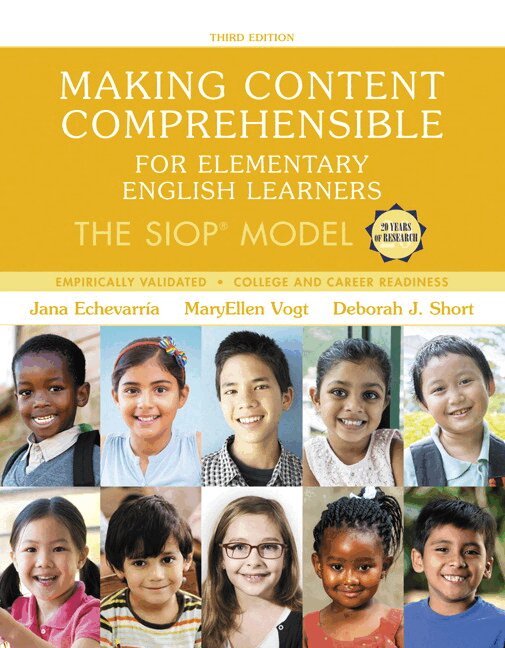
    Making Content Comprehensible for Elementary English Learners

    The SIOP Model

    AvJana Echevarria,MaryEllen Vogt

    Häftad, Engelska, 2017

    924 kr

    Tillfälligt slut

    Fler format och utgåvor

    Övrigt

    Tillf. slut

    Beskrivning

    Note: This is the bound book only and does not include access to the Enhanced Pearson eText. To order the Enhanced Pearson eText packaged with a bound book, use ISBN 0134550129.

    In this comprehensive guide, elementary educators get a user-friendly approach for planning and implementing lessons that provide students access to grade-level content, develop students’ academic English skills, and prepare students to be college- and career-ready. Proven successful in improving teaching effectiveness and realizing academic gains for students, the SIOP Model presented in this book can be implemented in all content areas, and across grade levels and English proficiency levels.

    Highlights of the 3rd Edition include specific applications of SIOP to Common Core and other state standards, as well as new educational reforms such as ESSA. To help teachers implement the SIOP model, new learning aids have been added, including Reflect and Apply exercises, Teaching with Technology vignettes, a new SIOP lesson plan template and sample lesson plan, and a new user-friendly approach to identifying and writing language objectives. The Enhanced Pearson eText version provides embedded video links that enable students to see the SIOP model in action, along with interviews featuring SIOP educators.

    Improve mastery and retention with the Enhanced Pearson eText*
    The Enhanced Pearson eText provides a rich, interactive learning environment designed to improve student mastery of content. The Enhanced Pearson eText is:

    • Engaging. The new interactive, multimedia learning features were developed by the authors and other subject-matter experts to deepen and enrich the learning experience.
    • Convenient. Enjoy instant online access from your computer or download the Pearson eText App to read on or offline on your iPad® and Android® tablet.*
    • Affordable. Experience the advantages of the Enhanced Pearson eText along with all the benefits of print for 40% to 50% less than a print bound book.

    *The Enhanced eText features are only available in the Pearson eText format. They are not available in third-party eTexts or downloads.

    *The Pearson eText App is available on Google Play and in the App Store. It requires Android OS 3.1-4, a 7” or 10” tablet, or iPad iOS 5.0 or later.

    Produktinformation

    • Utgivningsdatum:2017-07-28
    • Mått:213 x 272 x 15 mm
    • Vikt:670 g
    • Format:Häftad
    • Språk:Engelska
    • Antal sidor:384
    • Upplaga:3
    • Förlag:Pearson Education
    • ISBN:9780134550206

    Utforska kategorier

    • Språkvetenskap och lingvistik inom Språk och ordböcker
    • Lärarutbildning inom Psykologi och pedagogik
    • Pedagogik inom Psykologi och pedagogik

    Mer om författaren

    Jana Echevarría, PhD, is Professor Emerita at California State University, Long Beach where she was selected as Outstanding Professor. She has taught in general education, special education, ESL, and bilingual programs in U.S. schools, and has lived and worked in Taiwan, Mexico, Spain, and in Macedonia where she was a Fulbright Specialist. Her research and publications focus on effective instruction for English learners, including those with learning disabilities. She has presented her research across the United States and internationally including Oxford University (England), Wits University (South Africa), Harvard University (United States), Stanford University (United States), University of Barcelona (Spain) and South East Europe University (Macedonia). A founding researcher of the SIOP Model, her publications include more than 60 books, book chapters and journal articles. Currently she serves as the EL expert for the U.S. Department of Justice on the Lau case. Her blog is found at www.janaechevarria.com.MaryEllen Vogt, EdD, is Professor Emerita of Education at California State University, Long Beach. Dr. Vogt, a former classroom teacher, reading specialist, curriculum coordinator, and teacher educator, received her doctorate from the University of California, Berkeley. She is an author of numerous articles and chapters, and is co-author of seventeen books for teachers and administrators, including Professional Learning in Action: An Inquiry Approach for Teachers of Learning (Risko & Vogt, 2016). Her research interests include improving comprehension in the content areas, teacher change and development, and content literacy and language acquisition for English learners. Dr. Vogt has provided professional development in all fifty states and in several countries, including Germany, where she served as a Visiting Scholar at the University of Cologne. She was inducted into the California Reading Hall of Fame, received her university’s Distinguished Faculty Teaching Award, and served as President of the International Reading Association.Deborah J. Short, PhD, founded and directs Academic Language Research & Training, a consulting company, and provides professional development on sheltered instruction, content-based language teaching, and academic literacy worldwide. Formerly she was a Division Director at the Center for Applied Linguistics, Washington, DC, where she co-developed the SIOP Model and directed quasi-experimental and experimental studies on English learners funded by the Carnegie Corporation of New York, Rockefeller Foundation, and U.S. Department of Education, among others. Her publications include journal articles, the SIOP® Model book series, and several ESL textbook series for National Geographic/Cengage. She taught English as a second/foreign language in New York, California, Virginia, and the Democratic Republic of the Congo. She has served on the Board of Directors of the TESOL International Association and has presented research in the United States, Canada, New Zealand, Brazil, Colombia, Europe, and the Middle East.

    Innehållsförteckning

    • Brief Table of Contents 1. Introducing the SIOP® Model 2. Lesson Preparation 3. Building Background 4. Comprehensible Input 5. Strategies 6. Interaction 7. Practice & Application 8. Lesson Delivery 9. Review & Assessment 10. Issues of Reading, RTI, and Special Education for English Learners 11. Effective Use of the SIOP® Protocol 12. Frequently Asked Questions: Getting Started with the SIOP® Model Appendix A: SIOP (Sheltered Instruction Observation Protocol) Appendix B: Lesson Plans Appendix C: Research on the SIOP (Sheltered Instruction Observation Protocol) Model Appendix D: SIOP Professional Development Resources Glossary References Index Detailed Table of Contents1. Introducing the SIOP® Model Background on English LearnersDemographic TrendsDiverse CharacteristicsSchool Reform, Standards, and AccountabilityAchievement GapsAcademic Language and LiteracyResearch on Academic Language and LiteracyRole in SchoolingEffective Instructional Practice for English Learners: The SIOP® ModelContent-based ESL and Sheltered Content InstructionResearch and Development of the Sheltered Instruction Observation Protocol (SIOP®) ModelEffective SIOP® Model InstructionImplementing the SIOP® ModelSummaryDiscussion Questions2. Lesson Preparation BackgroundSIOP® Feature 1: Content Objectives Clearly Defined, Displayed, and Reviewed with StudentsSIOP® Feature 2: Language Objectives Clearly Defined, Displayed, and Reviewed with StudentsSelecting and Writing Content and Language ObjectivesSIOP® Feature 3: Content Concepts Appropriate for Age and Educational Background Level of StudentsSIOP® Feature 4: Supplementary Materials Used to a High Degree, Making the Lesson Clear and MeaningfulSIOP® Feature 5: Adaptation of Content to All Levels of Student ProficiencySIOP® Feature 6: Meaningful Activities That Integrate Lesson Concepts with Language Practice Opportunities for Reading, Writing, Listening, and/or SpeakingTeaching Ideas for Lesson PreparationDifferentiating Ideas for Multi-level ClassesRating Lessons with the SIOP® ProtocolThe LessonTeaching ScenariosDiscussion of LessonsTeaching with TechnologySummaryDiscussion Questions3. Building Background BackgroundSIOP® Feature 7: Concepts Explicitly Linked to Students’ Background ExperiencesSomething to Think AboutSIOP® Feature 8: Links Explicitly Made between Past Learning and New ConceptsSIOP® Feature 9: Key Vocabulary EmphasizedAcademic VocabularyWord ConsciousnessTeaching Academic VocabularyTeaching Ideas for Building BackgroundDifferentiating Ideas for Multi-level ClassesThe LessonTeaching ScenariosDiscussion of LessonsTeaching with TechnologySummaryDiscussion Questions4. Comprehensible Input BackgroundSIOP® Feature 10: Speech Appropriate for Students’ Proficiency LevelsSIOP® Feature 11: Clear Explanation of Academic TasksSIOP® Feature 12: A Variety of Techniques Used to Make Content Concepts ClearTeaching Ideas for Comprehensible InputDifferentiating Ideas for Multi-level ClassesThe LessonTeaching ScenariosDiscussion of LessonsTeaching with TechnologySummaryDiscussion Questions5. Strategies BackgroundSIOP® Feature 13: Ample Opportunities Provided for Students to Use Learning StrategiesThings to Consider When Teaching Learning StrategiesSIOP® Feature 14: Scaffolding Techniques Consistently Used, Assisting and Supporting Student UnderstandingThree Types of ScaffoldingSIOP® Feature 15: A Variety of Questions or Tasks That Promote Higher-Order Thinking SkillsTeaching Ideas for StrategiesDifferentiating Ideas for Multi-level ClassesThe LessonTeaching ScenariosDiscussion of LessonsTeaching with TechnologySummaryDiscussion Questions6. Interaction BackgroundTypical LessonSIOP® LessonSIOP® Feature 16: Frequent Opportunities for Interaction and Discussion Between Teacher/Student and Among Students, Which Encourage Elaborated Responses About Lesson ConceptsOral Language DevelopmentSIOP® Feature 17: Grouping Configurations Support Language and Content Objectives of the LessonSIOP® Feature 18: Sufficient Wait Time for Student Responses Consistently ProvidedSIOP® Feature 19: Ample Opportunity for Students to Clarify Key Concepts in L1 as Needed with Aide, Peer, or L1 TextTeaching Ideas for InteractionDifferentiating Ideas for Multi-level ClassesThe LessonTeaching ScenariosDiscussion of LessonsTeaching with TechnologySummaryDiscussion Questions7. Practice & ApplicationBackgroundSIOP® Feature 20: Hands-On Materials and/or Manipulatives Provided for Students to Practice Using New Content Knowledge in the ClassroomSIOP® Feature 21: Activities Provided for Students to Apply Content and Language KnowledgeSIOP® Feature 22: Activities Integrate All Language SkillsTeaching Ideas for Practice & ApplicationDifferentiating Ideas for Multi-level ClassesThe LessonTeaching ScenariosDiscussion of LessonsTeaching with TechnologySummaryDiscussion Questions8. Lesson Delivery BackgroundSIOP® Feature 23: Content Objectives Clearly Supported by Lesson DeliverySIOP® Feature 24: Language Objectives Clearly Supported by Lesson DeliverySIOP® Feature 25: Students Engaged Approximately 90% to 100% of the PeriodSIOP® Feature 26: Pacing of the Lesson Appropriate to Students’ Ability LevelsLinking Lesson Preparation and Lesson DeliveryTeaching Ideas for Lesson DeliveryDifferentiating Ideas for Multi-level ClassesThe LessonTeaching ScenariosDiscussion of LessonsTeaching with TechnologySummaryDiscussion Questions9. Review & AssessmentBackgroundClassroom Context and the Review & Assessment ComponentFormative and Summative AssessmentInformal AssessmentFormal AssessmentSIOP® Feature 27: Comprehensive Review of Key VocabularySIOP® Feature 28: Comprehensive Review of Key Content ConceptsSIOP® Feature 29: Regular Feedback Provided to Students on Their OutputSIOP® Feature 30: Assessment of Student Comprehension and Learning of All Lesson Objectives Throughout the LessonTeaching Ideas for Review & AssessmentDifferentiating Ideas for Multi-level ClassesThe LessonTeaching ScenariosDiscussion of LessonsTeaching with TechnologySummaryDiscussion Questions10. Issues of Reading, RTI, and Special Education for English LearnersIssues of Reading Development and AssessmentEstimating Students’ Reading LevelsEnglish Learners and the Common Core State Standards for Reading, Writing, Listening, and SpeakingAssisting Struggling Learners: Response to InterventionIssues Related to Special EducationSpecial Education Services: When Are They Appropriate?Search for Intervention Rather than DisabilityTeaching Ideas for Students with Special NeedsSummaryDiscussion Questions11. Effective Use of the SIOP® ProtocolBest Practice in Using the SIOP® ProtocolScoring and Interpreting the SIOP® ProtocolAssigning ScoresNot Applicable (NA) CategoryCalculating ScoresUsing Non-Numeric RatingSample LessonUsing SIOP® Scores and CommentsReliability and Validity of the SIOP®SummaryDiscussion Questions12. Frequently Asked Questions: Getting Started with the SIOP® Model General SIOP® QuestionsQuestions About Getting Started with SIOP® in the ClassroomQuestions About School-wide Implementation of the SIOP® ModelAppendix A: SIOP (Sheltered Instruction Observation Protocol) Appendix B: Lesson Plans Appendix C: Research on the SIOP (Sheltered Instruction Observation Protocol) Model Appendix D: SIOP Professional Development Resources Glossary ReferencesIndex