• Fri frakt över 249 kr
  • •
  • Snabba leveranser
  • •
  • Billiga böcker
Kundservice

Du är på sajten för privatpersoner.

Företag, bibliotek eller offentlig verksamhet?

Du handlar på classic.bokus.com, där alla dina funktioner finns intakta.
Till classic.bokus.com
Bokus logotyp. Gå till startsidan.
  • Erbjudanden
  • Nyheter
  • Student
  • Topplistor
  • Barn & ungdom
  • Bokus Play
  • E-böcker
  • Pocketböcker
  • Spel & pussel

10% rabatt på allt med kod: NYSTART10 →

Sidfot

Mina sidor

    Hjälp

    • Kundservice
    • Vanliga frågor och svar
    • Frakt och leverans
    • Retur vid ångerrätt
    • Reklamera vara
    • Betalning
    • Köpvillkor
    • Allmänna villkor
    • Information om webbplatsens tillgänglighet

    Om Bokus

    • Om oss
    • Pressrum
    • För studenter
    • För företag
    • För bibliotek och offentlig verksamhet
    • För leverantörer
    • Hållbarhet

    Populärt

    • Aktuella erbjudanden
    • Presentkort
    • Studentlitteratur
    • Nya böcker
    • Topplistor
    • Signerade böcker
    • Engelska böcker

    Inspiration

    • Boktips
    • BookTok
    • Populära bokserier
    • Barnbokskaraktärer
    • Populära författare
    Logotyp för Bokus
    Följ oss på Facebook (extern länk)Följ oss på Instagram (extern länk)Följ oss på YouTube (extern länk)Följ oss på TikTok (extern länk)
    bokus @ CookiesAnpassa cookiesIntegritetspolicyKöpvillkor
    Till Citymail hemsida (extern länk)Till Budbee hemsida (extern länk)Till Postnord hemsida (extern länk)Till Schenker hemsida (extern länk)Till Early Bird hemsida (extern länk)Till Walleys hemsida (extern länk)
    1. Medicin
    2. Andra medicinska specialiteter
    3. Behandling och behandlingsmetoder
    4. Tal- och språkstörningar

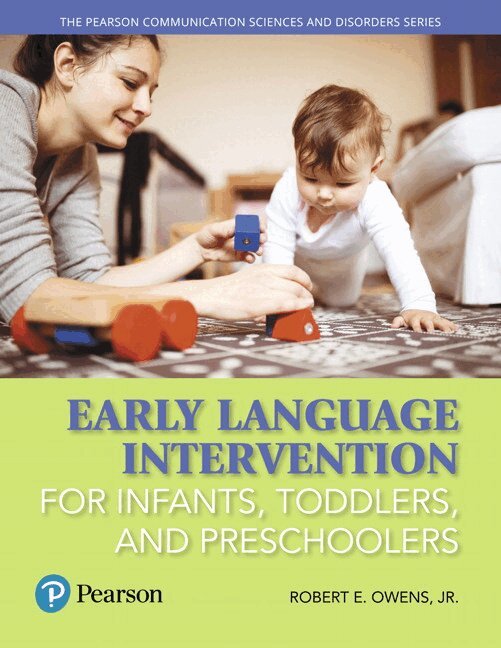
    Early Language Intervention for Infants, Toddlers, and Preschoolers

    AvRobert Owens

    Häftad, Engelska, 2017

    1 745 kr

    Beställningsvara. Skickas inom 7-10 vardagar. Fri frakt över 249 kr.

    Beskrivning

    Note: This is the bound book only and does not include access to the Enhanced Pearson eText. To order the Enhanced Pearson eText packaged with a bound book, use ISBN 0134509684.


    Early Language Intervention by Robert Owens is a comprehensive text on assessment and intervention with both verbal and nonverbal communication of infants, toddlers, and preschoolers. Informative and authoritative, it offers practical guidelines for functional methods that highlight language use within the daily routines of the home and classroom. Designed as an undergraduate-level text for communication disorders students, it covers assessment an intervention of both verbal and nonverbal communication, including augmentative and alternative communication (AAC), with young children who need support in learning to communicate. Also included are valuable resources, tables, and materials particularly useful for clinicians in practice.


    Improve mastery and retention with the Enhanced Pearson eText*
    The Enhanced Pearson eText provides a rich, interactive learning environment designed to improve student mastery of content. The Enhanced Pearson eText is:

    • Engaging. The new interactive, multimedia learning features were developed by the authors and other subject-matter experts to deepen and enrich the learning experience.
    • Convenient. Enjoy instant online access from your computer or download the Pearson eText App to read on or offline on your iPad® and Android® tablet.*
    • Affordable. Experience the advantages of the Enhanced Pearson eText along with all the benefits of print for 40% to 50% less than a print bound book.

    *The Enhanced eText features are only available in the Pearson eText format. They are not available in third-party eTexts or downloads.

    *The Pearson eText App is available on Google Play and in the App Store. It requires Android OS 3.1-4, a 7” or 10” tablet, or iPad iOS 5.0 or later.


    Produktinformation

    • Utgivningsdatum:2017-06-26
    • Mått:213 x 272 x 18 mm
    • Vikt:890 g
    • Format:Häftad
    • Språk:Engelska
    • Antal sidor:480
    • Upplaga:1
    • Förlag:Pearson Education
    • ISBN:9780134618906

    Utforska kategorier

    • Tal- och språkstörningar inom Medicin
    • Audiologi och otologi inom Medicin

    Mer om författaren

    Robert E. Owens, Jr, PhD (“Dr. Bob”) is an Associate Professor at the College of St. Rose in Albany, NY and a New York State Distinguished Teaching Professor. He holds the American Speech-Language-Hearing Association Honors of the Association. His teaching includes language development and language disorders courses and is the author of Language Development, An Introduction (9 editions) with Pearson, Language Disorders, A Functional Approach (6 editions), Program for the Acquisition of Language with the Severely Impaired (PALS), Help Your Baby Talk, Introducing the New Shared Communication Method, and Queer Kids, The Challenge & Promise for Lesbian, Gay & Bisexual Youth. His Language Development text is the most widely used in the world and has been translated into Spanish, Korean, and Arabic. He has also co-authored Introduction to Communication Disorders, A Life Span Perspective (4 editions) with Pearson, written a score of book chapters and professional articles, and authored two as-yet unpublished novels which are sure to win a posthumous Pulitzer prize. In love with the sound of his own voice, Dr. Bob has presented over 200 professional papers and workshops around the globe. His professional interests are language disorders in infants, toddlers, and preschoolers who are also some of his best friends.

    Innehållsförteckning

    • BRIEF TABLE OF CONTENTS Chapter 1: Components of Early InterventionChapter 2: Early Communication ImpairmentChapter 3: A Model for Early Communication InterventionChapter 4: Assessment of Early Communication Intervention: What to AssessChapter 5: Early Communication Assessment ProcessChapter 6: Presymbolic Early Communication InterventionChapter 7: Alternative and Augmentative Communication: Introduction and AssessmentChapter 8: Alternative and Augmentative Communication: InterventionChapter 9: Symbolic InterventionChapter 10: Feeding and Swallowing by Jessica Kisenwether, Ph.D., Misericordia University Appendix A: Sample IFSPAppendix B: Evaluation of At-Risk NeonatesAppendix C: Formal Tests for Young ChildrenAppendix D: Caregiver QuestionnaireAppendix E: Developmental MilestonesAppendix F: Interactional ObservationAppendix G: Forms of CommunicationAppendix H: Intervention Approaches for Children with ASDAppendix I: Stimulation ActivitiesAppendix J: Possible Electronic AAC Assessment ProtocolAppendix K: Feeding Assessment Interview Questionnaire DETAILED TABLE OF CONTENTS Chapter 1: Components of Early InterventionOverview of EILegal Basis for Early InterventionEducation of the Handicapped Act Amendments Individuals with Disabilities Education Act (IDEA)Individuals with Disabilities Education Improvement Act (IDEIA)SummaryTransdisciplinary TeamThe Importance of FamiliesCultural ConsiderationsParents/CaregiversIndividualized for Each ChildIndividualized Family Service Plan (IFSP)Natural EnvironmentThe Need for Evidence-Based PracticeChapter Conclusion  Chapter 2: Early Communication ImpairmentLate Language EmergenceRisk of Communication ImpairmentEstablished riskIntellectual Disability (ID)Autism Spectrum Disorder (ASD)Cerebral PalsyDeafness and Deaf-BlindnessCleft PalateAt-risk ChildrenInternational AdoptionsLow Socioeconomic StatusMaltreatment/Neglect, Fetal Alcohol Spectrum Disorder and Prenatal Cocaine ExposurePreterm and Low Birth Weight Infants Early Identifying Signs and BehaviorsAPGAR, an Infant’s First ExamChapter Conclusion  Chapter 3: A Model for Early Communication InterventionThe Evolving Model of ECI Service Delivery Functional CommunicationGeneralizationFamily-Centered InterventionIndividualizationConclusion Content for Improving CommunicationIntervention StrategiesResponsive Interaction StrategiesDirective Interaction StrategiesBlended Strategies Role of a Child’s EnvironmentFamily-Centered ServicesWorking with ParentsA Hybrid Approach to Family-Centered InterventionTeachers, Classroom Aides, and Child Care ProvidersChild PeersRole of the SLP as Part of the Team ConsultationService Coordination Transition Planning Advocacy Awareness and Advancement of the Knowledge BaseAn Example of Early Intervention: Parents Interacting with Infants (PIWI)Chapter Conclusion  Chapter 4: Assessment of Early Communication Intervention: What to AssessEvaluation vs. AssessmentTransdisciplinary Model of AssessmentPlay-based AssessmentConclusion Role of Parents & CaregiversA Rationale for Parental Involvement in AssessmentInvolving Families in Assessment Family Concerns, Priorities, and ResourcesInformal Communication Assessment Description of CommunicationPresymbolic BehaviorsSymbolic BehaviorsFormal Assessment Infants, Toddlers, and PreschoolersEarly identification of Children with ASDEligibility for ServicesChapter Conclusion  Chapter 5: Early Communication Assessment ProcessCommunication ScreeningFamilies with Culturally Linguistically Diverse Backgrounds Communication AssessmentMultiple MeasuresTransdisciplinary TeamsEcological Validity Pre-assessment Planning and Preliminary Data CollectingQuestionnaireCaregiver InterviewThe Evolving Assessment PlanInteractional ObservationThe Observation ProcessJudging Communication Success and IntentionalityCaregiver-Child InteractionsForming HypothesesPlay-based Interactional AssessmentDynamic AssessmentDescribing CommunicationSymbolic AssessmentPresymbolic BehaviorsSamplingAnalysis of DataDecision-making and RecommendationsOutcomesA Final Word on Parental InvolvementSpecial CasesChildren with Deafness and BlindnessInternational Adoptees and Children from Families Speaking Other-than-EnglishChildren with Challenging Behaviors Children with Motor Speech DisordersChildren with ASDChapter Conclusion  Chapter 6: Presymbolic Early Communication InterventionSpectrum of Early Communication Intervention Location of Intervention Types of ECI Service DeliveryIntervention ApproachEvidence-Based Practice (EBP)AAC and the Pressure to SpeakContingent ImitationExaggerated Intonation and Modified ProsodyFeedbackAvoidance of Non-speech Oral Motor Exercises Getting StartedEnhancing CommunicationIn the NICU or SCNEstablishing Early CommunicationFunctional Equivalence and Challenging BehaviorsEstablishing GesturesVocalizingLanguage Stimulation: Talking to Young ChildrenBilingual FamiliesPresymbolic SkillsEstablishing Joint AttendingImitationMeans-EndsMonitoring Intervention Chapter Conclusion  Chapter 7: Alternative and Augmentative Communication: Introduction and AssessmentTypes of AACUnaided AACAided AACEvidence-Based PracticeDangers in Ignoring EBPAAC MythsAssessmentElements of a Thorough AAC AssessmentDecision-making Chapter Conclusion  Chapter 8: Alternative and Augmentative Communication: InterventionGetting StartedInitiating CommunicationActive Learning Child-based InterventionRepresentationsOrganizationSelectionOutputThe Child’s Communication System IssuesFunctional Equivalence Vocabulary Multimodality and DevelopmentGeneralization: Role of the EnvironmentNeuromotor Considerations Intervention MethodsEarly Communication IntentionsTransitioning from Nonsymbolic to SymbolicReceptive UseExpressive UseChildren with Deafness and BlindnessChildren with ASDAided AACPicture Exchange System (PECS) Chapter ConclusionUseful Websites  Chapter 9: Symbolic InterventionEarly Symbolic GuidelinesSelecting New Symbols Expanding the Range of IntentionsTeaching Semantic CategoriesCombining into Longer UtterancesSymbolic Intervention TechniquesModel Language but Do Not Require a Child ResponseModel Language and Require a Child ResponseProvide Feedback but Do Not Require a Child ResponseRespond and Require a Child ResponseSpecific TargetsSingle WordsTwo-Word Constructions  Longer ConstructionsInvolving Parents, Teachers, and Other AdultsBook SharingLanguage ModelingA Helpful Website Two Examples of Early Communication InterventionHanen Early Language ProgramResponsive Education and Prelinguistic Milieu TeachingChapter Conclusion  Chapter 10: Feeding and Swallowing by Jessica Kisenwether, Ph.D., Misericordia UniversityBackgroundRole of the SLPSpecific Considerations in Pediatric SwallowingDifferences in Anatomy and PhysiologyDifferences in EtiologyDifferences in Communication SkillsDifferences in Treatment Development of FeedingNewborns - 3 Months6 - 12 Months15 - 24 Months Causes of Feeding/Swallowing DifficultyPrematurity and/or Low Birth WeightNeurological ConditionsCardiovascular ConditionsRespiratory ConditionsTraumatic Brain InjuryFailure to ThriveEsophageal ComplicationsCraniofacial AnomaliesEnvironmental Conditions Feeding TeamAssessment StrategiesMedical HistoryInterview ObservationPhysical ExaminationSwallow EvaluationInstrumental Evaluation Treatment StrategiesEnvironmentPositioningPacingTexture ChangesOral Motor/Sensory StimulationBehavioral TreatmentCultural Considerations Chapter Conclusion AppendicesAppendix A: Sample IFSPAppendix B: Evaluation of At-Risk NeonatesAppendix C: Formal Tests for Young ChildrenAppendix D: Caregiver QuestionnaireAppendix E: Developmental MilestonesAppendix F: Interactional ObservationAppendix G: Forms of CommunicationAppendix H: Intervention Approaches for Children with ASDAppendix I: Stimulation ActivitiesAppendix J: Possible Electronic AAC Assessment ProtocolAppendix K: Feeding Assessment Interview QuestionnaireGlossaryAuthor IndexContent Index