• Fri frakt över 249 kr
  • •
  • Snabba leveranser
  • •
  • Billiga böcker
Kundservice

Du är på sajten för privatpersoner.

Företag, bibliotek eller offentlig verksamhet?

Du handlar på classic.bokus.com, där alla dina funktioner finns intakta.
Till classic.bokus.com
Bokus logotyp. Gå till startsidan.
  • Erbjudanden
  • Nyheter
  • Student
  • Topplistor
  • Barn & ungdom
  • Bokus Play
  • E-böcker
  • Pocketböcker
  • Spel & pussel

10% rabatt på allt med kod NYSTART10 →

Sidfot

Mina sidor

    Hjälp

    • Kundservice
    • Vanliga frågor och svar
    • Frakt och leverans
    • Retur vid ångerrätt
    • Reklamera vara
    • Betalning
    • Köpvillkor
    • Allmänna villkor
    • Information om webbplatsens tillgänglighet

    Om Bokus

    • Om oss
    • Pressrum
    • För studenter
    • För företag
    • För bibliotek och offentlig verksamhet
    • För leverantörer
    • Hållbarhet

    Populärt

    • Aktuella erbjudanden
    • Presentkort
    • Studentlitteratur
    • Nya böcker
    • Topplistor
    • Signerade böcker
    • Engelska böcker

    Inspiration

    • Boktips
    • BookTok
    • Populära bokserier
    • Barnbokskaraktärer
    • Populära författare
    Logotyp för Bokus
    Följ oss på Facebook (extern länk)Följ oss på Instagram (extern länk)Följ oss på YouTube (extern länk)Följ oss på TikTok (extern länk)
    bokus @ CookiesAnpassa cookiesIntegritetspolicyKöpvillkor
    Till Citymail hemsida (extern länk)Till Budbee hemsida (extern länk)Till Postnord hemsida (extern länk)Till Schenker hemsida (extern länk)Till Early Bird hemsida (extern länk)Till Walleys hemsida (extern länk)
    1. Naturvetenskap och teknik
    2. Matematik och naturvetenskap
    3. Matematik

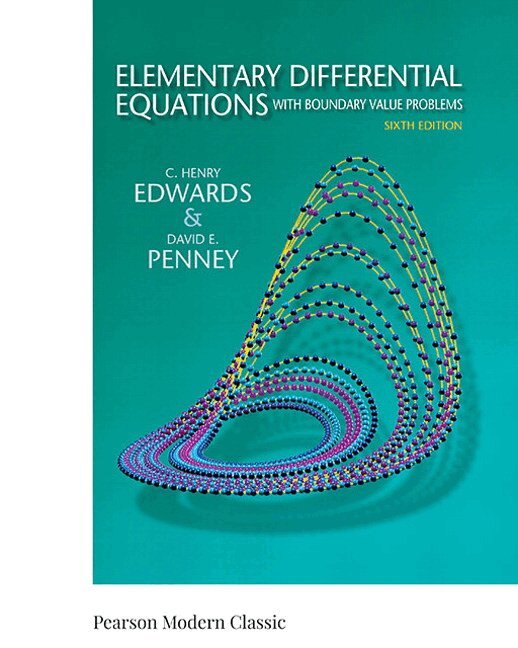
    Elementary Differential Equations with Boundary Value Problems (Classic Version)

    AvC. Edwards,David Penney

    Häftad, Engelska, 2018

    Del i serien Pearson Modern Classics for Advanced Mathematics Series

    1 480 kr

    Beställningsvara. Skickas inom 7-10 vardagar. Fri frakt över 249 kr.

    Beskrivning

    This title is part of the Pearson Modern Classics series. Pearson Modern Classics are acclaimed titles at a value price. Please visit www.pearsonhighered.com/math-classics-series for a complete list of titles.


    For briefer traditional courses in elementary differential equations that science, engineering, and mathematics students take following calculus.


    The Sixth Edition of this widely adopted book remains the same classic differential equations text it's always been, but has been polished and sharpened to serve both instructors and students even more effectively. Edwards and Penney teach students to first solve those differential equations that have the most frequent and interesting applications. Precise and clear-cut statements of fundamental existence and uniqueness theorems allow understanding of their role in this subject. A strong numerical approach emphasizes that the effective and reliable use of numerical methods often requires preliminary analysis using standard elementary techniques.

    Produktinformation

    • Utgivningsdatum:2018-03-22
    • Mått:201 x 251 x 32 mm
    • Vikt:1 300 g
    • Format:Häftad
    • Språk:Engelska
    • Serie:Pearson Modern Classics for Advanced Mathematics Series
    • Antal sidor:784
    • Upplaga:6
    • Förlag:Pearson Education
    • ISBN:9780134995410

    Utforska kategorier

    • Matematik inom Naturvetenskap och teknik

    Mer om författaren

    C. Henry Edwards is emeritus professor of mathematics at the University of Georgia. He earned his Ph.D. at the University of Tennessee in 1960, and recently retired after 40 years of classroom teaching (including calculus or differential equations almost every term) at the universities of Tennessee, Wisconsin, and Georgia, with a brief interlude at the Institute for Advanced Study (Princeton) as an Alfred P. Sloan Research Fellow. He has received numerous teaching awards, including the University of Georgia's honoratus medal in 1983 (for sustained excellence in honors teaching), its Josiah Meigs award in 1991 (the institution's highest award for teaching), and the 1997 statewide Georgia Regents award for research university faculty teaching excellence. His scholarly career has ranged from research and dissertation direction in topology to the history of mathematics to computing and technology in the teaching and applications of mathematics. In addition to being author or co-author of calculus, advanced calculus, linear algebra, and differential equations textbooks, he is well-known to calculus instructors as author of The Historical Development of the Calculus (Springer-Verlag, 1979). During the 1990s he served as a principal investigator on three NSF-supported projects: (1) A school mathematics project including Maple for beginning algebra students, (2) A Calculus-with- Mathematica program, and (3) A MATLAB-based computer lab project for numerical analysis and differential equations students. David E. Penney, University of Georgia, completed his Ph.D. at Tulane University in 1965 (under the direction of Prof. L. Bruce Treybig) while teaching at the University of New Orleans. Earlier he had worked in experimental biophysics at Tulane University and the Veteran's Administration Hospital in New Orleans under the direction of Robert Dixon McAfee, where Dr. McAfee's research team's primary focus was on the active transport of sodium ions by biological membranes. Penney's primary contribution here was the development of a mathematical model (using simultaneous ordinary differential equations) for the metabolic phenomena regulating such transport, with potential future applications in kidney physiology, management of hypertension, and treatment of congestive heart failure. He also designed and constructed servomechanisms for the accurate monitoring of ion transport, a phenomenon involving the measurement of potentials in microvolts at impedances of millions of megohms. Penney began teaching calculus at Tulane in 1957 and taught that course almost every term with enthusiasm and distinction until his retirement at the end of the last millennium. During his tenure at the University of Georgia he received numerous University-wide teaching awards as well as directing several doctoral dissertations and seven undergraduate research projects. He is the author of research papers in number theory and topology and is the author or co-author of textbooks on calculus, computer programming, differential equations, linear algebra, and liberal arts mathematics.

    Innehållsförteckning

    • Table of Contents Preface First-Order Differential Equations 1.1 Differential Equations and Mathematical Models1.2 Integrals as General and Particular Solutions1.3 Slope Fields and Solution Curves1.4 Separable Equations and Applications1.5 Linear First-Order Equations1.6 Substitution Methods and Exact Equations1.7 Population Models1.8 Acceleration-Velocity ModelsLinear Equations of Higher Order 2.1 Introduction: Second-Order Linear Equations2.2 General Solutions of Linear Equations2.3 Homogeneous Equations with Constant Coefficients2.4 Mechanical Vibrations2.5 Nonhomogeneous Equations and Undetermined Coefficients2.6 Forced Oscillations and Resonance2.7 Electrical Circuits2.8 Endpoint Problems and EigenvaluesPower Series Methods 3.1 Introduction and Review of Power Series3.2 Series Solutions Near Ordinary Points3.3 Regular Singular Points3.4 Method of Frobenius: The Exceptional Cases3.5 Bessel's Equation3.6 Applications of Bessel FunctionsLaplace Transform Methods 4.1 Laplace Transforms and Inverse Transforms4.2 Transformation of Initial Value Problems4.3 Translation and Partial Fractions4.4 Derivatives, Integrals, and Products of Transforms4.5 Periodic and Piecewise Continuous Input Functions4.6 Impulses and Delta FunctionsLinear Systems of Differential Equations 5.1 First-Order Systems and Applications5.2 The Method of Elimination5.3 Matrices and Linear Systems5.4 The Eigenvalue Method for Homogeneous Systems5.5 Second-Order Systems and Mechanical Applications5.6 Multiple Eigenvalue Solutions5.7 Matrix Exponentials and Linear Systems5.8 Nonhomogeneous Linear SystemsNumerical Methods 6.1 Numerical Approximation: Euler's Method6.2 A Closer Look at the Euler Method6.3 The Runge-Kutta Method6.4 Numerical Methods for SystemsNonlinear Systems and Phenomena 7.1 Equilibrium Solutions and Stability7.2 Stability and the Phase Plane7.3 Linear and Almost Linear Systems7.4 Ecological Models: Predators and Competitors7.5 Nonlinear Mechanical Systems7.6 Chaos in Dynamical SystemsFourier Series Methods 8.1 Periodic Functions and Trigonometric Series8.2 General Fourier Series and Convergence8.3 Fourier Sine and Cosine Series8.4 Applications of Fourier Series8.5 Heat Conduction and Separation of Variables8.6 Vibrating Strings and the One-Dimensional Wave Equation8.7 Steady-State Temperature and Laplace's EquationEigenvalues and Boundary Value Problems 9.1 Sturm-Liouville Problems and Eigenfunction Expansions9.2 Applications of Eigenfunction Series9.3 Steady Periodic Solutions and Natural Frequencies9.4 Cylindrical Coordinate Problems9.5 Higher-Dimensional PhenomenaReferences for Further Study Appendix: Existence and Uniqueness of Solutions Answers to Selected Problems Index