• Fri frakt över 249 kr
  • •
  • Snabba leveranser
  • •
  • Billiga böcker
Kundservice

Du är på sajten för privatpersoner.

Företag, bibliotek eller offentlig verksamhet?

Du handlar på classic.bokus.com, där alla dina funktioner finns intakta.
Till classic.bokus.com
Bokus logotyp. Gå till startsidan.
  • Erbjudanden
  • Nyheter
  • Student
  • Topplistor
  • Barn & ungdom
  • Bokus Play
  • E-böcker
  • Pocketböcker
  • Spel & pussel

10% rabatt på allt med kod NYSTART10 →

Sidfot

Mina sidor

    Hjälp

    • Kundservice
    • Vanliga frågor och svar
    • Frakt och leverans
    • Retur vid ångerrätt
    • Reklamera vara
    • Betalning
    • Köpvillkor
    • Allmänna villkor
    • Information om webbplatsens tillgänglighet

    Om Bokus

    • Om oss
    • Pressrum
    • För studenter
    • För företag
    • För bibliotek och offentlig verksamhet
    • För leverantörer
    • Hållbarhet

    Populärt

    • Aktuella erbjudanden
    • Presentkort
    • Studentlitteratur
    • Nya böcker
    • Topplistor
    • Signerade böcker
    • Engelska böcker

    Inspiration

    • Boktips
    • BookTok
    • Populära bokserier
    • Barnbokskaraktärer
    • Populära författare
    Logotyp för Bokus
    Följ oss på Facebook (extern länk)Följ oss på Instagram (extern länk)Följ oss på YouTube (extern länk)Följ oss på TikTok (extern länk)
    bokus @ CookiesAnpassa cookiesIntegritetspolicyKöpvillkor
    Till Citymail hemsida (extern länk)Till Budbee hemsida (extern länk)Till Postnord hemsida (extern länk)Till Schenker hemsida (extern länk)Till Early Bird hemsida (extern länk)Till Walleys hemsida (extern länk)
    1. Psykologi och pedagogik
    2. Pedagogik
    3. Undervisning i specifika ämnen

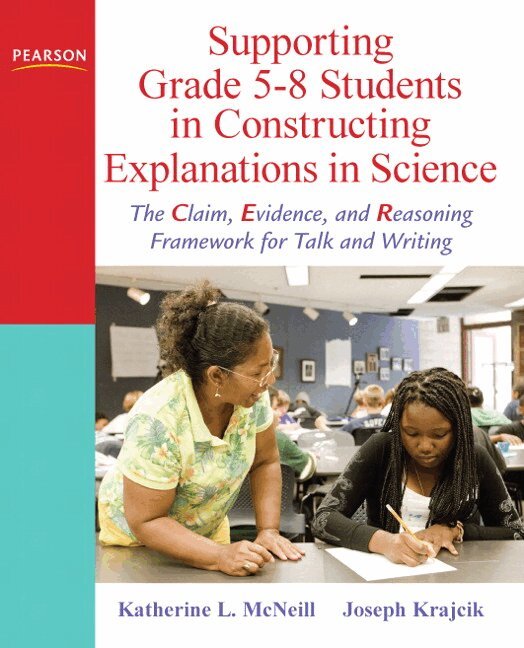
    Supporting Grade 5-8 Students in Constructing Explanations in Science

    The Claim, Evidence, and Reasoning Framework for Talk and Writing

    AvKatherine McNeill,Joseph Krajcik

    Häftad, Engelska, 2011

    771 kr

    Beställningsvara. Skickas inom 7-10 vardagar. Fri frakt över 249 kr.

    Beskrivning

    By providing a variety of strategies, scenarios, examples of student writing, classroom video clips from across all science content areas, rubrics, and guidelines for designing assessment items, Supporting Grade 5-8 Students in Constructing Explanations in Science: The Claim, Evidence, and Reasoning Framework for Talk and Writing provides teachers with the tools to successfully incorporate scientific explanation in their own classrooms.

    Grounded in NSF-funded research, this book/DVD supports middle grades science teachers with an instructional framework that breaks down the complex practice of scientific explanation into four components–claim, evidence, reasoning, and rebuttal–and providesconcrete examples of what this scientific inquiry practice looks like when it is successfully implemented in real classrooms. Over the last nine years that McNeill and Krajcik have developed, field tested, and refined this instructional model, they found that incorporating this framework for scientific explanation into curriculum materials, teacher instructional strategies, and assessments enhances students conceptual understanding and improves their ability to think and communicate more scientifically by carefully analyzing evidence and backing up their claims.

    Facilitator's Guide Package for Science Coaches and Staff Development Trainers

    Take the guess work out of leading professional development and book studies with the Facilitator's Guide and Book Package. To order, use Special ISBN: 9780132549400 and contact your sales representative at www.allynbaconmerrill.com/findmyrep.

    What Educators Are Saying

    I would encourage others to use it as a resource for a professional learning community or department discussion group and the like... absolutely I would recommend it – why? it is simply good for our students’ developing understanding of science...”

    - Pamela M. Pelletier, Senior Program Director, Science K-12, Boston Public Schools, Boston, Massachusetts

    "[This book] can easily be used to guide middle school teams to collaboratively work together to ask higher order thinking questions in any core content area. This type of questioning leads to great classroom discourse, therefore engaging students in using claims, evidence, and reasoning."

    - Kendra Walters Durham, Science Teacher, Wester Middle School, Frisco, Texas

    Take a Look Inside

    • Integrates video clips from a range of grade levels and contexts (e.g., urban and suburban) throughout the text to demonstrate the use of the scientific explanation framework in actual classrooms (Chapters 2, 4 and 7)
    • Provides examples of student work throughout the book to demonstrate student accomplishment and to illustrate the most common student difficulties and strategies for supporting those challenges. (Chapters 1, 2, 3, and 6)
    • Incorporates learning strategies that can support all students, including English Language Learners and students with special needs, and helps teachers with ideas on how to modify instruction to best meet the needs of their students.
    • Presents rubrics for evaluating students' written explanations and sample assessment tasks with model teacher critiques of student explanations based on developed rubric.

    Professional Learning Communities

    Save when you purchase 10 books or more! To order, use Special ISBN: 9780132752022 and contact your sales representative at www.allynbaconmerrill.com/findmyrep.

    Produktinformation

    • Utgivningsdatum:2011-01-25
    • Mått:0 x 10 x 0 mm
    • Vikt:0 g
    • Format:Häftad
    • Språk:Engelska
    • Antal sidor:192
    • Upplaga:1
    • Förlag:Pearson Education
    • ISBN:9780137043453

    Utforska kategorier

    • Undervisning i specifika ämnen inom Psykologi och pedagogik
    • Pedagogik inom Psykologi och pedagogik
    • Lärarutbildning inom Psykologi och pedagogik

    Mer om författaren

    Katherine L. McNeill is an Assistant Professor of science education at Boston College. A former middle school science teacher, she received her doctorate in science education from the University of Michigan. Her research focuses on helping students with diverse backgrounds become interested in science and learn both science content and scientific inquiry practices. Specifically, she has recently focused on how to support students in engaging in scientific explanation and argumentation in both talk and writing. Her research has been generously funded by the National Science Foundation (NSF). She has published numerous book chapters and journal articles from this work, including articles in the Journal of Research in Science Teaching, Science Education, The Journal of the Learning Sciences, and International Journal of Science Education.Joseph Krajcik, a Professor at the University of Michigan, develops classroom environments in which students find solutions to important intellectual questions that subsume essential learning goals. He is a fellow of AAAS and AERA, served as president of National Association for Research in Science Teaching in 1999, and received guest professorships from Beijing Normal University and the Weizmann Institute of Science. In 2009, he was named a distinguished professor at Ewha Woman’s University in South Korea and served as a faculty member in the Institute for Global Science, Technology and Society Education. In 2010, he received the Distinguished Contributions to Science Education Through Research Award from NARST.

    Recensioner i media

    "I would encourage others to use it as a resource for a professional learning community or department discussion group and the like... absolutely I would recommend it - why? it is simply good for our students' developing understanding of science..." - Pamela M. Pelletier, Senior Program Director, Science K-12, Boston Public Schools, Boston, Massachusetts " It can easily be used to guide middle school teams to collaboratively work together to ask higher order thinking questions in any core content area. This type of questioning leads to great classroom discourse, therefore engaging students in using claims, evidence, and reasoning." "I see this book being used as a district professional development tool for teachers, especially since it focuses on creating more sophisticated uses of scientific explanations in the classroom as students learn more about the process." - Kendra Walters Durham, Science Teacher, Wester Middle School, Frisco, Texas "I think this is a great book and will be a very useful guide for middle level teachers. I am definitely purchasing this book and I will encourage my colleagues, both in science and other content areas to also make the purchase. The explanation framework provides a powerful tool, in my opinion, for middle school teachers to inter-disciplinary work towards building 21st century competencies. I this is book would be extremely for in-service and pre-service teachers. I could certainly be very effectively used for professional development or book study opportunities." - Ann M. Novak, 7th/8th Grade Science Teacher, Greenhills School, Ann Arbor, Michigan

    Innehållsförteckning

    • Chapter 1: Importance of Supporting Students in Scientific Explanation1.1. The role of explanations in science1.2. Scientific explanations in the classroom1.3. Benefits of scientific explanations1.4. Alignment with the national science standards1.5. Student challenges with scientific explanations1.6. Check Point1.7. Study Group QuestionsChapter 2: Framework for Constructing Scientific Explanations2.1. Students’ understandings of scientific explanations2.2. Framework for constructing scientific explanations2.3. Video Example – Introducing the instructional framework2.4. Examples of scientific explanations2.5. Increasing the complexity of the framework over time2.6. Benefits of the framework for all learners2.7. Check Point2.8. Study Group QuestionsChapter 3: Designing Learning Tasks for Your Science Curriculum3.1. Considerations for designing learning tasks3.2. Step 1: Identify opportunities in the curriculum3.3. Examples of learning tasks3.4. Step 2: Design complexity of the learning task3.5. Step 3: Create Classroom Support3.6. Check Point3.7. Study Group QuestionsChapter 4: Teaching Strategies to Integrate into Classroom Instruction4.1. Teaching strategies4.2. Supporting all learners4.3. Check Point4.4. Study Group QuestionsChapter 5: Developing Assessment Tasks and Rubrics5.1. Overview of the development process5.2. Step 1: Identify and unpack the content standard5.3. Step 2: Select scientific explanation level of complexity5.4. Step 3: Create learning performances5.5. Step 4: Write the assessment task5.6. Step 5: Review the assessment task5.7. Step 6: Develop specific rubric5.8. Check Point5.9. Study Group QuestionsChapter 6: Using Rubrics and Student Data to Inform Instruction6.1. Role of assessment in creating a supportive learning environment6.2. Using rubrics to support student learning6.3. Providing students with feedback6.4. Check Point6.5. Study Group QuestionsChapter 7: Supporting Learning Over Time7.1. Developing a classroom culture7.2. A learning progression for scientific explanation7.3. Connecting to other content areas7.4. Check Point7.5. Study Group Questions