• Fri frakt över 249 kr
  • •
  • Snabba leveranser
  • •
  • Billiga böcker
Kundservice

Du är på sajten för privatpersoner.

Företag, bibliotek eller offentlig verksamhet?

Du handlar på classic.bokus.com, där alla dina funktioner finns intakta.
Till classic.bokus.com
Bokus logotyp. Gå till startsidan.
  • Erbjudanden
  • Nyheter
  • Student
  • Topplistor
  • Barn & ungdom
  • Bokus Play
  • E-böcker
  • Pocketböcker
  • Spel & pussel

10% rabatt på allt med kod NYSTART10 →

Sidfot

Mina sidor

    Hjälp

    • Kundservice
    • Vanliga frågor och svar
    • Frakt och leverans
    • Retur vid ångerrätt
    • Reklamera vara
    • Betalning
    • Köpvillkor
    • Allmänna villkor
    • Information om webbplatsens tillgänglighet

    Om Bokus

    • Om oss
    • Pressrum
    • För studenter
    • För företag
    • För bibliotek och offentlig verksamhet
    • För leverantörer
    • Hållbarhet

    Populärt

    • Aktuella erbjudanden
    • Presentkort
    • Studentlitteratur
    • Nya böcker
    • Topplistor
    • Signerade böcker
    • Engelska böcker

    Inspiration

    • Boktips
    • BookTok
    • Populära bokserier
    • Barnbokskaraktärer
    • Populära författare
    Logotyp för Bokus
    Följ oss på Facebook (extern länk)Följ oss på Instagram (extern länk)Följ oss på YouTube (extern länk)Följ oss på TikTok (extern länk)
    bokus @ CookiesAnpassa cookiesIntegritetspolicyKöpvillkor
    Till Citymail hemsida (extern länk)Till Budbee hemsida (extern länk)Till Postnord hemsida (extern länk)Till Schenker hemsida (extern länk)Till Early Bird hemsida (extern länk)Till Walleys hemsida (extern länk)
    1. Historia och arkeologi
    2. Historia
    3. Militärhistoria
    4. Första världskriget

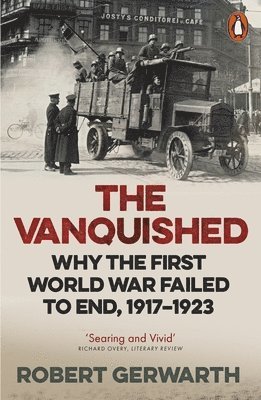
    Vanquished

    Why the First World War Failed to End, 1917-1923

    AvRobert Gerwarth

    Häftad, Engelska, 2017

    165 kr

    Skickas . Fri frakt över 249 kr.

    Fler format och utgåvor

    E-bok

    104 kr

    Beskrivning

    'A breathtaking, magisterial panorama, telling the epic story of post-war anarchy, dying empires and rising nation states. It makes us rethink our understanding of Europe's twentieth century' David Motadel, The Times Literary SupplementFor the Western allies 11 November 1918 has always been a solemn date - the end of fighting which had destroyed a generation, and also a vindication of a terrible sacrifice with the total collapse of their principal enemies: the German Empire, Austria-Hungary and the Ottoman Empire. But for much of the rest of Europe this was a day with no meaning, as a continuing, nightmarish series of conflicts engulfed country after country. In this highly original, gripping book Robert Gerwarth asks us to think again about the true legacy of the First World War. 'Lucid, incisive and packed with fascinating details' Financial Times, Books of the Year 'Important and timely ... obliges us to reconsider a period and a battlefront that has too often been neglected' Margaret MacMillan, The New York Times Review of Books'This narrative of continent-wide chaos performs a valuable service by chronicling the postwar turmoil of Europe ... helps us understand why few wars reach tidy conclusions' Max Hastings, Sunday Times'Reminds us, in vivid and often shocking detail, that only some countries saw killing end on the 11th day of the 11th month ... leaves a sense of foreboding for our own time' Robert Tombs, The Times

    Produktinformation

    • Utgivningsdatum:2017-06-29
    • Mått:131 x 197 x 22 mm
    • Vikt:346 g
    • Format:Häftad
    • Språk:Engelska
    • Antal sidor:464
    • Förlag:Penguin Books Ltd
    • ISBN:9780141976372

    Utforska kategorier

    • Första världskriget inom Historia och arkeologi
    • Europas historia inom Historia och arkeologi

    Mer om författaren

    Robert Gerwarth is Professor of Modern History at University College Dublin and Director of its Centre for War Studies. He is the author of The Bismarck Myth and a biography of Reinhard Heydrich. He has studied and taught in the United States, the United Kingdom, Germany and France.

    Recensioner i media

    This narrative of continent-wide chaos makes it easier to understand why order came to seem a supremely desirable objective in 1930s Europe, trumping freedom ... it helps us understand why few wars reach tidy conclusions: once a society has suspended its instinctive, social and legal prejudice against killing, it often proves hard to restore.

    Betyg & recensioner

    5/5