• Fri frakt över 249 kr
  • •
  • Snabba leveranser
  • •
  • Billiga böcker
Kundservice

Du är på sajten för privatpersoner.

Företag, bibliotek eller offentlig verksamhet?

Du handlar på classic.bokus.com, där alla dina funktioner finns intakta.
Till classic.bokus.com
Bokus logotyp. Gå till startsidan.
  • Erbjudanden
  • Nyheter
  • Student
  • Topplistor
  • Barn & ungdom
  • Bokus Play
  • E-böcker
  • Pocketböcker
  • Spel & pussel

Må bättre, för mindre! Upp till 50% rabatt på hälsoböcker

Sidfot

Mina sidor

    Hjälp

    • Kundservice
    • Vanliga frågor och svar
    • Frakt och leverans
    • Retur vid ångerrätt
    • Reklamera vara
    • Betalning
    • Köpvillkor
    • Allmänna villkor
    • Information om webbplatsens tillgänglighet

    Om Bokus

    • Om oss
    • Pressrum
    • För studenter
    • För företag
    • För bibliotek och offentlig verksamhet
    • För leverantörer
    • Hållbarhet

    Populärt

    • Aktuella erbjudanden
    • Presentkort
    • Studentlitteratur
    • Nya böcker
    • Topplistor
    • Signerade böcker
    • Engelska böcker

    Inspiration

    • Boktips
    • BookTok
    • Populära bokserier
    • Barnbokskaraktärer
    • Populära författare
    Logotyp för Bokus
    Följ oss på Facebook (extern länk)Följ oss på Instagram (extern länk)Följ oss på YouTube (extern länk)Följ oss på TikTok (extern länk)
    bokus @ CookiesAnpassa cookiesIntegritetspolicyKöpvillkor
    Till Citymail hemsida (extern länk)Till Budbee hemsida (extern länk)Till Postnord hemsida (extern länk)Till Schenker hemsida (extern länk)Till Early Bird hemsida (extern länk)Till Walleys hemsida (extern länk)
    1. Historia och arkeologi
    2. Historia
    3. Asiens historia

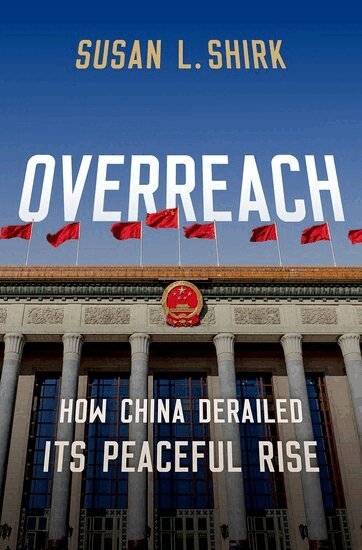
    Overreach

    How China Derailed Its Peaceful Rise

    AvSusan L. Shirk

    Inbunden, Engelska, 2022

    357 kr

    Beställningsvara. Skickas inom 5-8 vardagar. Fri frakt över 249 kr.

    Fler format och utgåvor

    E-bok

    244 kr

    E-bok

    244 kr

    Beskrivning

    For decades, China's rise to power was characterized by its reassurance that this rise would be peaceful. Then, as Susan L. Shirk, shows in this sobering, clear-eyed account of China today, something changed.For three decades after Mao's death in 1976, China's leaders adopted a restrained approach to foreign policy. They determined that any threat to their power, and that of the Chinese Communist Party, came not from abroad but from within—a conclusion cemented by the 1989 Tiananmen crisis. To facilitate the country's inexorable economic ascendence, and to prevent a backlash, they reassured the outside world of China's peaceful intentions.Then, as Susan Shirk shows in this illuminating, disturbing, and utterly persuasive new book, something changed. China went from fragile superpower to global heavyweight, threatening Taiwan as well as its neighbors in the South China Sea, tightening its grip on Hong Kong, and openly challenging the United States for preeminence not just economically and technologically but militarily. China began to overreach. Combining her decades of research and experience, Shirk, one of the world's most respected experts on Chinese politics, argues that we are now fully embroiled in a new cold war.To explain what happened, Shirk pries open the "black box" of China's political system and looks at what derailed its peaceful rise. As she shows, the shift toward confrontation began in the mid-2000s under the mild-mannered Hu Jintao, first among equals in a collective leadership. As China's economy boomed, especially after the Global Financial Crisis of 2008, Hu and the other leaders lost restraint, abetting aggression toward the outside world and unchecked domestic social control. When Xi Jinping took power in 2012, he capitalized on widespread official corruption and open splits in the leadership to make the case for more concentrated power at the top. In the decade following, and to the present day—the eve of the 20th CCP Congress when he intends to claim a third term—he has accumulated greater power than any leader since Mao. Those who implement Xi's directives compete to outdo one another, provoking an even greater global backlash and stoking jingoism within China on a scale not seen since the Cultural Revolution.Here is a devastatingly lucid portrait of China today. Shirk's extensive interviews and meticulous analysis reveal the dynamics driving overreach. To counter it, she argues, the worst mistake the rest of the world, and the United States in particular, can make is to overreact. Understanding the domestic roots of China's actions will enable us to avoid the mistakes that could lead to war.

    Produktinformation

    • Utgivningsdatum:2022-10-18
    • Mått:165 x 242 x 29 mm
    • Vikt:789 g
    • Format:Inbunden
    • Språk:Engelska
    • Antal sidor:424
    • Förlag:OUP USA
    • ISBN:9780190068516

    Utforska kategorier

    • Asiens historia inom Historia och arkeologi
    • Militärhistoria inom Historia och arkeologi
    • Internationella relationer inom Samhälle och politik

    Mer om författaren

    Susan L. Shirk is a Research Professor and Chair of the 21st Century China Center at the School of Global Policy and Strategy, UC San Diego. Shirk is the author of China: Fragile Superpower, and The Political Logic of Economic Reform in China. From 1997-2000, she served as Deputy Assistant Secretary of State in the Bureau of East Asia and Pacific Affairs, with responsibility for China, Taiwan, Hong Kong and Mongolia.

    Recensioner i media

    Complete with 64 pages of notes and a 15-page Index, her new book (which includes a fine analysis of the hot-button issues of Hong Kong and Taiwan) is an accessible and detailed account of where we have been with China, and how we got to this difficult state of affairs.

    Innehållsförteckning

    • Prologue: How China Lost the West 1. The Origins of Overreach 2. Deng's Ghost 3. Inside the Black Box 4. The Rise and Fall of Collective Leadership 5. Loss of Restraint 6. Stability Maintenance 7. Strongman Rule 8. Going to Extremes 9. State pf Paranoia 10. Downward Spiral Conclusion: Overreach and Overreaction