• Fri frakt över 249 kr
  • •
  • Snabba leveranser
  • •
  • Billiga böcker
Kundservice

Du är på sajten för privatpersoner.

Företag, bibliotek eller offentlig verksamhet?

Du handlar på classic.bokus.com, där alla dina funktioner finns intakta.
Till classic.bokus.com
Bokus logotyp. Gå till startsidan.
  • Erbjudanden
  • Nyheter
  • Student
  • Topplistor
  • Barn & ungdom
  • Bokus Play
  • E-böcker
  • Pocketböcker
  • Spel & pussel

10% rabatt på allt med kod NYSTART10 →

Sidfot

Mina sidor

    Hjälp

    • Kundservice
    • Vanliga frågor och svar
    • Frakt och leverans
    • Retur vid ångerrätt
    • Reklamera vara
    • Betalning
    • Köpvillkor
    • Allmänna villkor
    • Information om webbplatsens tillgänglighet

    Om Bokus

    • Om oss
    • Pressrum
    • För studenter
    • För företag
    • För bibliotek och offentlig verksamhet
    • För leverantörer
    • Hållbarhet

    Populärt

    • Aktuella erbjudanden
    • Presentkort
    • Studentlitteratur
    • Nya böcker
    • Topplistor
    • Signerade böcker
    • Engelska böcker

    Inspiration

    • Boktips
    • BookTok
    • Populära bokserier
    • Barnbokskaraktärer
    • Populära författare
    Logotyp för Bokus
    Följ oss på Facebook (extern länk)Följ oss på Instagram (extern länk)Följ oss på YouTube (extern länk)Följ oss på TikTok (extern länk)
    bokus @ CookiesAnpassa cookiesIntegritetspolicyKöpvillkor
    Till Citymail hemsida (extern länk)Till Budbee hemsida (extern länk)Till Postnord hemsida (extern länk)Till Schenker hemsida (extern länk)Till Early Bird hemsida (extern länk)Till Walleys hemsida (extern länk)
    1. Filosofi och religion
    2. Filosofi
    3. Filosofiska discipliner

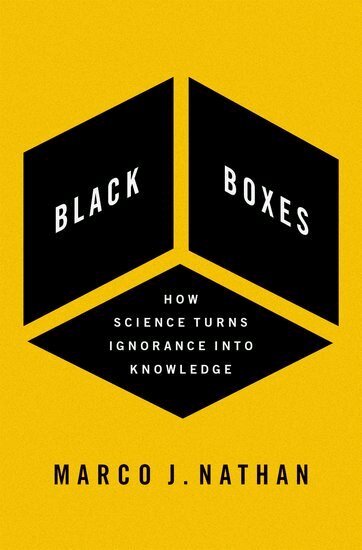
    Black Boxes

    How Science Turns Ignorance Into Knowledge

    AvMarco J. Nathan

    Inbunden, Engelska, 2021

    1 084 kr

    Beställningsvara. Skickas inom 5-8 vardagar. Fri frakt över 249 kr.

    Fler format och utgåvor

    E-bok

    852 kr

    E-bok

    852 kr

    Beskrivning

    Textbooks and other popular venues commonly present science as a progressive "brick-by-brick" accumulation of knowledge and facts. Despite its hallowed history and familiar ring, this depiction is nowadays rejected by most specialists. There currently are two competing models of the scientific enterprise: reductionism and antireductionism. Neither provides an accurate depiction of the productive interaction between knowledge and ignorance, supplanting the old metaphor of the "wall" of knowledge. This book explores an original conception of the nature and advancement of science. Marco J. Nathan's proposed shift brings attention to a prominent, albeit often neglected, construct--the black box--which underlies a well-oiled technique for incorporating a productive role of ignorance and failure into the acquisition of empirical knowledge. The black box is a metaphorical term used by scientists for the isolation of a complex phenomenon that they have deliberately set aside or may not yet fully understand. What is a black box? How does it work? How do we construct one? How do we determine what to include and what to leave out? What role do boxes play in contemporary scientific practice? Nathan's monograph develops an overarching framework for thinking about black boxes and discusses prominent historical cases that used it, including Darwin's view of inheritance in his theory of evolution and the "stimulus-response model" in psychology, among others. By detailing some fascinating episodes in the history of biology, psychology, and economics, Nathan revisits foundational questions about causation, explanation, emergence, and progress, showing how the insights of both reductionism and antireductionism can be reconciled into a fresh and exciting approach to science.

    Produktinformation

    • Utgivningsdatum:2021-10-12
    • Mått:165 x 241 x 27 mm
    • Vikt:612 g
    • Format:Inbunden
    • Språk:Engelska
    • Antal sidor:310
    • Förlag:OUP USA
    • ISBN:9780190095482

    Utforska kategorier

    • Filosofiska discipliner inom Filosofi och religion
    • Naturvetenskapens filosofi inom Naturvetenskap och teknik

    Mer om författaren

    Marco J. Nathan is Associate Professor and Chair in the Department of Philosophy at the University of Denver. His research focuses on the philosophy of science, with particular emphasis on biology, neuroscience, cognitive neuropsychology, and economics. He has published numerous articles and chapters in philosophical and scientific venues.

    Recensioner i media

    The innovative approach Nathan has adopted is to turn attention from preoccupation with what is known to describe the role of "black boxes" in science. Readers familiar with these debates should find that the motif of black boxes lends nuance to familiar arguments.

    Innehållsförteckning

    • ContentsPrefaceChapter 1: Bricks and Boxes1.1 The Wall1.2 A Theory of Everything?1.3 Pandora's Gift to Science: The Black Box1.4 Structure and Synopsis1.5 Aim and ScopeChapter 2: Between Scylla and Charybdis2.1 Introduction2.2 The Rock Shoal and the Whirlpool2.3 The Rise and Fall of Classical Reductionism2.4 Antireductionism Strikes Back2.5 The Reductionists Return2.6 Scylla or Charybdis?2.7 Why Not Have the Cake and Eat It Too?Chapter 3: Lessons from the History of Science3.1 Introduction3.2 Darwin's Quest for Inheritance and Variation3.3 Mendel's Missing Mechanisms: A Tale of Two Syntheses3.4 Absent Minded: Psychological Behaviors3.5 The Nature and Significance of Economics3.6 The Many Faces of Black BoxesChapter 4: Placeholders4.1 Introduction4.2 Two Theses About Fitness4.3 Are Dispositions Explanatory?4.4 Placeholders in Scientific Theory and Practice4.5 Two Types of PlaceholdersChapter 5: Black-Boxing 1015.1 Introduction5.2 Step One: The Framing Stage5.3 Step Two: The Difference-Making Stage5.4 Step Three: The Representation Stage5.5 What is a Black Box? A Three-Part RecipeChapter 6: History of Science 'Black-Boxing Style'6.1 Introduction6.2 Darwin's Black Boxes6.3 Mendel's Black Boxes6.4 Skinner's Black Boxes6.5 Friedman's Black Boxes6.6 Black Boxes in Science: Concluding RemarksChapter 7: Diet Mechanistic Philosophy7.1 Introduction7.2 The New Mechanistic Philosophy7.3 Three Steps: A Neo-Mechanistic Perspective7.4 Mechanisms, Models, and Metaphysics7.5 Mechanisms and Black Boxes7.6 What's in a Mechanism?7.7 The Diet Recipe: Concluding RemarksChapter 8: Emergence Reframed8.1 Introduction8.2 Emergence: Metaphysical or Epistemic?8.3 Emergence in Action: Systems Neuroscience8.4 Emergents and Black Boxes8.5 Refinements and Implications8.6 Adequacy Conditions and Advantages 8.7 Concluding RemarksChapter 9: The Fuel of Scientific Progress9.1 Introduction9.2 The Roots of Incommensurability9.3 Referential Models and Incommensurability9.4 Black Boxes and Reference Potential, Part I9.5 Black Boxes and Reference Potential, Part II9.6 Incommensurability, Progress, and Black Boxes: Concluding RemarksChapter 10: Sailing Through the Strait10.1 Back to Bricks and Boxes10.2 The Quagmire10.3 Rocking the Rock, Weathering the Whirlpool10.4 A History of Black Boxes10.5 The Devil in the Details?References