• Fri frakt över 249 kr
  • •
  • Snabba leveranser
  • •
  • Billiga böcker
Kundservice

Du är på sajten för privatpersoner.

Företag, bibliotek eller offentlig verksamhet?

Du handlar på classic.bokus.com, där alla dina funktioner finns intakta.
Till classic.bokus.com
Bokus logotyp. Gå till startsidan.
  • Erbjudanden
  • Nyheter
  • Student
  • Topplistor
  • Barn & ungdom
  • Bokus Play
  • E-böcker
  • Pocketböcker
  • Spel & pussel

10% rabatt på allt med kod: NYSTART10 →

Sidfot

Mina sidor

    Hjälp

    • Kundservice
    • Vanliga frågor och svar
    • Frakt och leverans
    • Retur vid ångerrätt
    • Reklamera vara
    • Betalning
    • Köpvillkor
    • Allmänna villkor
    • Information om webbplatsens tillgänglighet

    Om Bokus

    • Om oss
    • Pressrum
    • För studenter
    • För företag
    • För bibliotek och offentlig verksamhet
    • För leverantörer
    • Hållbarhet

    Populärt

    • Aktuella erbjudanden
    • Presentkort
    • Studentlitteratur
    • Nya böcker
    • Topplistor
    • Signerade böcker
    • Engelska böcker

    Inspiration

    • Boktips
    • BookTok
    • Populära bokserier
    • Barnbokskaraktärer
    • Populära författare
    Logotyp för Bokus
    Följ oss på Facebook (extern länk)Följ oss på Instagram (extern länk)Följ oss på YouTube (extern länk)Följ oss på TikTok (extern länk)
    bokus @ CookiesAnpassa cookiesIntegritetspolicyKöpvillkor
    Till Citymail hemsida (extern länk)Till Budbee hemsida (extern länk)Till Postnord hemsida (extern länk)Till Schenker hemsida (extern länk)Till Early Bird hemsida (extern länk)Till Walleys hemsida (extern länk)
    1. Samhälle och politik
    2. Social välfärd och brottslighet
    3. Socialt arbete och välfärd

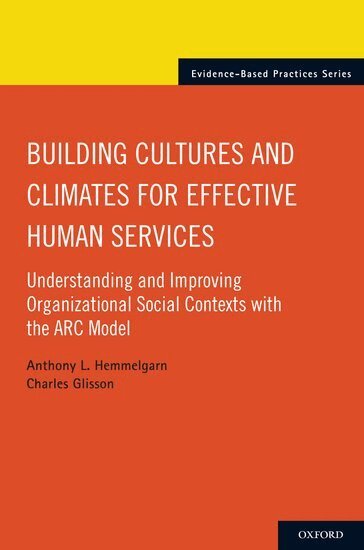
    Building Cultures and Climates for Effective Human Services

    Understanding and Improving Organizational Social Contexts with the ARC Model

    AvAnthony L. Hemmelgarn,Charles Glisson

    Häftad, Engelska, 2018

    Del i serien Evidence-Based Practices

    887 kr

    Beställningsvara. Skickas inom 5-8 vardagar. Fri frakt över 249 kr.

    Beskrivning

    It is widely acknowledged that many healthcare, behavioral health, and social service organizations provide less-than-optimal services and that the challenge of improving services depends on successfully changing organizational culture and climate. However, there are almost no organizational-level strategies that have been tested with randomized controlled trials. Building Cultures and Climates for Effective Human Services addresses the need for evidence-based organizational strategies for improving human service quality and outcomes by uniquely describing the authors' own case examples, nationwide studies, and randomized controlled trials to explain how organizational culture and climate can be assessed and changed. The two authors use their decades of research and practice experience in assessing and changing human service organizations to explain how organizations can improve the services they provide using the authors' ARC model, which effectively removes service barriers and supports the implementation of evidence-based practices and other innovations. The book also blends case examples with research from nationwide studies, regional experiments, and randomized controlled trials to explain the ARC model of organizational effectiveness and how it works to improve services. It provides a balance between theory, empirical research, and actual case examples to help researchers, organizational consultants, administrators, and service providers gain a practical understanding of how culture and climate affect services and how they can be improved. Furthermore, the text describes the three ARC strategies, each composed of multiple elements, to: (1) embed key organizational principles, (2) implement core organizational component tools, and (3) apply mental models to alter shared reasoning and beliefs that affect success. No other organizational-level strategies for improving services have been so well documented and tested.

    Produktinformation

    • Utgivningsdatum:2018-09-06
    • Mått:231 x 155 x 15 mm
    • Vikt:358 g
    • Format:Häftad
    • Språk:Engelska
    • Serie:Evidence-Based Practices
    • Antal sidor:248
    • Förlag:OUP USA
    • ISBN:9780190455286

    Utforska kategorier

    • Socialt arbete och välfärd inom Samhälle och politik

    Mer om författaren

    Anthony Hemmelgarn, PhD, is an industrial psychologist who has worked with researchers, organizational leaders, and practitioners nationwide to improve organizational cultures, climates, and effectiveness for over two decades. He is a primary co-developer and the lead implementation expert for ARC, an empirically-proven organizational development model that has improved organizational social contexts within human services across the nation, as well as client, staff, and organizational outcomes. He and his colleagues' publications in leading journals have helped shape research, organizational change theory, and organizational strategies to improve cultures and climates within human service organizations. He continues to promote and develop innovative approaches to optimize human services outcomes in healthcare and other human service organizations today.Charles Glisson, PhD, is currently Chancellor's Professor Emeritus at the University of Tennessee Knoxville and has directed research on human service organizations funded by the National Institutes for Health, W.T. Grant Foundation and other funders for over 40 years. He has authored over one hundred publications on human service organizations and is internationally known for his research on assessing and changing organizational social context to improve human services. He was awarded the NASW Lifetime Achievement Award in Health and Mental Health in 2014.

    Recensioner i media

    "Everyone who cares about human services should read this book. Packed with lessons from four decades of research and illustrated with compelling case studies, this book details the powerful impact of organizational social context on service quality and outcomes. More importantly, it shares the welcome news that evidence-based, organizational strategies can improve goal setting, decision making, leadership, training, job redesign, and data feedback cycles-allto the benefit of better intervention delivery and better client outcomes. " -Enola K. Proctor, PhD, Shanti K. Khinduka Distinguished Professor, Brown School; Director, Implementation Science, Washington University Institute for Clinical and Translational Science"This is a timely, must-read book for those involved in leading, managing, or working in human service systems and organizations. The authors describe their rigorous and systematic approach and take the reader deeply into the why and how of improving human service organizations. They also provide practical strategies for attaining positive organizational change. This work demonstrates the importance of focusing on organizational context as prerequisite toconsidering implementation of specific service models or evidence-based practices. While there is often an assumption that changing a service model or implementing a new treatment will be enough to improveoutcomes, this rigorous body of work demonstrates that optimizing organizational culture and climate sets the stage for serving clients and patients in ways that lead to improved outcomes." Gregory A. Aarons, PhD, Director, Child and Adolescent Services Research Center, University of California, San Diego

    Innehållsförteckning

    • Chapter 1. Improving Organizational Social Contexts for Effective Human Services Chapter 2. Case Examples Illustrating the Importance of Social Contexts in Human Service Organizations Chapter 3. Understanding and Assessing Organizational Social Context (OSC) Chapter 4. Introducing the Availability Responsiveness and Continuity (ARC) Organizational Strategies Chapter 5. The Impact of ARC in Human Service Organizations Chapter 6. ARC Infrastructure, Preparation, and Key Strategies for Creating Effective Human Service Organizations Chapter 7. ARC Stages and Component Tools Chapter 8. The Role of Mental Models in Organizational Change Chapter 9. Mission-driven versus Rule-driven Human Service Organizations Chapter 10. Results-oriented versus Process-oriented Human Service Organizations Chapter 11. Improvement-directed versus Status Quo-directed Human Service Organizations Chapter 12. Participatory-based versus Authority-based Human Service Organizations Chapter 13. Relationship-centered versus Individual-centered Human Service Organizations Chapter 14. Conclusion and Future Challenges for Improving Human Service Organizations References