Evidence-Based Practices - Böcker
Visar alla böcker i serien Evidence-Based Practices. Handla med fri frakt och snabb leverans.
8 produkter
8 produkter
629 kr
Skickas inom 5-8 vardagar
Evidence Based Treatment with Older Adults: Theory, Practice, and Research provides a detailed examination of five research-supported psychosocial interventions for use with older adults: cognitive behavioral therapy, motivational interviewing, life review/reminiscence, problem solving therapy, and psychoeducational/social support approaches. These interventions address the diversity of mental health conditions and late-life challenges that older adults and their family members experience. Detailed explanations of the approaches, skills, and strategies employed in each intervention are provided, as are adaptions for use of the interventions with older adults. Vignettes are also used to demonstrate the use of specific practice skills and techniques with older clients. The theory undergirding each approach and the historical development of the interventions is explained, and provides the reader with a rich understanding of background and context of each therapy. In addition, the distinct issues such as depression, anxiety, substance abuse/misuse for which evidence exists are highlighted. Research support for application of the interventions in community-based, acute care, and long-term care settings and in individual and group formats is also discussed. Finally, implementation issues encountered in therapeutic work with older adults are described as are accommodations to enhance treatment efficacy. In sum, this book provides a comprehensive overview of evidence based psychosocial interventions for older adults; it is ideal for students and mental health professionals interested in clinical work with older adults and their families.
Building Cultures and Climates for Effective Human Services
Understanding and Improving Organizational Social Contexts with the ARC Model
Häftad, Engelska, 2018
537 kr
Skickas inom 5-8 vardagar
It is widely acknowledged that many healthcare, behavioral health, and social service organizations provide less-than-optimal services and that the challenge of improving services depends on successfully changing organizational culture and climate. However, there are almost no organizational-level strategies that have been tested with randomized controlled trials. Building Cultures and Climates for Effective Human Services addresses the need for evidence-based organizational strategies for improving human service quality and outcomes by uniquely describing the authors' own case examples, nationwide studies, and randomized controlled trials to explain how organizational culture and climate can be assessed and changed. The two authors use their decades of research and practice experience in assessing and changing human service organizations to explain how organizations can improve the services they provide using the authors' ARC model, which effectively removes service barriers and supports the implementation of evidence-based practices and other innovations. The book also blends case examples with research from nationwide studies, regional experiments, and randomized controlled trials to explain the ARC model of organizational effectiveness and how it works to improve services. It provides a balance between theory, empirical research, and actual case examples to help researchers, organizational consultants, administrators, and service providers gain a practical understanding of how culture and climate affect services and how they can be improved. Furthermore, the text describes the three ARC strategies, each composed of multiple elements, to: (1) embed key organizational principles, (2) implement core organizational component tools, and (3) apply mental models to alter shared reasoning and beliefs that affect success. No other organizational-level strategies for improving services have been so well documented and tested.
Screening, Assessment, and Treatment of Substance Use Disorders
Evidence-based practices, community and organizational setting in the era of integrated care
Häftad, Engelska, 2018
590 kr
Skickas inom 5-8 vardagar
There is a clear and pressing need for health professionals, including social workers, to be trained in evidence-based practices (EBPs) in the area of substance use disorders (SUD). The Substance Abuse and Mental Health Services Administration (SAMHSA) and other national organizations and government agencies have all put out reports calling for this vital need, though there remains a significant shortage of properly trained clinicians. The aim of this book is to provide an integrated perspective on addiction treatment on the evidence-base of psychosocial and medication-assisted treatment for substance use disorder. The volume is unique in that it critically examines the evidence base of both psychosocial and pharmacological treatment practices targeting a profession of social work audience. It is also one of few that (1) incorporates evidence both from the United States and internationally, and (2) presents a methodology that permits the authors to systematically review a large number of empirically based studies in an organized and easy-to-read manner. Additionally, the text incorporates a health disparities perspective and describes implementation barriers at the organizational, community, and policy levels. It can be used in policy, human behavior, and clinical practice both nationally and internationally.
670 kr
Skickas inom 5-8 vardagar
Research shows that many adults with serious mental illness live with or maintain contact with their families. But families are rarely given information about their relative's illness and their own needs for support are ignored. To be optimally beneficial, family members and other caregivers need education about the disorder, some knowledge of illness management techniques, and personal support. Family psychoeducation (FPE) is a powerful evidence-based psychosocial intervention that serves consumers and their families. FPE has proven efficacious in reducing relapse and hospitalization, reducing symptoms, increasing employability of persons with severe and persistent mental illness, and, in many cases, enhancing their families' well-being. Its success rests with a state-of-the-art education model for improving caregivers' understanding of their loved one's illness through learning what is known and not known about it and how to assess and cope with its manifestations. Here, in the first book of its kind, Harriet P. Lefley traces the history of FPE -- including the developments in mental health services and systems and theoretical approaches that inform it -- and the robust empirical evidence it now claims after a quarter-century of development and evaluation at major research centers around the world. Presenting first the approach's generic components, training models, and required competencies, Lefley then discusses the available variations, such as Family Education (FE), a brief manualized form of FPE offered by professionally trained family members that has some empirical support for knowledge gains and easing family distress. The result is a comprehensive, practical introduction to family psychoeducation that critically appraises the evidence and examines the model's place in contemporary mental health systems. This groundbreaking volume is an ideal training tool for graduate students of social work, psychology, and psychiatry and a valuable addition to the clinician's armamentarium of evidence-based practices for clients with serious mental illness.
768 kr
Skickas inom 5-8 vardagar
School Social Work: An Evidence-Informed Framework for Practice offers school social work students and veteran practitioners a new framework for choosing their interventions based on the best available evidence. It is the first work that synthesizes the evidence-based practice (EBP) process with recent conceptual frameworks of school social work clinical practice offered by leading scholars and policymakers. Many other books on EBP try to fit empirically validated treatments into practice contexts without considering the multiple barriers to implementing evidence-based practices in places as complicated and multi-faceted as schools. Additionally, there are vital questions in the literature about what the best levels for intervention are in school social work. Responding to the complexity of applying EBP in schools, this volume offers a conceptual framework that addresses the real-world concerns of practitioners as they work to provide the best services to their school clients.For each domain of school social work practice, the authors critically review interventions, presenting the current research with guidelines for addressing such implementation issues as cost, school culture, adaptations for special populations, and negotiating multiple arenas of practice. In addition, the chapters are grounded in the process of evidence-based practice, illustrating how school practitioners can pose useful questions, search for relevant evidence, appraise the evidence, apply it in keeping with client values, and monitor the results. Written by four school social work scholars with over four decades of theoretical, research, and practice experience, this volume will be relevant to both research faculty studying school social work interventions and students learning about school social work practice.
407 kr
Skickas inom 5-8 vardagar
School Social Work: An Evidence-Informed Framework for Practice offers school social work students and veteran practitioners a new framework for choosing their interventions based on the best available evidence. It is the first work that synthesizes the evidence-based practice (EBP) process with recent conceptual frameworks of school social work clinical practice offered by leading scholars and policymakers. Many other books on EBP try to fit empirically-validated treatments into practice contexts without considering the multiple barriers to implementing evidence-based practices in places as complicated and multi-faceted as schools. Additionally, there are vital questions in the literature about what the best levels for intervention (micro- or macro-) are in school social work. This volume will acknowledge the complexity of applying EBP in schools, and offer a conceptual framework that addresses the real-world concerns of practitioners as they struggle to provide the best services to their school clients. School Social Work: An Evidence-Informed Framework for Practice synthesizes these important and exciting ideas in school social work practice. Written by four school social work scholars with over four decades of theoretical, research, and practice experience, this volume will be relevant to both research faculty studying school social work interventions and students learning about school social work practice.
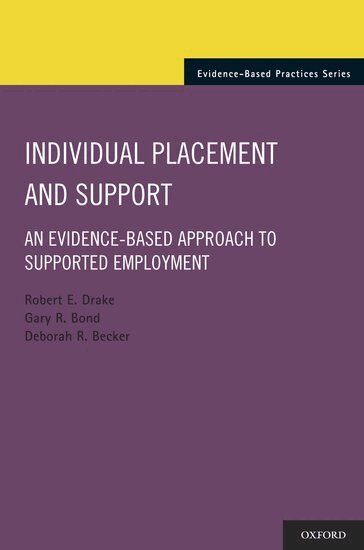
Individual Placement and Support
An Evidence-Based Approach to Supported Employment
Häftad, Engelska, 2012
688 kr
Skickas inom 5-8 vardagar
Employment is the highest priority for many people with severe mental illness and it is a central aspect of recovery. Over the past two decades, the Individual Placement and Support (IPS) model of supported employment has emerged as the prominent evidence-based approach to vocational rehabilitation. This comprehensive monograph synthesizes the research and experience on IPS supported employment: historical context, core principles, effectiveness, long-term outcomes, non-vocational outcomes, cost-effectiveness, generalizability, fidelity, implementation, policy, and future research. A collaboration of the top researchers in the area, this book will have broad appeal to professionals and researchers working with populations with psychiatric disabilities and in community mental health and social service settings. In tracing the evolution of IPS, readers are equipped with an elegant example of the transition from needs assessment, to model development, to testing, and to dissemination.
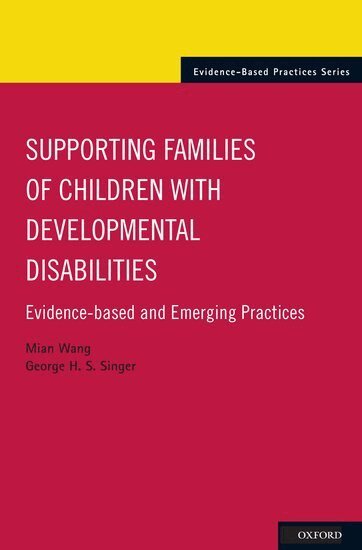
Supporting Families of Children With Developmental Disabilities
Evidence-based and Emerging Practices
Inbunden, Engelska, 2016
1 064 kr
Skickas inom 5-8 vardagar
Supporting Families of Children with Developmental Disabilities: Evidence-based and Emerging Practices provides a comprehensive review of the empirical evidence on interventions for families of individuals - ranging from post-preschool age to adulthood - with developmental disabilities. The book presents both narrative and meta-analytic syntheses of a large body of research to evaluate which interventions meet contemporary standards as evidence based practices. The body of studies reviewed in the book has not previously been gathered into one volume, nor evaluated as a whole for the quality and extent of the evidence. The research is presented in the context of contemporary social policy and practices aimed at maximizing the development of children with disabilities while increasing the quality of life of their families. The criteria and procedures followed for identifying, reviewing, evaluating, and categorizing the studies are articulated in line with other major professional standards. Individual chapters focus on several different schools of practice, including: group psycho-educational interventions, behavioral parent training, multiple component interventions, supportive interventions for families of children with autism, home- and school-based practices, self-help groups, and advocacy programs. Supporting Families of Children with Developmental Disabilities is an important tool for moving the disability field forward for future research, practice, and social policy.