• Fri frakt över 249 kr
  • •
  • Snabba leveranser
  • •
  • Billiga böcker
Kundservice

Du är på sajten för privatpersoner.

Företag, bibliotek eller offentlig verksamhet?

Du handlar på classic.bokus.com, där alla dina funktioner finns intakta.
Till classic.bokus.com
Bokus logotyp. Gå till startsidan.
  • Erbjudanden
  • Nyheter
  • Student
  • Topplistor
  • Barn & ungdom
  • Bokus Play
  • E-böcker
  • Pocketböcker
  • Spel & pussel

10% rabatt på allt med kod: NYSTART10 →

Sidfot

Mina sidor

    Hjälp

    • Kundservice
    • Vanliga frågor och svar
    • Frakt och leverans
    • Retur vid ångerrätt
    • Reklamera vara
    • Betalning
    • Köpvillkor
    • Allmänna villkor
    • Information om webbplatsens tillgänglighet

    Om Bokus

    • Om oss
    • Pressrum
    • För studenter
    • För företag
    • För bibliotek och offentlig verksamhet
    • För leverantörer
    • Hållbarhet

    Populärt

    • Aktuella erbjudanden
    • Presentkort
    • Studentlitteratur
    • Nya böcker
    • Topplistor
    • Signerade böcker
    • Engelska böcker

    Inspiration

    • Boktips
    • BookTok
    • Populära bokserier
    • Barnbokskaraktärer
    • Populära författare
    Logotyp för Bokus
    Följ oss på Facebook (extern länk)Följ oss på Instagram (extern länk)Följ oss på YouTube (extern länk)Följ oss på TikTok (extern länk)
    bokus @ CookiesAnpassa cookiesIntegritetspolicyKöpvillkor
    Till Citymail hemsida (extern länk)Till Budbee hemsida (extern länk)Till Postnord hemsida (extern länk)Till Schenker hemsida (extern länk)Till Early Bird hemsida (extern länk)Till Walleys hemsida (extern länk)
    1. Naturvetenskap och teknik
    2. Matematik och naturvetenskap
    3. Naturvetenskap:allmänt
    4. Populärvetenskap

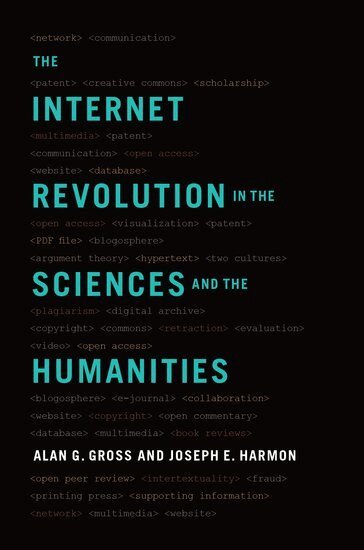
    The Internet Revolution in the Sciences and Humanities

    AvAlan G. Gross,Joseph E. Harmon

    Inbunden, Engelska, 2016

    2 373 kr

    Beställningsvara. Skickas inom 5-8 vardagar. Fri frakt över 249 kr.

    Fler format och utgåvor

    Häftad

    520 kr

    Beskrivning

    The Internet Revolution in the Sciences and Humanities takes a new look at C.P. Snow's distinction between the two cultures, a distinction that provides the driving force for a book that contends that the Internet revolution has sown the seeds for transformative changes in both the sciences and the humanities. It is because of this common situation that the humanities can learn from the sciences, as well as the sciences from the humanities, in matters central to both: generating, evaluating, and communicating knowledge on the Internet. In a succession of chapters, the authors deal with the state of the art in web-based journal articles and books, web sites, peer review, and post-publication review. In the final chapter, they address the obstacles the academy and scientific organizations face in taking full advantage of the Internet: outmoded tenure and promotion procedures, the cost of open access, and restrictive patent and copyright law. They also argue that overcoming these obstacles does not require revolutionary institutional change. In their view, change must be incremental, making use of the powers and prerogatives scientific and academic organizations already have.

    Produktinformation

    • Utgivningsdatum:2016-06-23
    • Mått:241 x 159 x 25 mm
    • Vikt:590 g
    • Format:Inbunden
    • Språk:Engelska
    • Antal sidor:272
    • Förlag:OUP USA
    • ISBN:9780190465926

    Utforska kategorier

    • Populärvetenskap inom Naturvetenskap och teknik
    • Referensverk och tvärvetenskap inom Samhälle och politik
    • Naturvetenskap:allmänt inom Naturvetenskap och teknik

    Mer om författaren

    Alan G. Gross work is firmly grounded in the humanities, having been trained as a Shakespeare scholar at Princeton under Gerald Eades Bentley. In a long career, he has been an English professor at Wayne State, a Dean at Purdue-Calumet, and professor of Communication Studies at the University of Minnesota. In the last quarter-century, he has written and co-written a steady stream of major-press books on academic communication.Joseph E. Harmon works as a science writer, editor, and manager at Argonne National Laboratory. He is the coauthor with Alan Gross of Communicating Science: The Scientific Article from the 17th Century to the Present, The Scientific Literature: A Guided Tour, The Craft of Scientific Communication, and Science from Sight to Insight: How Scientists Illustrate Meaning.

    Recensioner i media

    "The Internet Revolution in the Sciences and Humanities presents a broadly well-conceived comparison between two traditions of academic enquiry. The book is at its strongest when it lays out the ways in which the major asymmetries between how these two fields differ from one another in their use of the Internet." -- Internet Histories"While it is true that readers must turn to the companion websiteto see in action some of the Internet features the authors describe, the fact that readers can follow and appreciate the authors thesis without having recourse to the website shows why the traditional print monograph is a durable, serviceable, and often sufficient vehicle for scholarship, even when that scholarship makes a compelling case for its reinvention." -- Journal of Scholarly Publishing"Gross and Harmon s The Internet Revolution in the Sciences and the Humanities is not a time-stamped review of content on the Internet, which would be out of date within a month of publication. Instead, it is a rich assessment of what the Internet has and, more importantly, can achieve in the communication and evaluation of scholarly knowledge." -- Metascience

    Innehållsförteckning

    • Table of Contents About the Companion Website Chapter 1: The Internet and the Two Cultures Ideal TypesThe Scientific Culture and Scientist as Ideal TypeThe Humanistic Culture and Humanist as Ideal TypeThe Sciences and Humanities TransformedThe Book ItselfThe Audience Chapter 2: The Scientific Article: What's NewRevolution or Evolution?A Survey of the Web ArticleIncreasing AccessibilityThe Changing Nature of AuthorshipCoping with ComplexityIncreasing Inter- and Intra-textualityIncluding Reader Comments and Reader StatisticsEnhancing VisualizationInternet Visualization and the Science of ShapeBirth of a Science of ShapeThe Mathematical Visualization of ShapeScience of Shape and the InternetConclusion Chapter 3: The Internet Humanities Essay: Seeing and Hearing AnewHistorians See AnewPhotographs as Historical EvidenceArt as Historical EvidenceReinterpreting the Civil War: The Role of VisualizationMeeting the Challenge of Urban History: A Multi-Media Los AngelesRe-imagining the Roman Forum: Vision as HypothesisMusicians See and Hear AnewFilm Scholars See AnewConclusion Chapter 4: Archival Web Sites in the Humanities and SciencesWeb Sites That Provide Resources for ScholarshipWeb Sites That Store Data for Scientific ResearchWeb Sites That Store Scientific or Scholarly PapersWeb Sites That Create Knowledge Through Volunteer ParticipationWeb Sites That Codify Existing KnowledgeConclusion Chapter 5: Evaluation before Publication: Opening up Peer ReviewThe Case for and against Peer ReviewArgument Theory and Peer ReviewTheory ApplicationOpen Internet Peer Review in the SciencesOpen Internet Peer Review in the HumanitiesPeer Sourcing: The Wave of the Future?Conclusion Chapter 6: Evaluation after Publication: Setting the Record StraightScience BlogsWhat Science Blogs RevealHow Science Blogs WorkHumanities Post-Peer ReviewPost-Publication Peer Review: The ArticlePost-Publication Peer Review: The BookConclusion Chapter 7: Overcoming the Obstacles to Internet ExploitationThe OpportunitiesGated Access: The First ObstacleCurrent Tenure Rules: The Second ObstacleDigital Preservation: The Third ObstaclePatents and Copyright: The Fourth ObstacleFreedom of Information: The Fifth ObstacleA Path Forward