Alan G. Gross - Böcker
Visar alla böcker från författaren Alan G. Gross. Handla med fri frakt och snabb leverans.
11 produkter
11 produkter
1 670 kr
Skickas inom 5-8 vardagar
The Internet Revolution in the Sciences and Humanities takes a new look at C.P. Snow's distinction between the two cultures, a distinction that provides the driving force for a book that contends that the Internet revolution has sown the seeds for transformative changes in both the sciences and the humanities. It is because of this common situation that the humanities can learn from the sciences, as well as the sciences from the humanities, in matters central to both: generating, evaluating, and communicating knowledge on the Internet. In a succession of chapters, the authors deal with the state of the art in web-based journal articles and books, web sites, peer review, and post-publication review. In the final chapter, they address the obstacles the academy and scientific organizations face in taking full advantage of the Internet: outmoded tenure and promotion procedures, the cost of open access, and restrictive patent and copyright law. They also argue that overcoming these obstacles does not require revolutionary institutional change. In their view, change must be incremental, making use of the powers and prerogatives scientific and academic organizations already have.
379 kr
Skickas inom 5-8 vardagar
The Internet Revolution in the Sciences and Humanities takes a new look at C.P. Snow's distinction between the two cultures, a distinction that provides the driving force for a book that contends that the Internet revolution has sown the seeds for transformative changes in both the sciences and the humanities. It is because of this common situation that the humanities can learn from the sciences, as well as the sciences from the humanities, in matters central to both: generating, evaluating, and communicating knowledge on the Internet. In a succession of chapters, the authors deal with the state of the art in web-based journal articles and books, web sites, peer review, and post-publication review. In the final chapter, they address the obstacles the academy and scientific organizations face in taking full advantage of the Internet: outmoded tenure and promotion procedures, the cost of open access, and restrictive patent and copyright law. They also argue that overcoming these obstacles does not require revolutionary institutional change. In their view, change must be incremental, making use of the powers and prerogatives scientific and academic organizations already have.
The Scientific Sublime
Popular Science Unravels the Mysteries of the Universe
Inbunden, Engelska, 2018
325 kr
Skickas inom 5-8 vardagar
The sublime evokes our awe, our terror, and our wonder. Applied first in ancient Greece to the heights of literary expression, in the 18th-century the sublime was extended to nature and to the sciences, enterprises that viewed the natural world as a manifestation of God's goodness, power, and wisdom. In The Scientific Sublime, Alan Gross reveals the modern-day sublime in popular science. He shows how the great popular scientists of our time--Richard Feynman, Stephen Hawking, Steven Weinberg, Brian Greene, Lisa Randall, Rachel Carson, Stephen Jay Gould, Steven Pinker, Richard Dawkins, and E. O. Wilson--evoke the sublime in response to fundamental questions: How did the universe begin? How did life? How did language? These authors maintain a tradition initiated by Joseph Addison, Edmund Burke, Immanuel Kant, and Adam Smith, towering 18th-century figures who adapted the literary sublime first to nature, then to science--though with one crucial difference: religion has been replaced wholly by science. In a final chapter, Gross explores science's attack on religion, an assault that attempts to sweep permanently under the rug two questions science cannot answer: What is the meaning of life? What is the meaning of the good life?
Communicating Science
The Scientific Article from the 17th Century to the Present
Inbunden, Engelska, 2002
2 062 kr
Skickas inom 5-8 vardagar
This book describes the development of the scientific article from its modest beginnings to the global phenomenon that it has become today. Their analysis of a large sample of texts in French, English, and German focuses on the changes in the style, oganization, and argumentative structure of scientific communication over time. They also speculate on the future currency of the scientific article, as it enters the era of the World Wide Web. This book is an outstanding resource text in the rhetoric of science, and will stand as the definitive study on the topic.
279 kr
Skickas inom 7-10 vardagar
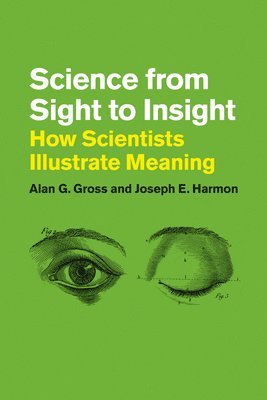
John Dalton's molecular structures. Scatter plots and geometric diagrams. Watson and Crick's double helix. The way in which scientists understand the world - and the key concepts that explain it - is undeniably bound up in not only words, but images. Moreover, from PowerPoint presentations to articles in academic journals, scientific communication routinely relies on the relationship between words and pictures. In Science from Sight to Insight, Alan G. Gross and Joseph E. Harmon present a short history of the scientific visual, and then formulate a theory about the interaction between the visual and textual. With great insight and admirable rigor, the authors argue that scientific meaning itself comes from the complex interplay between the verbal and the visual in the form of graphs, diagrams, maps, drawings, and photographs. The authors use a variety of tools to probe the nature of scientific images, from Heidegger's philosophy of science to Peirce's semiotics of visual communication. Their synthesis of these elements offers readers an examination of scientific visuals at a much deeper and more meaningful level than ever before.
327 kr
Skickas inom 7-10 vardagar
The scientific article has been a hallmark of the career of every important Western scientist since the seventeenth century. Yet its role in the history of science has not been fully explored. Joseph E. Harmon and Alan G. Gross remedy this oversight with "The Scientific Literature", a collection of writings - excerpts from scientific articles, letters, memoirs, proceedings, transactions, and magazines - that illustrates the origin of the scientific article in 1665 and its evolution over the next three and a half centuries. Featuring articles - as well as sixty tables and illustrations, tools vital to scientific communication - that represent the broad sweep of modern science, "The Scientific Literature" is a historical tour through both the rhetorical strategies that scientists employ to share their discoveries and the methods that scientists use to argue claims of new knowledge. Commentaries that explain each excerpt's scientific and historical context and analyze its communication strategy accompany each entry. A unique anthology, "The Scientific Literature" will allow both the scholar and the general reader to experience firsthand the development of modern science.
247 kr
Skickas inom 7-10 vardagar
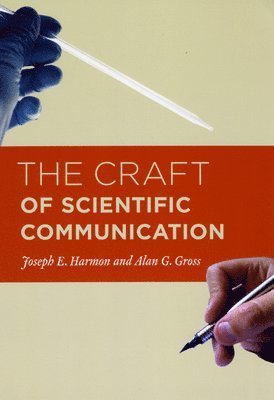
The ability to communicate in print and person is essential to the life of a successful scientist. But since writing is often secondary in scientific education and teaching, there remains a significant need for guides that teach scientists how best to convey their research to general and professional audiences. "The Craft of Scientific Communication" will teach science students and scientists alike how to improve the clarity, cogency, and communicative power of their words and images. In this remarkable guide, Joseph E. Harmon and Alan G. Gross have combined their many years of experience in the art of science writing to analyze published examples of how the best scientists communicate. Organized topically with information on the structural elements and the style of scientific communications, each chapter draws on models of past successes and failures to show students and practitioners how best to negotiate the world of print, online publication, and oral presentation.
611 kr
Skickas inom 3-6 vardagar
Examines the nature of rhetorical theory and criticism, the rhetoric of science, and the impact of poststructuralism and postmodernism on contemporary accounts of rhetoric.Rhetorical Hermeneutics asks whether rhetorical theory can function as a general hermeneutic, a master key to texts. The dazzling central essay by Dilip Parameshwar Gaonkar questions rhetoric's globally interpretive status; Gaonkar begins with the ubiquity of rhetoric: "It is a habit of our time to invoke rhetoric, time and again, to make sense of a wide variety of discursive practices that beset and perplex us, and of discursive artifacts that annoy and entertain us, and of discursive formations that inscribe and subjugate us. Rhetoric is a way of reading the endless discursive debris that surrounds us."Starting from the work of John Angus Campbell, Alan Gross, and Lawrence Prelli on the rhetoric of science, Gaonkar broadens his critique to fundamental issues for any rhetorical theory and develops four questions that cut to the heart of the possibility of a (post)modern rhetoric: How can rhetoric, an art traditionally directed toward practice, transform itself into hermeneutic theory, a mode of reading? Does contemporary rhetorical theory have legitimate theoretical status? Can an intentional, strategic theory of rhetoric survive the poststructuralist, postmodernist critique? Is the case study, the centerpiece of rhetorical and ethnographic scholarship, epistemologically robust enough to bear the weight of a discipline?Representing a variety of disciplines, contributors to this volume include: M. Leff, D. McCloskey, J. A. Campbell, A. Gross, S. Fuller, C. Miller, C. Willard, J. Jasinski, W. Keith, D. Kaufer, A. King, and T. Farrell. In a pellucid final essay, "A Close Reading of the Third Kind," Gaonkar responds to his critics.
State of Rhetoric of Science and Technology
A Special Issue of Technical Communication Quarterly
Häftad, Engelska, 2005
649 kr
Skickas inom 10-15 vardagar
The ubiquity of the Internet and digital technology has changed the sites of rhetorical discourse and inquiry, as well as the methods by which such analyses are performed. This special issue discusses the state of rhetoric of science and technology at the beginning of the twenty-first century. While many books connecting rhetorical theory to the Internet have paved the way for more refined and insightful studies of online communication, the articles here serve as a reflective moment, an opportunity to consider thoughtful statements from those who have published and been influential in the field.
Many Voices of Modern Physics
Written Communication Practices of Key Discoveries
Inbunden, Engelska, 2024
935 kr
Skickas inom 7-10 vardagar
The Many Voices of Modern Physics follows a revolution that began in 1905 when Albert Einstein published papers on special relativity and quantum theory. Unlike Newtonian physics, this new physics often departs wildly from common sense, a radical divorce that presents a unique communicative challenge to physicists when writing for other physicists or for the general public, and to journalists and popular science writers as well. In their two long careers, Joseph Harmon and the late Alan Gross have explored how scientists communicate with each other and with the general public. Here, they focus not on the history of modern physics but on its communication. In their survey of physics communications and related persuasive practices, they move from peak to peak of scientific achievement, recalling how physicists use the communicative tools available - in particular, thought experiments, analogies, visuals, and equations - to convince others that what they say is not only true but significant, that it must be incorporated into the body of scientific and general knowledge. Each chapter includes a chorus of voices, from the many celebrated physicists who devoted considerable time and ingenuity to communicating their discoveries, to the science journalists who made those discoveries accessible to the public, and even to philosophers, sociologists, historians, an opera composer, and a patent lawyer. With their final collaboration, Harmon and Gross offer a tribute to the communicative practices of the physicists who convinced their peers and the general public that the universe is a far more bizarre and interesting place than their nineteenth-century predecessors imagined.
Communicating Science
The Scientific Article from the 17th Century to the Present
Häftad, Engelska, 2009
371 kr
Skickas inom 5-8 vardagar