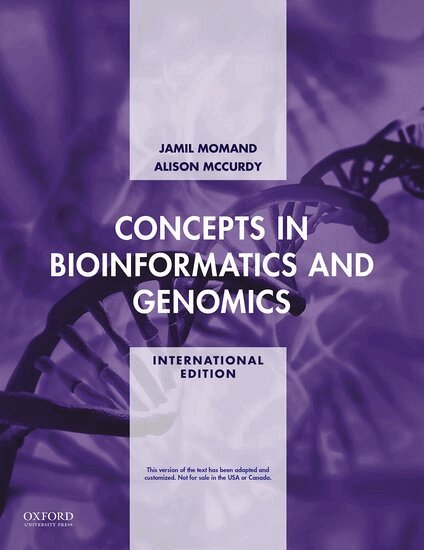
2 972 kr
Beställningsvara. Skickas inom 5-8 vardagar. Fri frakt över 249 kr.
Beskrivning
Produktinformation
- Utgivningsdatum:2017-06-07
- Mått:277 x 216 x 20 mm
- Vikt:964 g
- Format:Häftad
- Språk:Engelska
- Antal sidor:464
- Förlag:OUP USA
- ISBN:9780190610548
Utforska kategorier
Mer om författaren
Jamil Momand has been a professor of biochemistry at California State University, Los Angeles (Cal State LA) since 1999. Dr. Momand received the Cal State LA Outstanding Professor Award for the 2014-2015 academic year.Alison McCurdy is a Professor of Chemistry at California State University, Los Angeles. She was the recipient of the 2009 California State University Distinguished Woman Award.
Recensioner i media
It is a real problem that bioinformatics requires aptitude in both biology and computing, yet the textbook market has not fully risen to meet this challenge for the undergraduates. I see this text as helping to bridge this gap. I would consider adopting this text because it is taking the biology-computation balance seriously and using what has become the dominant scripting language for biologists, Python.
Innehållsförteckning
- Concepts in Bioinformatics and Genomics (Detailed Table of Contents) PrefaceAbout the Author Chapter I: Review of Molecular Biology 1.1 Genes and DNA 1.2 RNA-the intermediary 1.3 Amino acids-the building blocks of proteins 1.4 Levels of protein structure 1.5 The genetic code 1.6 Relative sizes of matter 1.7 DNA alterations 1.8 A case study: sickle cell anemia· What are the symptoms of sickle cell anemia?· Sickle cell anemia is the first disease linked to a specific mutation 1.9 Introduction to p53 ExercisesReferences Box 1-1. A Closer Look: A rare inherited cancer is caused by mutated Tp53 Chapter 2: Information organization and sequence databases 2.1 Introduction 2.2 Public databases 2.3 The header 2.4 The feature keys · The CDS feature key and gene structure· The gene feature key and FASTA format· Thought Question 2.1 2.5 Limitations of GenBank 2.6 Reference Sequence (RefSeq)· Alternative splicing 2.7 Primary and secondary databases· The UniProt Knowledge Base (UniProtKB) database ExercisesAnswers to Thought QuestionsReferences Box 2-1. A Closer Look: GenBank is Critical to the Discovery of the MDM2 Oncoprotein-an Inhibitor of p53 Chapter 3: Molecular Evolution 3.1 Introduction 3.2 Conserved regions in proteins 3.3 Molecular Evolution· Transformation of normal cells to cancer cells· Are mutations inherited?· Natural selection· Mechanisms of mutation 3.4 Ancestral genes and protein evolution 3.5 Modular proteins and protein evolution ExercisesReferences Chapter 4: Substitution matrices 4.1 Introduction 4.2 The identity substitution matrix 4.3 An amino acid substitution system based on natural selection 4.4 Development of the matrix of "accepted" amino acid substitutions· Thought Question 4-1 4.5 Relative mutability calculations 4.6 Development of the PAM1 mutation probability matrix 4.7 Determination of the relative frequencies of amino acids 4.8 Conversion of the PAM1 mutation probability matrix to the PAM1 log-odds substitution matrix 4.9 Conversion of the PAM1 mutational probability matrix to other PAM 4.10 Practical uses for PAM substitution matrices 4.11 The BLOSUM substitution matrix· Thought Question 4-2 4.12 The physico-chemical properties of amino acids correlate to values in matrices 4.13 Practical usage ExercisesAnswers to Thought QuestionsReferences Chapter 5: Pairwise sequence alignment 5.1 Introduction 5.2 Sliding window· Dot plots· The Dotter program 5.3 The Needleman-Wunsch global alignment program· Initialization and matrix fill· Traceback· Gap penalties 5.4 Modified Needleman-Wunsch global alignment (N-Wmod) program with linear gap penalty· N-Wmod initialization· N-Wmod matrix fill· N-Wmod traceback 5.5 Ends-free global alignment 5.6 Local alignment algorithm with linear gap penalty ExercisesReferences Chapter 6: Basic Local Alignment Sequence Tool and Multiple Sequence Alignment 6.1 Introduction 6.2 The BLAST program· Four phases in the BLAST program· How does BLAST account for gaps?· How is a hit deemed to be statistically significant?· Thought Question 6-1· Why is the BLAST program faster than the Smith-Waterman program?· Low complexity regions and masking· Usefulness of BLAST· Psi-BLAST· Thought Question 6-2 6.3. Multiple Sequence Alignment (MSA)· CLUSTALW ExercisesAnswers to Thought QuestionsReferences Chapter 7: Protein structure prediction 7.1 Introduction 7.2 Experimental methods of structure determination· X-ray crystallography· NMR spectroscopy 7.3 Information deposited into the Protein Data Bank 7.4 Molecular viewers· Thought question 7-1 7.5 Protein folding· Christian Anfisen's protein unfolding and refolding experiment· Local minimum energy states· Energy Landscape theory 7.6 Protein structure prediction methods· Prediction method 1: computational methods· Combining computational methods and knowledge-based systems· Calculation of accuracy of structure predictions· Prediction method 2: statistical and knowledge-based methods· Prediction method 3: neural networks· Prediction method 4: homology modeling· Prediction method 5: Threading ExercisesAnswers to Thought QuestionsReferences Box 7-1. A Closer Look: p53 co-crystallized with DNA reveals insights into cancer Chapter 8: Phylogenetics 8.1 Introduction 8.2 Phylogeny and phylogenetics· Molecular clocks· Phylogenetic tree nomenclature· How to tell if sequences in two lineages are undergoing sequence substitution at nearly equal rates?· DNA, RNA and protein-based trees 8.3 Two classes of tree-generation methods· Unweighted pair group method with arithmetic mean (UPGMA)· Thought question 8-1· Thought question 8-2· Thought question 8-3· Thought question 8-4· Bootstrap analysis· Other substitution rate models-Kimura two-parameter model and Gamma distance model· Neighbor-Joining method 8.4 Application of phylogenetics to studies of the origin of modern humans 8.5 Phylogenetic Tree of Life 8.6 The Tp53 gene family members in different species ExercisesAnswers to Thought QuestionsReferences Box 8-1. A Closer Look: What do we know about Neanderthal and Denisovan? Chapter 9. Genomics 9.1 Introduction 9.2 DNA sequencing-dideoxy method · Dideoxy nucleotides· The step-by-step procedure of DNA sequencing· Electrophoresis· Thought question 9-1 9.3 Polymerase chain reaction (PCR) 9.4 DNA sequencing-next generation (next-gen) sequencing technologies· Common themes in next-gen sequencing technologies· Ion semiconductor sequencing· Nanoport-based sequencing 9.5 The PhiX174 bacteriophage genome 9.6 The genome of Haemophilus influenzae Rd. and the whole genome shotgun sequencing approach· The whole genome shotgun approach· Thought question 9-2· The Haemophilus influenzae Rd. genome 9.7 Genome assembly and annotation· Contig N50 and scaffold N50· Bacterial genome annotation systems 9.8 Genome comparisons· Synteny Dotplot· Comparison of E. coli Substrain DH10B to E. coli Substrain MG1655 9.10 The human genome· General characteristics of the human genome· Thought question 3· Detailed analysis of the human genome landscape 9.11 The region of the human genome that encompasses the Tp53 gene· General comments on the region encoding the Tp53 gene· Tracks that display information about the Tp53 region of the genome 9.12 The haplotype map· What is a haplotype?· Haplotypes can be specified by markers derived from SNPs, indels and CNVs· Tag SNPs· Thought question 9-4· How did haplotypes originate?· The HapMap database 9.13 Practical application of Tag SNP, SNP and mutation analyses 9.14 What is the smallest genome? ExercisesAnswers to Thought QuestionsReferences Box 9-1. A Closer Look: DNA Fingerprinting (DNA Profiling) Chapter 10. Transcript and protein expression analysis 10.1 Introduction 10.2 Basic principles of gene expression 10.3 Measurement of transcript levels· Thought question 10-1 10.4 The transcriptome and microarrays· Stages of a microarray experiment· Heatmaps· Thought question 10-2· Cluster analysis· Thought question 3· Practical applications of microarray data· Considerations to take in the interpretation of microarray data· Protein levels can be controlled by regulation of degradation rate 10.5 RNA-seq (RNA sequencing)· Advantages of RNA-seq· Overview of RNA-seq steps· Bridge amplification· Analysis of an experiment using RNA-seq 10.6 Proteome· Separation of proteins and quantification of their steady-state levels-two-dimensional (2D) gel electrophoresis· Identification of proteins-liquid chromatography-mass spectroscopy (LC-MS)· Advantages and challenges of current proteome analysis techniques 10.7 Regulation of p53-controlled genes ExercisesAnswers to Thought QuestionsReferences Chapter 11. Basic probability 11.1 Introduction 11. 2 The basics of probability· Definitions and basic rules· Counting methods when order matters· Counting methods when order does not matter· Independence· Dependence· Thought Question 11-1· Bayesian inference· Thought Question 11-2 11.3 Random variables· Discrete random variables· Thought Question 11-3· Thought Question 11-4· Continuous random variables ExercisesAnswers to Thought QuestionsReferences Chapter 12. Advanced probability for bioinformatics applications 12.1 Introduction 12.2 Extreme value distribution 12.3 Significance of alignments 12.4 Stochastic processes· Markov chains· Thought Question 12-1· Hidden Markov models· Poisson process and Jukes-Cantor Model ExercisesAnswers to Thought QuestionsReferences Chapter 13. Programming basics and applications to bioinformatics 13.1 Introduction 13.2 Developers and users work together to make new discoveries. 13.3 Why Python? 13.4 Getting started with Python 13.5 Data flow: representing and manipulating data· Variable names· Data types and operators 13.6 Putting it together-a simple program to lookup the hydrophobicity of an amino acid 13.7 Decision making· Operations for decision making· If-tests· Conditional expressions· Loops· Thought Question 13-1· Thought Question 13-2· Thought Question 13-3 13.8 Input and output 13.9 Program design: developing Kyte-Doolittle's hydropathy sliding window tool· Step 1: Understand the problem· Steps 2 through 4: Develop and refine algorithm· Step 5: Code in target language (Python)· Steps 6 and 7: Program verification (testing and debugging)· Thought Question 13-4 13.10 Hierarchical design: functions and modules· Python functions· Thought Question 13.5· Python modules and packages ExercisesAnswers to Thought QuestionsReferences Chapter 14. Developing a bioinformatics tool 14.1 Introduction 14.2 Analysis of an existing tool: EMBOSS water local alignment tool· Thought question 14.3 Overview of SPA: A simple pairwise alignment tool 14.4 Algorithms 14.5 Algorithms for SPA· Input sequences· Create substitution matrix· Input gap penalties· Suite of pairwise sequence alignment algorithms· Output alignment 14.6 Algorithm complexity 14.7 Extensions to simple pairwise alignment tool ExercisesProjectAnswers to Thought QuestionsReferences GlossaryIndex
Du kanske också är intresserad av
- -30%
- Signerad!
- 4 för 3
- 4 för 3
- -21%
Hjärnans akilleshälar : hur din hjärna lurar dig, och vad du kan göra åt det
Anders Hansen
229 kr289 kr
- 4 för 3
- 4 för 3