• Fri frakt över 249 kr
  • •
  • Snabba leveranser
  • •
  • Billiga böcker
Kundservice

Du är på sajten för privatpersoner.

Företag, bibliotek eller offentlig verksamhet?

Du handlar på classic.bokus.com, där alla dina funktioner finns intakta.
Till classic.bokus.com
Bokus logotyp. Gå till startsidan.
  • Erbjudanden
  • Nyheter
  • Student
  • Topplistor
  • Barn & ungdom
  • Bokus Play
  • E-böcker
  • Pocketböcker
  • Spel & pussel

10% rabatt på allt med kod: NYSTART10 →

Sidfot

Mina sidor

    Hjälp

    • Kundservice
    • Vanliga frågor och svar
    • Frakt och leverans
    • Retur vid ångerrätt
    • Reklamera vara
    • Betalning
    • Köpvillkor
    • Allmänna villkor
    • Information om webbplatsens tillgänglighet

    Om Bokus

    • Om oss
    • Pressrum
    • För studenter
    • För företag
    • För bibliotek och offentlig verksamhet
    • För leverantörer
    • Hållbarhet

    Populärt

    • Aktuella erbjudanden
    • Presentkort
    • Studentlitteratur
    • Nya böcker
    • Topplistor
    • Signerade böcker
    • Engelska böcker

    Inspiration

    • Boktips
    • BookTok
    • Populära bokserier
    • Barnbokskaraktärer
    • Populära författare
    Logotyp för Bokus
    Följ oss på Facebook (extern länk)Följ oss på Instagram (extern länk)Följ oss på YouTube (extern länk)Följ oss på TikTok (extern länk)
    bokus @ CookiesAnpassa cookiesIntegritetspolicyKöpvillkor
    Till Citymail hemsida (extern länk)Till Budbee hemsida (extern länk)Till Postnord hemsida (extern länk)Till Schenker hemsida (extern länk)Till Early Bird hemsida (extern länk)Till Walleys hemsida (extern länk)
    1. Medicin
    2. Medicinska studiehandledningar och referensmaterial

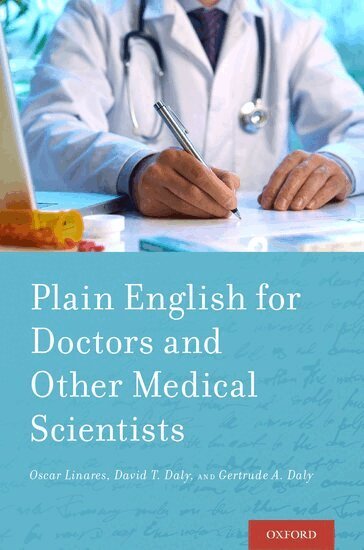
    Plain English for Doctors and Other Medical Scientists

    AvOscar Linares,David Daly

    Häftad, Engelska, 2017

    811 kr

    Beställningsvara. Skickas inom 5-8 vardagar. Fri frakt över 249 kr.

    Beskrivning

    Plain English for Doctors shows how to write about medical science in a clear and vivid way. It can help a medical writer at any level, from beginner to veteran, since it gives specific, practical advice. Writing in plain English can help your writing reach a wider audience, including people in other specialties, levels of training, other fields, and other countries around the world. What makes medical writing hard to read? Is it complex science or complex grammar? This book shows how to keep good science but avoid complex grammar. It describes the symptoms of medicus incomprehensibilis, those over-used writing habits that tend to make medical writing hard to read. It shows how to treat each symptom using a proven plain English writing tip. Each tip is easy to apply and comes with exercises. The exercises are based on excerpts from articles published in leading medical journals. Model revisions vastly improve reading ease and grade level.The book looks at medical writing from three angles. Concept 1, Take charge of your reading ease score, shows how to manage reading ease. Concept 2, Write vividly, shows how to write more vividly by focusing on real world objects and actions. Concept 3, Present logical reasoning clearly, gives tips on how to choose a clear narrative pathway and forge a strong chain of logical reasoning. This book is a must for anyone who writes about medical science. The ability to express complex ideas in simple language is not a remedial skill. Rather, it can only be seen as a sign of mastery.

    Produktinformation

    • Utgivningsdatum:2017-05-04
    • Mått:234 x 156 x 12 mm
    • Vikt:327 g
    • Format:Häftad
    • Språk:Engelska
    • Antal sidor:232
    • Förlag:OUP USA
    • ISBN:9780190654849

    Utforska kategorier

    • Medicinska studiehandledningar och referensmaterial inom Medicin
    • Hälso- och sjukvård: administration och ledning inom Medicin
    • Medicinsk utrustning och medicinska tekniker inom Medicin

    Mer om författaren

    Oscar Linares, MD is a Cuban-born internist and geriatrician. He studied mathematical modeling under Dr. Loren Zech, a senior scientist at the National Institutes of Health. He is an experienced medical researcher and author of over 40 peer-reviewed scientific articles. David Daly is a lawyer experienced in drafting and negotiating international automotive contracts in plain English. He has won three awards from the State Bar of Michigan for clear legal writing. He has worked with Dr. Linares to write medical articles, medical opinions, and legal briefs in medical cases in plain English. Gertrude Daly is a technical writer and editor.

    Recensioner i media

    Plain English for Doctors and Other Medical Scientists is a very instructional text for anybody involved in biomedical research struggling with delivering their findings to the general scientific community and beyond. This book makes tremendous inroads in simplifying the task of communicating complex science void of complexities of grammar. Thus, it makes a unique contribution to biomedical sciences by providing instruction for quick dissemination of knowledge which ultimately may result in prevention of illness and discovery of cures.

    Innehållsförteckning

    • Table of ContentsPreface Introduction a. Why bother to write in plain English? b. What do we mean by plain English? c. Medicus incomprehensibilis d. Using the tips in your writing e. Notes on the exercises Concept 1 - Take charge of your reading ease score a. Flesch reading ease & Flesch-Kincaid grade level tests b. WSEG scores - How we track key reading ease data 1. Use normal sentence length a. Keep sentence length 15 words average, 25 words maximum b. Keep the subject and verb close together in the first seven or eight words c. Put the main point first. Then give commentary, detail or support 2. Prefer the short word a. Keep essential scientific terms; minimize other long words b. Cite a common medical term once to avoid confusion c. Write a compound word to promote reading ease and show how you pronounce it d. Omit any unnecessary word ending e. Avoid the noun string f. Don't be afraid to start a sentence with "and" or "but" g. Avoid using a high percentage of long words 3. Omit any needless word a. Spot and omit needless words b. Omit the needless "of" c. Omit the needless "that" Concept 2 - Use vivid language 4. Prefer active voice a. Identify active and passive voice b. Revise passive into active voice c. When should you use active voice? d. Minimize forms of the verbs "to be" and "to have" e. Identify nominalization f. Convert nominalization into a verb in active voice 5. Prefer concrete language a. Identify abstract and concrete subjects b. Revise abstract into concrete c. Use nouns & verbs to carry the weight of meaning d. Write in the singular e. Talk in terms of one doctor treating one patient 6. Observe the 1066 principle a. Prefer the short word to describe the real world b. Prefer "-'s" to show real-world possession or connection c. Use terms consistently; avoid elegant variation d. Avoid using a long, Latin word to describe the real-world 7. Statistical analysis of WSEG scores for exercises in Chapters 1-6 Concept 3 - Present logical reasoning clearly 8. Organize your narrative in a way that's helpful for your reader a. Introduce and develop a single idea in each paragraphs b. Present two-dimensional data in a table, chart, or graph 9. Choose a clear narrative pathway a. Start with things known b. Start by anchoring the discussion in the real world b. Choose a good narrative pathway c. Make a smooth transition between concrete and abstract 10. Forge a strong chain of logical reasoning a. Explain each step of reasoning b. State the problem before you solve it c. State the problem in words before you state it in symbols Afterword: Can things ever change? Appendices 1. English users around the world 2. Selected excerpts from medical science articles 3. Exercise key Glossary References