• Fri frakt över 249 kr
  • •
  • Snabba leveranser
  • •
  • Billiga böcker
Kundservice

Du är på sajten för privatpersoner.

Företag, bibliotek eller offentlig verksamhet?

Du handlar på classic.bokus.com, där alla dina funktioner finns intakta.
Till classic.bokus.com
Bokus logotyp. Gå till startsidan.
  • Erbjudanden
  • Nyheter
  • Student
  • Topplistor
  • Barn & ungdom
  • Bokus Play
  • E-böcker
  • Pocketböcker
  • Spel & pussel

10% rabatt på allt med kod NYSTART10 →

Sidfot

Mina sidor

    Hjälp

    • Kundservice
    • Vanliga frågor och svar
    • Frakt och leverans
    • Retur vid ångerrätt
    • Reklamera vara
    • Betalning
    • Köpvillkor
    • Allmänna villkor
    • Information om webbplatsens tillgänglighet

    Om Bokus

    • Om oss
    • Pressrum
    • För studenter
    • För företag
    • För bibliotek och offentlig verksamhet
    • För leverantörer
    • Hållbarhet

    Populärt

    • Aktuella erbjudanden
    • Presentkort
    • Studentlitteratur
    • Nya böcker
    • Topplistor
    • Signerade böcker
    • Engelska böcker

    Inspiration

    • Boktips
    • BookTok
    • Populära bokserier
    • Barnbokskaraktärer
    • Populära författare
    Logotyp för Bokus
    Följ oss på Facebook (extern länk)Följ oss på Instagram (extern länk)Följ oss på YouTube (extern länk)Följ oss på TikTok (extern länk)
    bokus @ CookiesAnpassa cookiesIntegritetspolicyKöpvillkor
    Till Citymail hemsida (extern länk)Till Budbee hemsida (extern länk)Till Postnord hemsida (extern länk)Till Schenker hemsida (extern länk)Till Early Bird hemsida (extern länk)Till Walleys hemsida (extern länk)
    1. Filosofi och religion
    2. Religion och tro
    3. Religion: allmänt

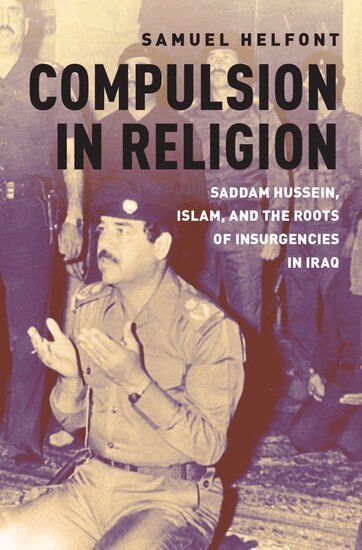
    Compulsion in Religion

    Saddam Hussein, Islam, and the Roots of Insurgencies in Iraq

    AvSamuel Helfont

    Inbunden, Engelska, 2018

    796 kr

    Beställningsvara. Skickas inom 5-8 vardagar. Fri frakt över 249 kr.

    Fler format och utgåvor

    E-bok

    249 kr

    E-bok

    249 kr

    Häftad

    367 kr

    Beskrivning

    Samuel Helfont draws on extensive research with Ba'thist archives to investigate the roots of the religious insurgencies that erupted in Iraq following the American-led invasion in 2003. In looking at Saddam Hussein's policies in the 1990s, many have interpreted his support for state-sponsored religion as evidence of a dramatic shift away from Arab nationalism toward political Islam. While Islam did play a greater role in the regime's symbols and Saddam's statements in the 1990s than it had in earlier decades, the regime's internal documents challenge this theory. The "Faith Campaign" Saddam launched during this period was the culmination of a plan to use religion for political ends, begun upon his assumption of the Iraqi presidency in 1979. At this time, Saddam began constructing the institutional capacity to control and monitor Iraqi religious institutions. The resulting authoritarian structures allowed him to employ Islamic symbols and rhetoric in public policy, but in a controlled manner. Saddam ultimately promoted a Ba'thist interpretation of religion that subordinated it to Arab nationalism, rather than depicting it as an independent or primary political identity.The point of this examination of Iraqi history, other than to correct the current understanding of Saddam Hussein's political use of religion throughout his presidency, is to examine how Saddam's controlled use of religion was dismantled during the US-Iraq war, and consequently set free extremists that were suppressed under his regime. When the American-led invasion destroyed the regime's authoritarian structures, it unwittingly unhinged the forces that these structures were designed to contain, creating an atmosphere infused with religion, but lacking the checks provided by the former regime. Groups such as the Sadrists, al-Qaida, and eventually the Islamic State emerged out of this context to unleash the insurgencies that have plagued post-2003 Iraq.

    Produktinformation

    • Utgivningsdatum:2018-05-17
    • Mått:236 x 157 x 27 mm
    • Vikt:544 g
    • Format:Inbunden
    • Språk:Engelska
    • Antal sidor:304
    • Förlag:OUP USA
    • ISBN:9780190843311

    Utforska kategorier

    • Religion: allmänt inom Filosofi och religion
    • Mellanösterns historia inom Historia och arkeologi
    • Politik och statsskick inom Samhälle och politik

    Mer om författaren

    Samuel Helfont is Lecturer in International Relations at the University of Pennsylvania and Senior Fellow at the Foreign Policy Research Institute in Philadelphia.

    Recensioner i media

    Compulsion in Religion is the definitive account of the religious policies of Saddam's regime and mosque-state relations in Ba?thist Iraq. The work will be of interest to scholars of Iraq, religion and comparative politics, but it is also accessible to general readers. It stands as a corrective to several variants of the narrative positing that the religious policies of Saddam's regime were responsible for the eventual rise of ISIS a decade after the former's toppling.

    Innehållsförteckning

    • Preface and AcknowledgementsIntroduction: Religion and Authoritarianism in Saddam's IraqPart I: The Penetration of Iraq's Religious Landscape 1979-1989Chapter 1: Saddam Takes ControlChapter 2: Co-opting and Coercing Religion in Saddam's Iraq Chapter 3: Co-opting and Coercing Shi'ismChapter 4: Suppressing the Islamist OppositionChapter 5: Addressing the Limits of Coercion and Co-optationPart II: The Gulf War and its Aftermath 1990-1993Chapter 6: Continuity and Change in the Gulf WarChapter 7: Iraq's Religious Landscape in the Wake of the Gulf WarPart III: The Faith Campaign 1993-2003Chapter 8: A Transformed Religious LandscapeChapter 9: The Regime and the Shi'is in the 1990sChapter 10: Mechanisms of ControlChapter 11: Putting the System to WorkPart IV: The Invasion of Iraq War and the Emergence of Religious InsurgenciesChapter 12: American Misconceptions about Iraq and the 2003 InvasionChapter 13: Emergence of Religious Insurgencies in IraqConclusion: Saddam the Counter-Insurgent and other Reflections on Ruling IraqNotesBibliographyIndex