• Fri frakt över 249 kr
  • •
  • Snabba leveranser
  • •
  • Billiga böcker
Kundservice

Du är på sajten för privatpersoner.

Företag, bibliotek eller offentlig verksamhet?

Du handlar på classic.bokus.com, där alla dina funktioner finns intakta.
Till classic.bokus.com
Bokus logotyp. Gå till startsidan.
  • Erbjudanden
  • Nyheter
  • Student
  • Topplistor
  • Barn & ungdom
  • Bokus Play
  • E-böcker
  • Pocketböcker
  • Spel & pussel

10% rabatt på allt med kod NYSTART10 →

Sidfot

Mina sidor

    Hjälp

    • Kundservice
    • Vanliga frågor och svar
    • Frakt och leverans
    • Retur vid ångerrätt
    • Reklamera vara
    • Betalning
    • Köpvillkor
    • Allmänna villkor
    • Information om webbplatsens tillgänglighet

    Om Bokus

    • Om oss
    • Pressrum
    • För studenter
    • För företag
    • För bibliotek och offentlig verksamhet
    • För leverantörer
    • Hållbarhet

    Populärt

    • Aktuella erbjudanden
    • Presentkort
    • Studentlitteratur
    • Nya böcker
    • Topplistor
    • Signerade böcker
    • Engelska böcker

    Inspiration

    • Boktips
    • BookTok
    • Populära bokserier
    • Barnbokskaraktärer
    • Populära författare
    Logotyp för Bokus
    Följ oss på Facebook (extern länk)Följ oss på Instagram (extern länk)Följ oss på YouTube (extern länk)Följ oss på TikTok (extern länk)
    bokus @ CookiesAnpassa cookiesIntegritetspolicyKöpvillkor
    Till Citymail hemsida (extern länk)Till Budbee hemsida (extern länk)Till Postnord hemsida (extern länk)Till Schenker hemsida (extern länk)Till Early Bird hemsida (extern länk)Till Walleys hemsida (extern länk)
    1. Filosofi och religion
    2. Filosofi
    3. Filosofiska discipliner

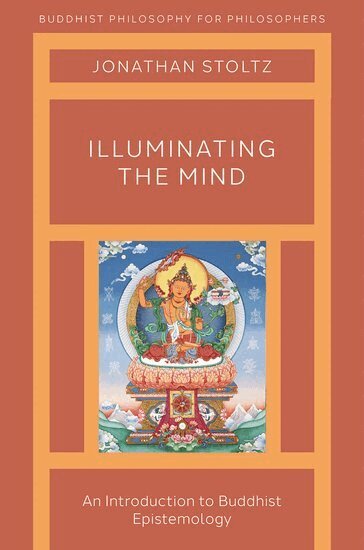
    Illuminating the Mind

    An Introduction to Buddhist Epistemology

    AvJonathan Stoltz

    Inbunden, Engelska, 2021

    Del i serien Buddhist Philosophy For Philosophers

    1 719 kr

    Beställningsvara. Skickas inom 5-8 vardagar. Fri frakt över 249 kr.

    Fler format och utgåvor

    Häftad

    394 kr

    E-bok

    338 kr

    E-bok

    338 kr

    Beskrivning

    Illuminating the Mind puts the field of Buddhist epistemology in conversation with contemporary debates in philosophy. Jonathan Stoltz provides readers with an introduction to epistemology within the Buddhist intellectual tradition in a manner that is accessible to those whose primary background is in the “Western” tradition of philosophy. The book examines many of the most important topics in the field of epistemology, topics that are central both to contemporary discussions of epistemology and to the classical Buddhist tradition of epistemology in India and Tibet. Among the topics discussed are Buddhist accounts of the nature of knowledge episodes, the defining conditions of perceptual knowledge and of inferential knowledge, the status of testimonial knowledge, and skeptical criticisms of the entire project of epistemology. Stoltz demonstrates how many of the arguments and debates occurring within classical Buddhist epistemological treatises coincide with the arguments and disagreements found in contemporary epistemology. He shows, for example, how Buddhist epistemologists developed an anti-luck epistemology-one that is linked to a sensitivity requirement for knowledge. Likewise, Stoltz explores the question of how the study of Buddhist epistemology can be of relevance to contemporary debates about the value of contributions from experimental epistemologists, and to broader debates concerning the use of philosophical intuitions about knowledge. Illuminating the Mind is essential reading for scholars and students interested in epistemology and its treatment in intellectual traditions beyond Western philosophy.

    Produktinformation

    • Utgivningsdatum:2021-09-09
    • Mått:241 x 163 x 22 mm
    • Vikt:544 g
    • Format:Inbunden
    • Språk:Engelska
    • Serie:Buddhist Philosophy For Philosophers
    • Antal sidor:346
    • Förlag:OUP USA
    • ISBN:9780190907532

    Utforska kategorier

    • Filosofiska discipliner inom Filosofi och religion

    Mer om författaren

    Jonathan Stoltz is a professor of philosophy at the University of St. Thomas (Minnesota) where he has been teaching since 2006. His scholarly research is focused on the areas of epistemology and the philosophy of logic, both in the 'Western' tradition and in the Indian and Tibetan traditions of philosophy.

    Recensioner i media

    Illuminating the Mind skillfully relates various Buddhist positions to contemporary debates in analytic epistemology, carefully navigating the issues that arise from the fundamental differences in orientation between the two traditions. Stoltz has clearly demonstrated that Buddhist philosophers can be valuable contributors to contemporary epistemology.

    Innehållsförteckning

    • Preface Chapter 1: Preliminaries1. Two Histories2. Core Terms and Concepts3. Pramana4. The Episodic Nature of Cognition/Knowledge5. Main Themes of the Book Chapter 2: Knowledge1. Defining Knowledge?2. Revealing the Unknown3. Non-deceptive Cognition4. Analytic Theories of Knowledge and 'The Standard Analysis'5. Pramana and Reliabilism Chapter 3: Perception1. Perception and Non-conceptual Awareness2. Perceptual Judgment3. Four Types of Perception4. Reflexive Perception and Self-awareness5. Perception, Illusion, and Hallucination Chapter 4: Inference1. Two Forms of Inference2. Inference and Conceptual Cognition3. The Structure of Inferential Reasoning4. Evidence and Entailment5. Epistemic Closure Chapter 5: Testimony1. The Nyaya Account and the Buddhist Response2. Reductive and Non-reductive Theories of Testimonial Knowledge3. Speakers, Hearers, and Knowledge4. The Transmission Theory of Testimony Chapter 6: Ignorance1. Mistaken Cognition2. Ignorant Perception3. Ignorant Veridical Conception Chapter 7: Skepticism1. Skepticism and Skeptical Scenarios2. Knowledge and Instruments of Knowledge3. Nagarjuna and the Epistemic Regress Problem4. The Structure of Knowledge Chapter 8: Sensitivity & Safety1. Knowledge, Perception, and Inference2. Tracking and Sensitivity3. Safety and Knowledge4. Discrimination and Alternatives Chapter 9: Internalism & Externalism1. The Etiology of Cognition2. Analyzing Knowledge and Internalism3. Intrinsic vs. Extrinsic Determination of Knowledge Status4. Factive Mental Episodes and Externalism Chapter 10: Experimental & Cross-cultural Epistemology1. Philosophical Intuitions and Experimental Epistemology2. Cross-cultural Intuitions about Knowledge3. The Value of Buddhist Epistemology NotesBibliographyIndex