E-bok, Engelska, 2023
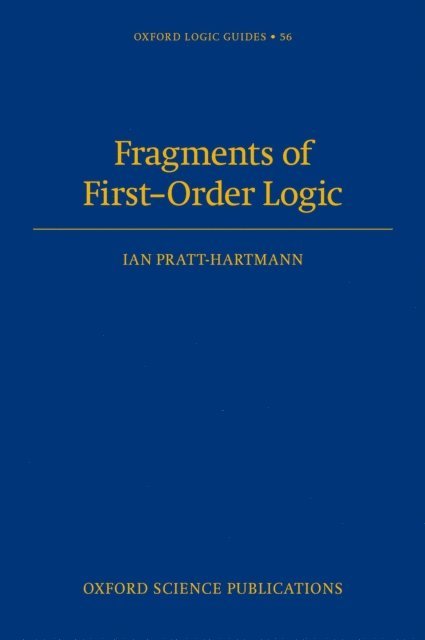
Fragments of First-Order Logic
1650 kr
Läs direkt i Bokus Reader – eller ladda ned till din enhet (PDF kräver ofta zoom och scroll på små skärmar).
Beskrivning
A sentence of first-order logic is satisfiable if it is true in some structure, and finitely satisfiable if it is true in some finite structure. The question arises as to whether there exists an algorithm for determining whether a given formula of first-order logic is satisfiable, or indeed finitely satisfiable. This question was answered negatively in 1936 by Church and Turing (for satisfiability) and in 1950 by Trakhtenbrot (for finite satisfiability).In contrast, the satisfiability and finite satisfiability problems are algorithmically solvable for restricted subsets---or, as we say, fragments---of first-order logic, a fact which is today of considerable interest in Computer Science. This book provides an up-to-date survey of the principal axes of research, charting the limits of decision in first-order logic and exploring the trade-off between expressive power and complexity of reasoning. Divided into three parts, the book considers for which fragments of first-order logic there is an effective method for determining satisfiability or finite satisfiability. Furthermore, if these problems are decidable for some fragment, what is their computational complexity? Part I focusses on fragments defined by restricting the set of available formulas. Topics covered include the Aristotelian syllogistic and its relatives, the two-variable fragment, the guarded fragment, the quantifier-prefix fragments and the fluted fragment. Part II investigates logics with counting quantifiers. Starting with De Morgan''s numerical generalization of the Aristotelian syllogistic, we proceed to the two-variable fragment with counting quantifiers and its guarded subfragment, explaining the applications of the latter to the problem of query answering in structured data. Part III concerns logics characterized by semantic constraints, limiting the available interpretations of certain predicates. Taking propositional modal logic and graded modal logic as our cue, we return to the satisfiability problem for two-variable first-order logic and its relatives, but this time with certain distinguished binary predicates constrained to be interpreted as equivalence relations or transitive relations. The work finishes, slightly breaching the bounds of first-order logic proper, with a chapter on logics interpreted over trees.
Produktinformation
- Utgivningsdatum: 2023-04-06
- Språk: Engelska
- Filformat: PDF
- Kopieringsskydd: LCP
- ISBN: 9780192693891
- Förlag: Oxford University Press
Utforska kategorier
Betyg & recensioner
0 recensioner
Inga recensioner tillgängliga.