• Fri frakt över 249 kr
  • •
  • Snabba leveranser
  • •
  • Billiga böcker
Kundservice

Du är på sajten för privatpersoner.

Företag, bibliotek eller offentlig verksamhet?

Du handlar på classic.bokus.com, där alla dina funktioner finns intakta.
Till classic.bokus.com
Bokus logotyp. Gå till startsidan.
  • Erbjudanden
  • Nyheter
  • Student
  • Topplistor
  • Barn & ungdom
  • Bokus Play
  • E-böcker
  • Pocketböcker
  • Spel & pussel

10% rabatt på allt med kod: NYSTART10 →

Sidfot

Mina sidor

    Hjälp

    • Kundservice
    • Vanliga frågor och svar
    • Frakt och leverans
    • Retur vid ångerrätt
    • Reklamera vara
    • Betalning
    • Köpvillkor
    • Allmänna villkor
    • Information om webbplatsens tillgänglighet

    Om Bokus

    • Om oss
    • Pressrum
    • För studenter
    • För företag
    • För bibliotek och offentlig verksamhet
    • För leverantörer
    • Hållbarhet

    Populärt

    • Aktuella erbjudanden
    • Presentkort
    • Studentlitteratur
    • Nya böcker
    • Topplistor
    • Signerade böcker
    • Engelska böcker

    Inspiration

    • Boktips
    • BookTok
    • Populära bokserier
    • Barnbokskaraktärer
    • Populära författare
    Logotyp för Bokus
    Följ oss på Facebook (extern länk)Följ oss på Instagram (extern länk)Följ oss på YouTube (extern länk)Följ oss på TikTok (extern länk)
    bokus @ CookiesAnpassa cookiesIntegritetspolicyKöpvillkor
    Till Citymail hemsida (extern länk)Till Budbee hemsida (extern länk)Till Postnord hemsida (extern länk)Till Schenker hemsida (extern länk)Till Early Bird hemsida (extern länk)Till Walleys hemsida (extern länk)
    1. Språk och ordböcker
    2. Språkvetenskap och lingvistik

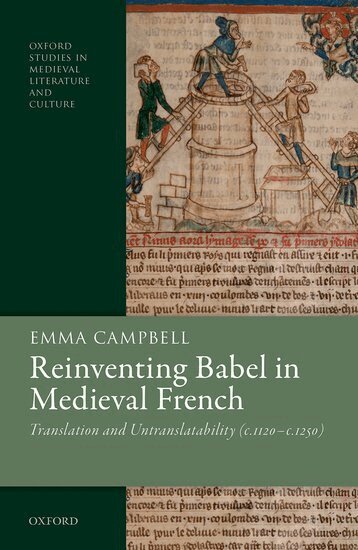
    Reinventing Babel in Medieval French

    Translation and Untranslatability (c. 1120-c. 1250)

    AvEmma Campbell

    Inbunden, Engelska, 2023

    Del i serien Oxford Studies in Medieval Literature and Culture

    1 389 kr

    Beställningsvara. Skickas inom 5-8 vardagar. Fri frakt över 249 kr.

    Fler format och utgåvor

    E-bok

    1 245 kr

    E-bok

    1 245 kr

    Beskrivning

    How can untranslatability help us to think about the historical as well as the cultural and linguistic dimensions of translation? For the past two centuries, theoretical debates about translation have responded to the idea that translation overcomes linguistic and cultural incommensurability, while never inscribing full equivalence. More recently, untranslatability has been foregrounded in projects at the intersections between translation studies and other disciplines, notably philosophy and comparative literature. The critical turn to untranslatability re-emphasizes the importance of translation's negotiation with foreignness or difference and prompts further reflection on how that might be understood historically, philosophically, and ethically. If translation never replicates a source exactly, what does it mean to communicate some elements and not others? What or who determines what is translatable, or what can or cannot be recontextualized? What linguistic, political, cultural, or historical factors condition such determinations? Central to these questions is the way translation negotiates with, and inscribes asymmetries among, languages and cultures, operations that are inevitably ethical and political as well as linguistic.This book explores how approaching questions of translatability and untranslatability through premodern texts and languages can inform broader interdisciplinary conversations about translation as a concept and a practice. Working with case studies drawn from the francophone cultures of Flanders, England, and northern France, it explores how medieval texts challenge modern definitions of language, text, and translation and, in so doing, how such texts can open sites of variance and non-identity within what later became the hegemonic global languages we know today.

    Produktinformation

    • Utgivningsdatum:2023-10-05
    • Mått:162 x 240 x 22 mm
    • Vikt:690 g
    • Format:Inbunden
    • Språk:Engelska
    • Serie:Oxford Studies in Medieval Literature and Culture
    • Antal sidor:348
    • Förlag:OUP OXFORD
    • ISBN:9780192871718
    • Utmärkelser:Winner of the MLA Aldo and Jeanne Scaglione Prize for French and Francophone Studies, 2023 Shortlisted for the R. Gapper Book Prize

    Utforska kategorier

    • Språkvetenskap och lingvistik inom Språk och ordböcker
    • Litteraturvetenskap inom Skönlitteratur

    Mer om författaren

    Emma Campbell is Associate Professor/Reader in the School of Modern Languages and Cultures at the University of Warwick. Focusing on the francophone literary cultures of the Middle Ages, her work explores how contemporary approaches can be brought into dialogue with medieval texts. She has published on a range of works prior to the fourteenth century, including major traditions such as saints' lives and bestiaries. She is the author of Medieval Saints' Lives: The Gift, Kinship and Community in Old French Hagiography (2008) and co-editor of two further books, including Rethinking Medieval Translation: Ethics, Politics, Theory (2012).

    Recensioner i media

    Campbell's book is a mine not only of information but also of innovative interpretations, leading the way in a call for renewed efforts to dismantle received narratives about the past without abandoning our commitment to better understanding that past.

    Innehållsförteckning

    • Introduction: Reinventing Babel: Translation and Untranslatability in Medieval French Texts 1: Cultivating Difference: Translation and 'Remainder' in Wauchier de Denain's L'Histoire des Moines d'Egypte 2: Spiritual Translatio in the French Lives of Saint Catherine of Alexandria: Gender and Hagiographic Translation 3: Translation, Memory, and the Limits of Translatability in the Writing of Marie de France 4: Translatio and the Afterlives of Translation in Chrétien de Troyes' Cligés 5: Monolingualism, Absolute Translation, and Linguistic Mastery in Franco-English Jargon Texts: Jehan et Blonde and Renart teinturier 6: Translating Nature in French Verse Bestiaries: Translation and/as Ontology Conclusion