• Fri frakt över 249 kr
  • •
  • Snabba leveranser
  • •
  • Billiga böcker
Kundservice

Du är på sajten för privatpersoner.

Företag, bibliotek eller offentlig verksamhet?

Du handlar på classic.bokus.com, där alla dina funktioner finns intakta.
Till classic.bokus.com
Bokus logotyp. Gå till startsidan.
  • Erbjudanden
  • Nyheter
  • Student
  • Topplistor
  • Barn & ungdom
  • Bokus Play
  • E-böcker
  • Pocketböcker
  • Spel & pussel

10% rabatt på allt med kod NYSTART10 →

Sidfot

Mina sidor

    Hjälp

    • Kundservice
    • Vanliga frågor och svar
    • Frakt och leverans
    • Retur vid ångerrätt
    • Reklamera vara
    • Betalning
    • Köpvillkor
    • Allmänna villkor
    • Information om webbplatsens tillgänglighet

    Om Bokus

    • Om oss
    • Pressrum
    • För studenter
    • För företag
    • För bibliotek och offentlig verksamhet
    • För leverantörer
    • Hållbarhet

    Populärt

    • Aktuella erbjudanden
    • Presentkort
    • Studentlitteratur
    • Nya böcker
    • Topplistor
    • Signerade böcker
    • Engelska böcker

    Inspiration

    • Boktips
    • BookTok
    • Populära bokserier
    • Barnbokskaraktärer
    • Populära författare
    Logotyp för Bokus
    Följ oss på Facebook (extern länk)Följ oss på Instagram (extern länk)Följ oss på YouTube (extern länk)Följ oss på TikTok (extern länk)
    bokus @ CookiesAnpassa cookiesIntegritetspolicyKöpvillkor
    Till Citymail hemsida (extern länk)Till Budbee hemsida (extern länk)Till Postnord hemsida (extern länk)Till Schenker hemsida (extern länk)Till Early Bird hemsida (extern länk)Till Walleys hemsida (extern länk)
    1. Ekonomi och Ledarskap
    2. Nationalekonomi
    3. Mikroekonomi

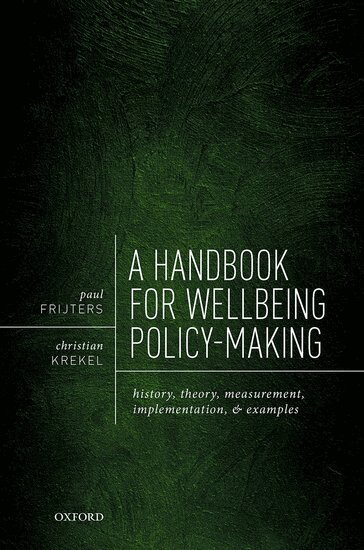
    A Handbook for Wellbeing Policy-Making

    History, Theory, Measurement, Implementation, and Examples

    AvPaul Frijters,Christian Krekel

    Inbunden, Engelska, 2021

    1 820 kr

    Beställningsvara. Skickas inom 5-8 vardagar. Fri frakt över 249 kr.

    Beskrivning

    This is an open access title. It is available to read and download as a free PDF version on the Oxford Academic platform. It is made available under a Creative Commons Attribution-Non Commercial-No Derivatives 4.0 International licence.Around the world, governments are starting to directly measure the subjective wellbeing of their citizens and to use it for policy evaluation and appraisal. What would happen if a country were to move from using GDP to using subjective wellbeing as the primary metric for measuring economic and societal progress? Would policy priorities change? Would we continue to care about economic growth? What role would different government institutions play in such a scenario? And, most importantly, how could this be implemented in daily practice, for example in policy evaluations and appraisals of government analysts, or in political agenda-setting at the top level?This volume provides answers to these questions from a conceptual to technical level, by showing how direct measures of subjective wellbeing can be used for policy evaluation and appraisal, either complementary in the short-run or even entirely in the long-run. It gives a brief history of the idea that governments should care about the happiness of their citizens, provides theories, makes suggestions for direct measurement, derives technical standards and makes suggestions on how to conduct wellbeing cost-effectiveness and cost-benefit analyses, and gives examples of how real-world policy evaluations and appraisals would change if they were based on subjective wellbeing. In doing so, it serves the growing interest of governments as well as non-governmental and international organisations in how to put subjective wellbeing metrics into policy practice.

    Produktinformation

    • Utgivningsdatum:2021-05-27
    • Mått:163 x 141 x 30 mm
    • Vikt:846 g
    • Format:Inbunden
    • Språk:Engelska
    • Antal sidor:454
    • Förlag:OUP OXFORD
    • ISBN:9780192896803

    Utforska kategorier

    • Mikroekonomi inom Ekonomi och Ledarskap
    • Ekonomisk politik inom Ekonomi och Ledarskap
    • Miljöekonomi inom Ekonomi och Ledarskap

    Mer om författaren

    Paul Frijters is Professor of Wellbeing Economics at the London School of Economics. From 2016 to 2019 he was at the Center for Economic Performance and thereafter at the Department of Social Policy. He completed his Masters in Econometrics at the University of Groningen and his PhD in Economics at the University of Amsterdam. He has taught at the University of Melbourne, the Australian National University, the University of Queensland, and the LSE. Professor Frijters specializes in applied microeconometrics, including labour, health, and happiness economics and has published over 150 refereed journal articles. In 2009, he was voted Australia's best young economist under the age of 40 by the Australian Economic Society.Christian Krekel is Assistant Professor in Behavioural Science in the Department of Psychological and Behavioural Science at the London School of Economics. He is also a Research Associate at the Centre for Economic Performance and at the Wellbeing Research Centre at the University of Oxford. Dr Krekel is an applied economist and his research fields include behavioural economics and wellbeing, policy and programme evaluation, and applied panel and spatial analysis. He obtained his PhD in Economics from the Paris School of Economics. He was awarded the Young Economist Award by the European Economic Association.

    Recensioner i media

    the book makes a very important contribution as it brings wellbeing research that has grown rapidly over the last three decases to policy by develping a forceful framework for welling cost-effectiveness analysis.

    Innehållsförteckning

    • Richard Layard: Foreword Preface 1: The Case for Wellbeing as the Goal of Government in the Context of Constraints on Policy-making 2: Wellbeing Measurement and Policy Design Measures, Key Findings, and Wellbeing Frameworks 3: Wellbeing Policy Evaluation and Appraisal: Data, Methods, Literature, Rules-of-thumb, and Technical Standards Appendix A. Data: General Overview Appendix B. Data: Technical Details Appendix C. Data: Download Links and Sample Studies Appendix D. Conversion between Different Scales and Indicators of Wellbeing Appendix E. Headline Cost-effectiveness Graph and Justification of the Elements 4: Wellbeing Cost-effectiveness Analysis and Existing Approaches Appendix. The Monetary Value of Wellbeing in Mathematical Notation 5: Applying Wellbeing Insights to Existing Policy Evaluations and Appraisals