• Fri frakt över 249 kr
  • •
  • Snabba leveranser
  • •
  • Billiga böcker
Kundservice

Du är på sajten för privatpersoner.

Företag, bibliotek eller offentlig verksamhet?

Du handlar på classic.bokus.com, där alla dina funktioner finns intakta.
Till classic.bokus.com
Bokus logotyp. Gå till startsidan.
  • Erbjudanden
  • Nyheter
  • Student
  • Topplistor
  • Barn & ungdom
  • Bokus Play
  • E-böcker
  • Pocketböcker
  • Spel & pussel

10% rabatt på allt med kod NYSTART10 →

Sidfot

Mina sidor

    Hjälp

    • Kundservice
    • Vanliga frågor och svar
    • Frakt och leverans
    • Retur vid ångerrätt
    • Reklamera vara
    • Betalning
    • Köpvillkor
    • Allmänna villkor
    • Information om webbplatsens tillgänglighet

    Om Bokus

    • Om oss
    • Pressrum
    • För studenter
    • För företag
    • För bibliotek och offentlig verksamhet
    • För leverantörer
    • Hållbarhet

    Populärt

    • Aktuella erbjudanden
    • Presentkort
    • Studentlitteratur
    • Nya böcker
    • Topplistor
    • Signerade böcker
    • Engelska böcker

    Inspiration

    • Boktips
    • BookTok
    • Populära bokserier
    • Barnbokskaraktärer
    • Populära författare
    Logotyp för Bokus
    Följ oss på Facebook (extern länk)Följ oss på Instagram (extern länk)Följ oss på YouTube (extern länk)Följ oss på TikTok (extern länk)
    bokus @ CookiesAnpassa cookiesIntegritetspolicyKöpvillkor
    Till Citymail hemsida (extern länk)Till Budbee hemsida (extern länk)Till Postnord hemsida (extern länk)Till Schenker hemsida (extern länk)Till Early Bird hemsida (extern länk)Till Walleys hemsida (extern länk)
    1. Psykologi och pedagogik
    2. Pedagogik
    3. Pedagogisk psykologi

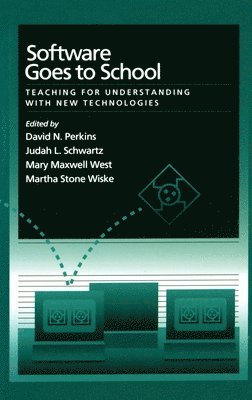
    Software Goes to School

    Teaching for Understanding with New Technologies

    AvDavid N. Perkins,Judah L. Schwartz

    Inbunden, Engelska, 1995

    1 346 kr

    Beställningsvara. Skickas inom 5-8 vardagar. Fri frakt över 249 kr.

    Beskrivning

    Declining test scores, burgeoning drop-out rates, poor showings in international comparisons--the malaise of public education seems to grow everyday. In this context, technology has emerged as one of the hopes of a renewed educational enterprise. Yet modern information-processing technologies have proved far from a panacea for the ills of education. Software Goes to School describes why that is the case in its consideration of three broad themes. The first part of the book addresses the question of what it means to understand. What constitutes understanding something? What are our principle resources in teaching for understanding? The second part of the book focuses front and centre on what technology can offer in teaching for understanding. Individual chapters examine how technologies afford new ways of representing complex concepts and make available new means by which students can manipulate abstract entities in a "hands-on" way. The last part of the book discusses the complexities of realistic educational settings, explores what happens when technology-based innovations are introduced, and examines the means by which a pedagogy of understanding can take root and thrive. Authored by an eminent group of researchers, this book offers numerous practical guidelines on how computers and software can work together for the betterment of the teaching process. Students and professionals in educational psychology, developmental psychology, and educational computing--as well as concerned parents--will want to read this stimulating new work.

    Produktinformation

    • Utgivningsdatum:1995-09-28
    • Mått:162 x 243 x 25 mm
    • Vikt:567 g
    • Format:Inbunden
    • Språk:Engelska
    • Antal sidor:304
    • Förlag:OUP USA
    • ISBN:9780195089387

    Utforska kategorier

    • Pedagogisk psykologi inom Psykologi och pedagogik
    • Barnpsykologi och utvecklingspsykologi inom Psykologi och pedagogik
    • Material och digital teknik i undervisningen inom Psykologi och pedagogik

    Mer om författaren

    David N. Perkins is Co-director of Project Zero, Associate of the Educational Technology Center, and Senior Research Associate, all at the Harvard Graduate School of Education. Judah L. Schwartz is Professor of Engineering Science and Education at the Massachusetts Institute of Technology, and Professor of Education and Co-director at the Educational Technology Center at Harvard. Martha Stone Wiske is Co-director of the Educational Technology Center, Senior Research Associate at Project Zero, and Lecturer at Harvard. Mary Maxwell West is Senior Research Associate in the Program Evaluation & Research Group at Lesley College.

    Innehållsförteckning

    • Contributors Introduction PART I: Understanding Understanding 1: Raymond S. Nickerson: Can Technology Help Teach for Understanding? 2: Marianne Wiser: Uses of History of Science to Understand and Remedy Students' Misconceptions about Heat and Temperature 3: Susan Carey and Carol Smith: On Understanding the Nature of Scientific Knowledge 4: Carlos E. Vasco: History of Mathematics as a Tool for Teaching Mathematics for Understanding 5: David N. Perkins et al.: Inside Understanding PART II: Using Technology to Make a Distinctive Contribution 6: Judah L. Schwartz: Shuttling Between the Particular and the General: Reflections of the Role of Conjecture and Hypothesis in the Generation of Knowledge in Science and Mathematics 7: Joseph Snir, Carol Smith, and Lorraine Grosslight: Conceptually Enhanced Simulations: A Computer Tool for Science Teaching 8: James J. Kaput: Creating Cybernetic and Psychological Ramps from the Concrete to the Abstract: Examples from Multiplicative Structure 9: E. Paul Goldenberg: Multiple Representations: A Vehicle for Understanding Understanding 10: Judah L. Schwartz: The Right Size Byte: Reflections of an Educational Software Designer PART III: Connecting Educational Research and Practice 11: Martha Stone Wiske: A Cultural Perspective on School-University Collaboration 12: Magdalene Lampert: Managing the Tensions in Connecting Students' Inquiry with Learning Mathematics in School 13: Joseph Snir and Carol Smith: Constructing Understanding in the Science Classroom: Integrating Laboratory Experiments, Student and Computer Models, and Class Discussion in Learning Scientific Concepts 14: Steven H. Schwartz and David N. Perkins: Teaching the Metacurriculum: A New Approach to Enhancing Subject-Matter Learning 15: Margaret Vickers and Jane Smalley: Integrating Computers into Classroom Teaching: Cross-National Perspectives Index