• Fri frakt över 249 kr
  • •
  • Snabba leveranser
  • •
  • Billiga böcker
Kundservice

Du är på sajten för privatpersoner.

Företag, bibliotek eller offentlig verksamhet?

Du handlar på classic.bokus.com, där alla dina funktioner finns intakta.
Till classic.bokus.com
Bokus logotyp. Gå till startsidan.
  • Erbjudanden
  • Nyheter
  • Student
  • Topplistor
  • Barn & ungdom
  • Bokus Play
  • E-böcker
  • Pocketböcker
  • Spel & pussel

10% rabatt på allt med kod NYSTART10 →

Sidfot

Mina sidor

    Hjälp

    • Kundservice
    • Vanliga frågor och svar
    • Frakt och leverans
    • Retur vid ångerrätt
    • Reklamera vara
    • Betalning
    • Köpvillkor
    • Allmänna villkor
    • Information om webbplatsens tillgänglighet

    Om Bokus

    • Om oss
    • Pressrum
    • För studenter
    • För företag
    • För bibliotek och offentlig verksamhet
    • För leverantörer
    • Hållbarhet

    Populärt

    • Aktuella erbjudanden
    • Presentkort
    • Studentlitteratur
    • Nya böcker
    • Topplistor
    • Signerade böcker
    • Engelska böcker

    Inspiration

    • Boktips
    • BookTok
    • Populära bokserier
    • Barnbokskaraktärer
    • Populära författare
    Logotyp för Bokus
    Följ oss på Facebook (extern länk)Följ oss på Instagram (extern länk)Följ oss på YouTube (extern länk)Följ oss på TikTok (extern länk)
    bokus @ CookiesAnpassa cookiesIntegritetspolicyKöpvillkor
    Till Citymail hemsida (extern länk)Till Budbee hemsida (extern länk)Till Postnord hemsida (extern länk)Till Schenker hemsida (extern länk)Till Early Bird hemsida (extern länk)Till Walleys hemsida (extern länk)
    1. Ekonomi och Ledarskap
    2. Företagsekonomi
    3. Organisationsteori

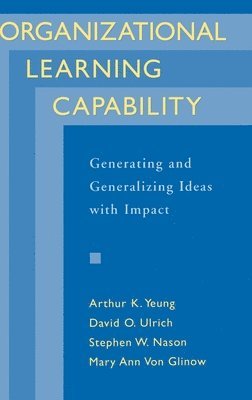
    Organizational Learning Capability

    AvArthur K. Yeung,David O. Ulrich

    Inbunden, Engelska, 1999

    1 788 kr

    Beställningsvara. Skickas inom 5-8 vardagar. Fri frakt över 249 kr.

    Beskrivning

    Organizational learning matters now more than ever. In today's hypercompetitive business environment, successful executives must be able to discover opportunities, face problems, and pursue innovative ideas, then turn those ideas into action throughout an organization. Based on both empirical research and practice experience, this book gives managers the tools to do just that.Organizational learning capability is the capacity to generateand generalize ideas with impact. Managers generate new ideas in four basic ways: experimentation, in which organizations learn by trying many new products and processes; continuous improvement, inwhich they learn by constantly improving what they have done before and mastering each step in a process before moving on to other processes; knowledge acquisition, in which they learn by encouraging individuals and teams to acquire new knowledge continuously; and benchmarking, in which they learn by studying how other groups do things and trying to adapt their techniques. Each learning types leads to different performance consequences.Managers must also be able togeneralize information through technology, movement of people, incentives, and learning processes. By both generating and generalizing ideas with impact, managers have a blueprint for making learninghappen. Learning may not be sustained, however, unless it is congruent with the larger business context--the organization's strategy and culture and the industry's characteristics. Unfortunately, just as organizations develop learning capabilities, they also suffer from certain learning disabilities. This book outlines common disabilities and the means to overcome them.The authors assist practicing managers by providing several examples of successful andunsuccessful organizations and describing the ways in which they have helped organizations improve learning capability in their consulting practices. Based on detailed case studies, a review of pastliterature, and data gleaned from a worldwide survey of companies,Organizational Learning Capability is an accessible and useful guide for managers competing in the information economy. This book turns abstract ideas into practice, offers tools that managers can use, and presents a simple yet profound road map for making learning a reality.

    Produktinformation

    • Utgivningsdatum:1999-03-13
    • Mått:236 x 160 x 20 mm
    • Vikt:513 g
    • Format:Inbunden
    • Språk:Engelska
    • Antal sidor:232
    • Förlag:OUP USA
    • ISBN:9780195102048

    Utforska kategorier

    • Organisationsteori inom Ekonomi och Ledarskap
    • Ledarskapsböcker inom Ekonomi och Ledarskap

    Mer om författaren

    Arthur K. Yeung is Executive Director (Asia-Pacific) of the University of Michigan Business School, where he teaches and conducts research in the leadership and organizational capabilities of Asian multinational corporations. Dave Ulrich is Professor in the School of Business at the University of Michigan in Ann Arbor. Stephen W. Nason is Professor in the Department of Management of Organizations at The Hong KongUniversity of Science and Technology. Mary Ann Von Glinow is Professor in the College of Business at Florida International University and a former president of the Academy of Management.

    Recensioner i media

    "A candid and scintillating look at how organizations must overcome their learning disabilities to improve their effectiveness. The authors paradigms are provocative and help redefine the essence of organizational effectiveness."

    Innehållsförteckning

    • 1: Organizational Learning: From Theory to Reality 2: What We Know about Organizational Learning: Different Learning Styles 3: A Model for Organizational Learning Capability: The Three Building Blocks 4: Generating Ideas with Impact: 3M, HP, and Other "Idea Machines" 5: Generalizing Ideas with Impact: The Case of Samsung Electronics 6: Identifying Learning Disabilities: Samsung Revisited and Three Health Care Systems 7: Building Organizational Learning Capability: A Blueprint for Learning Architects 8: Learning Matters, Warts and All: Diary of a True Learning Organization Worksheets Appendix 1: Notes on Research Methodology and Participating Companies Appendix 2: Survey Research Instrument Notes Index