• Fri frakt över 249 kr
  • •
  • Snabba leveranser
  • •
  • Billiga böcker
Kundservice

Du är på sajten för privatpersoner.

Företag, bibliotek eller offentlig verksamhet?

Du handlar på classic.bokus.com, där alla dina funktioner finns intakta.
Till classic.bokus.com
Bokus logotyp. Gå till startsidan.
  • Erbjudanden
  • Nyheter
  • Student
  • Topplistor
  • Barn & ungdom
  • Bokus Play
  • E-böcker
  • Pocketböcker
  • Spel & pussel

10% rabatt på allt med kod: NYSTART10 →

Sidfot

Mina sidor

    Hjälp

    • Kundservice
    • Vanliga frågor och svar
    • Frakt och leverans
    • Retur vid ångerrätt
    • Reklamera vara
    • Betalning
    • Köpvillkor
    • Allmänna villkor
    • Information om webbplatsens tillgänglighet

    Om Bokus

    • Om oss
    • Pressrum
    • För studenter
    • För företag
    • För bibliotek och offentlig verksamhet
    • För leverantörer
    • Hållbarhet

    Populärt

    • Aktuella erbjudanden
    • Presentkort
    • Studentlitteratur
    • Nya böcker
    • Topplistor
    • Signerade böcker
    • Engelska böcker

    Inspiration

    • Boktips
    • BookTok
    • Populära bokserier
    • Barnbokskaraktärer
    • Populära författare
    Logotyp för Bokus
    Följ oss på Facebook (extern länk)Följ oss på Instagram (extern länk)Följ oss på YouTube (extern länk)Följ oss på TikTok (extern länk)
    bokus @ CookiesAnpassa cookiesIntegritetspolicyKöpvillkor
    Till Citymail hemsida (extern länk)Till Budbee hemsida (extern länk)Till Postnord hemsida (extern länk)Till Schenker hemsida (extern länk)Till Early Bird hemsida (extern länk)Till Walleys hemsida (extern länk)
    1. Medicin
    2. Andra medicinska specialiteter
    3. Psykiatri

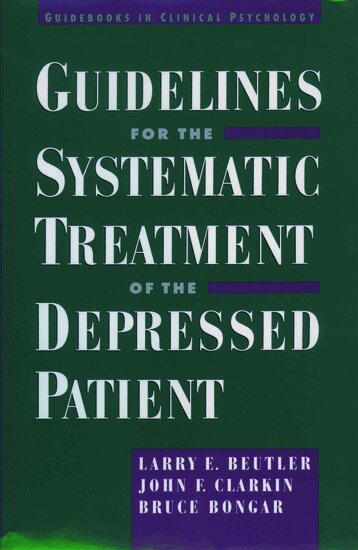
    Guidelines for the Systematic Treatment of the Depressed Patient

    AvLarry E. Beutler,John Clarkin

    Inbunden, Engelska, 2000

    Del i serien Guidebooks in Clinical Psychology

    417 kr

    Beställningsvara. Skickas inom 5-8 vardagar. Fri frakt över 249 kr.

    Beskrivning

    From initial consultation to termination of treatment, psychologists and other mental health practitioners make a series of crucial decisions to determine the progress and therapy of the patient. These decisions have varied implications such as the clinical course of the patient, the efficacy and efficiency of the treatment, and the cost of the sessions. Thus, the decisions made by mental health professionals need to be accurate and consistent, respecting a series of guidelines that will ultimately benefit the patient. This is the first in a series of guidebooks that is designed to do just that by providing practitioners with some structure in the development of treatment programmes. Previous guidelines have been based on consensus panels of experts or on the opinions of membership groups, causing guidelines to be very far off from the findings of empirical research. Here, guidelines are presented in terms of treatment principles rather than in terms of specific treatment models or theories, and they do not favour one theory of psychotherapy over another. Instead, they define strategies and considerations that can be woven into comprehensive treatment programmes. The entire series of guidebooks will cover numerous topics, including anxiety disorders, drug abuse, alcohol abuse, and treatment of serious mental disorders. This volume will cover in detail the nature of depression, issues in treatment research, contemporary treatments, and implications for education and training. It is ideal for postgraduates and professionals in the mental health field and is intended to provide important background on treatment of non-bipolar depressive disorders.

    Produktinformation

    • Utgivningsdatum:2000-02-17
    • Mått:168 x 245 x 35 mm
    • Vikt:812 g
    • Format:Inbunden
    • Språk:Engelska
    • Serie:Guidebooks in Clinical Psychology
    • Antal sidor:464
    • Förlag:OUP USA
    • ISBN:9780195105308

    Utforska kategorier

    • Psykiatri inom Medicin
    • Psykoterapi som behandlingsmetod inom Medicin

    Recensioner i media

    "The current volume reflects an extension of the authors' long-standing clinical and research involvement in systematically selecting the optimal treatment for any given patient. This book reflects their firsthand experience with depressed patients, within both clinical research contexts. In addition to evaluating the research methodology that has been used to study treatment efficacy, the book also contains an invaluable review of what is known boththeoretically and empirically about depression and its treatment. In this book, the authors provide us with a creative blending of research and practice. There is much in this volume to which clinicians canrelate. The appeal of this book is very clear: If you are a practitioner who wants to be informed by research or a researcher who wants to stay close to clinical reality, this book deserves a very special place on your bookshelf." -- Marvin Goldfried, Psychotherapy Research, 11(2) 2001"The current volume reflects an extension of the authors' long-standing clinical and research involvement in systematically selecting the optimal treatment for any given patient. This book reflects their firsthand experience with depressed patients, within both clinical research contexts. In addition to evaluating the research methodology that has been used to study treatment efficacy, the book also contains an invaluable review of what is known boththeoretically and empirically about depression and its treatment. In this book, the authors provide us with a creative blending of research and practice. There is much in this volume to which clinicians canrelate. The appeal of this book is very clear: If you are a practitioner who wants to be informed by research or a researcher who wants to stay close to clinical reality, this book deserves a very special place on your bookshelf." -- Marvin Goldfried, Psychotherapy Research, 11(2) 2001

    Innehållsförteckning

    • PART I: INTRODUCTION TO TREATMENT GUIDELINES; PART II: GUIDELINES FOR TREATMENT RELEVANT ASSESSMENT; PART III: GUIDELINES MANAGEMENT AND TREATMENT; PART IV: THE NATURE OF DEPRESSION; PART V: CONTEMPORARY TREATMENT MODELS