• Fri frakt över 249 kr
  • •
  • Snabba leveranser
  • •
  • Billiga böcker
Kundservice

Du är på sajten för privatpersoner.

Företag, bibliotek eller offentlig verksamhet?

Du handlar på classic.bokus.com, där alla dina funktioner finns intakta.
Till classic.bokus.com
Bokus logotyp. Gå till startsidan.
  • Erbjudanden
  • Student
  • Topplistor
  • Barn & ungdom
  • Bokus Play
  • E-böcker
  • Ljudböcker
  • Pocketböcker
  • Spel och pussel

Pocketfynda! Hundratals böcker för 49 kr/st →

Sidfot

Mina sidor

    Hjälp

    • Kundservice
    • Vanliga frågor och svar
    • Frakt och leverans
    • Retur vid ångerrätt
    • Reklamera vara
    • Betalning
    • Köpvillkor
    • Allmänna villkor
    • Information om webbplatsens tillgänglighet

    Om Bokus

    • Om oss
    • Pressrum
    • För studenter
    • För företag
    • För bibliotek och offentlig verksamhet
    • För leverantörer
    • Hållbarhet

    Populärt

    • Aktuella erbjudanden
    • Presentkort
    • Studentlitteratur
    • Nya böcker
    • Topplistor
    • Signerade böcker
    • Engelska böcker

    Inspiration

    • Boktips
    • BookTok
    • Barnbokskaraktärer
    • Populära författare
    Logotyp för Bokus
    Följ oss på Facebook (extern länk)Följ oss på Instagram (extern länk)Följ oss på YouTube (extern länk)Följ oss på TikTok (extern länk)
    bokus @ CookiesAnpassa cookiesIntegritetspolicyKöpvillkor
    Till Citymail hemsida (extern länk)Till Budbee hemsida (extern länk)Till Postnord hemsida (extern länk)Till Schenker hemsida (extern länk)Till Early Bird hemsida (extern länk)Till Walleys hemsida (extern länk)
    1. Psykologi och pedagogik
    2. Psykologi
    3. Psykologiska teorier och skolor

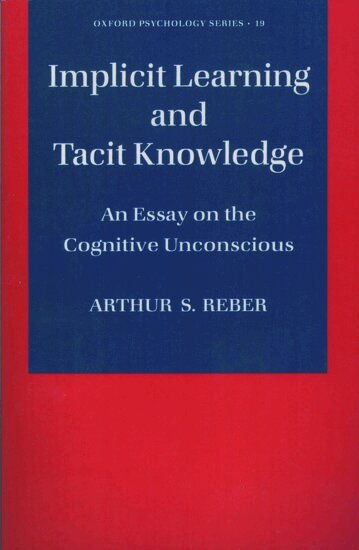
    Implicit Learning and Tacit Knowledge

    An Essay on the Cognitive Unconscious

    AvArthur S. Reber

    Häftad, Engelska, 1996

    Del 19 i serien Oxford Psychology Series

    1 101 kr

    Beställningsvara. Skickas inom 5-8 vardagar. Fri frakt över 249 kr.

    Fler format och utgåvor

    E-bok

    708 kr

    Beskrivning

    Implicit knowledge, a term coined by Reber in 1965, is acquired independent of conscious attempts to learn, and generally without the capacity to communicate what has been acquired. One of the core assumptions of this argument is that implicit learning is a fundamental process, one that lies at the very heart of the adaptive behavioural repertoire of every complex organism. This is a highly readable account of the cognitive unconscious, focusing in particular on the problem of implicit learning.

    Produktinformation

    • Utgivningsdatum:1996-09-26
    • Mått:234 x 157 x 11 mm
    • Vikt:290 g
    • Format:Häftad
    • Språk:Engelska
    • Serie:Oxford Psychology Series
    • Antal sidor:200
    • Förlag:OUP USA
    • ISBN:9780195106589

    Utforska kategorier

    • Psykologiska teorier och skolor inom Psykologi och pedagogik
    • Psykologisk metod inom Psykologi och pedagogik
    • Kognitiv psykologi inom Psykologi och pedagogik

    Recensioner i media

    From reviews of the hardback: "...every psychologist will enjoy reading this book." De Psycholoog

    Innehållsförteckning

    • 1. Introductory Remarks ; 1.1 On Learning ; 1.2 On Evolution ; 1.3 On Measuring the Contents of Consciousness ; 1.4 On Intelligence and Instruction ; 1.5 A Note on Terminology ; 1.6 A Rapid Historical Overview ; 1.7 Summary ; 1.8 A Personal Aside ; 2. Implicit Cognition: The Data Base ; 2.1 The Polarity Fallacy ; 2.2 On the Primacy of the Implicit ; 2.3 On Functionalism ; 2.4 Some Assumptions ; 2.5 Experimental Procedures ; 2.6 Empirical Studies of Implicit Learning ; 2.7 Methodological Issues in Implicit and Explicit Learning ; 3. Evolutionary Considerations: The Primacy of the Implicit ; 3.1 Some Introductory Remarks ; 3.2 The Evolutionist's Line ; 3.3 An Evolutionary Context for the Cognitive Unconscious ; 3.4 Hypothesized Characteristics of Implicit Systems ; 4. Implicit Issues: Some Extensions and Some Speculations ; 4.1 Implicit Learning and/or Implicit Memory ; 4.2 On Rules ; 4.3 Knowledge Representation ; 4.4 On Consciousness ; 4.5 Prediction and Generation of Events ; 4.6 Nativism and Empiricism ; 4.7 Afterwords ; 4.8 In Summary